
Western Sooty Hairstreak - Hodges#4277
Satyrium fuliginosum
This record describes Satyrium fuliginosum (species). Recorded family: Lycaenidae. Recorded order: Lepidoptera.
Identification and Appearance
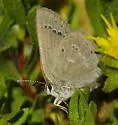
Tailless, dorsal drab gray, underwing grayish to brown, with the FW usually having a line of dark dots circled in white, and the HW can have some whitish dots. Distinction from S. semiluna as a distinct species from S. fuliginosa is debated, and needs further study in potential areas of contact. S. semiluna is distinguished by the presence (sometimes faint) of a stigma or sex brand on the upper front wing of the males (lacking in S. fuliginosum ), and by distribution. Zone of contact should be near the east base of the Sierra Nevada and northward across southwestern Oregon. Similar species of Blues in genus Plebejus will usually show at least some blue scaling above, even in females (none in Sooty Hairstreaks); they will have a white fringe (dull grayish in Sooty Hairstreaks); and, the front wing will have a very strong black bar at the end of the discal cell (often there is a second black spot in the middle of the cell as well), while this spot is absent to weak and usually not black in Sooty Hairstreaks. The pattern of the lower side will usually have a smoother look in Blues, and will look dirty or sooty in the Hairstreaks. Also, the Sooty Hairstreaks will most often have the dark postmedian spots dull in color (sometimes only faint), while in the Blues they are usually bold and black. Fresh individuals are much easier to identify than faded worn specimens.
Classification
- Kingdom
- Animalia
- Phylum
- Arthropoda
- Class
- Insecta
- Order
- Lepidoptera (Butterflies and Moths)
- Superfamily
- Papilionoidea
- Family
- Lycaenidae (Blues, Coppers, Hairstreaks, Harvesters)
- Subfamily
- Theclinae
- Tribe
- Eumaeini
- Genus
- Satyrium
Imported taxonomy record. Source availability varies; see the source references and editorial policy below.
Habitat and Range
Habitat
Open, usually exposed areas in association with Lupines ( Lupinus species).
Geographic Range
Sierra Nevada of California north in mountains through northern California into southern Oregon (west of Great Basin). Some populations further north in the Cascades show similarities to S. fuliginosum , but are classed as S. semiluna when the two are split as separate species.
Seasonal Activity
One brood flies late June - August.
Diet and Behavior
Diet: Larva feed on Lupines.
Additional species information
Species notes from the sources
Etymology: Latin for "sooty"
About Butterflies and Moths: the wider group
Order-level background for Lepidoptera, the group containing Satyrium fuliginosum. Species-specific details appear above.
Group overview
Lepidoptera includes approximately 180,000 described species of butterflies and moths. Moths outnumber butterflies roughly 10:1. The monarch butterfly's eastern population has declined by more than 80% since the mid-1990s, and the western population by over 95% since the 1980s. The IUCN lists the migratory monarch as Vulnerable.
Ecological role of the group
Butterflies and moths are essential indicators of ecosystem health. As caterpillars, they are a primary food source for birds - a single nest of blue tit chicks requires ~10,000 caterpillars. Adult moths pollinate many night-blooming plants.
Economic and practical significance of the group
Lepidoptera are critical pollinators. In Europe, grassland butterfly species have declined by almost 50% since the early 1990s. In the UK, three-quarters of butterflies are in decline. In the U.S., five butterfly species have gone extinct since 1950, with 29 listed as endangered.
Recorded sources for this group: IUCN Red List, Xerces Society, USFWS, PNAS, WWF. Imported estimates may describe particular regions or reporting periods.
Photos of Western Sooty Hairstreak - Hodges#4277 (5)
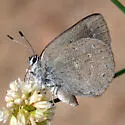
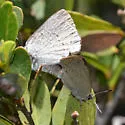
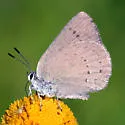
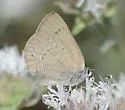
Photo credits: Contributed by tom murray; Additional contributions by Steve Nanz , Chuck Entz , Nick Block , David Ferguson
Frequently Asked Questions About Western Sooty Hairstreak - Hodges#4277
What is Western Sooty Hairstreak - Hodges#4277?
Western Sooty Hairstreak - Hodges#4277 (Satyrium fuliginosum) is a species in the family Lycaenidae, within the order Lepidoptera.
How big is Western Sooty Hairstreak - Hodges#4277?
25-32mm
How do you identify Western Sooty Hairstreak - Hodges#4277?
Tailless, dorsal drab gray, underwing grayish to brown, with the FW usually having a line of dark dots circled in white, and the HW can have some whitish dots. Distinction from S. semiluna as a distinct species from S. fuliginosa is debated, and needs further study in potential areas of contact. S. semiluna is distinguished by the presence (sometimes faint) of a stigma or sex brand on the upper front wing of the males (lacking in S. fuliginosum ), and by distribution. Zone of contact should be near the east base of the Sierra Nevada and northward across southwestern Oregon. Similar species of Blues in genus Plebejus will usually show at least some blue scaling above, even in females (none in Sooty Hairstreaks); they will have a white fringe (dull grayish in Sooty Hairstreaks); and, the front wing will have a very strong black bar at the end of the discal cell (often there is a second black spot in the middle of the cell as well), while this spot is absent to weak and usually not black in Sooty Hairstreaks. The pattern of the lower side will usually have a smoother look in Blues, and will look dirty or sooty in the Hairstreaks. Also, the Sooty Hairstreaks will most often have the dark postmedian spots dull in color (sometimes only faint), while in the Blues they are usually bold and black. Fresh individuals are much easier to identify than faded worn specimens.
Where is Western Sooty Hairstreak - Hodges#4277 found?
| Feature | Details |
|---|---|
| Habitat | Open, usually exposed areas in association with Lupines ( Lupinus species). |
| Range | Sierra Nevada of California north in mountains through northern California into southern Oregon (west of Great Basin). Some populations further north in the Cascades show similarities to S. fuliginosum , but are classed as S. semiluna when the two are split as separate species. |
What does Western Sooty Hairstreak - Hodges#4277 eat?
The diet of the Western Sooty Hairstreak - Hodges#4277 includes Larva feed on Lupines..
When is Western Sooty Hairstreak - Hodges#4277 active?
Western Sooty Hairstreak - Hodges#4277: seasonal activity - One brood flies late June - August..