
Edwards' Hairstreak - Hodges#4281
Satyrium edwardsii
This record describes Satyrium edwardsii (species). Recorded family: Lycaenidae. Recorded order: Lepidoptera.
Identification and Appearance
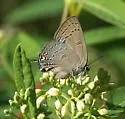
Adult: dark brown above, sometimes with an orange spot above the tail. The underside is pale brown. It is best distinguished from most similar hairstreaks by the row of white-rimmed rounded spots on the undersides (in some specimens, this chain is reduced or absent). Another defining characteristic is the long orange mark along the inner margin of the hindwing underside. Similar species mostly have only a small amount of orange. [modified from Butterflies of Canada] The lack of an orange cap on the blue spot on the hindwing underside means that the Edwards' Hairstreak is mostly likely to be confused with the Banded and Hickory Hairstreaks ( S. calanus and S. caryaevorum ). In both of these species the dark spots beneath are more sharply rectangular and mostly fused to form a band rather than being broken into rounded spots, and there is only a small amount of orange on the inner margin of the hindwing beneath. King Hairstreak ( Satyrium kingi ) is similar, but with a red cap on the large blue spot. It has a pattern more similar to that of Banded and Hickory Hairstreaks, and it mostly occurs further south than Edwards Hairstreak. The Acadian Hairstreak ( Sayrium acadicum ) has smaller more nearly circular black spots mostly completely ringed in white, and is less brownish in overall coloring (distinctly gray). It has a red cap on the large blue thecla spot on the lower hind wing, and is associated with Willows ( Salix species). Larva: dark greenish-brown with pale oblique dashes
Classification
- Kingdom
- Animalia
- Phylum
- Arthropoda
- Class
- Insecta
- Order
- Lepidoptera (Butterflies and Moths)
- Superfamily
- Papilionoidea
- Family
- Lycaenidae (Blues, Coppers, Hairstreaks, Harvesters)
- Subfamily
- Theclinae
- Tribe
- Eumaeini
- Genus
- Satyrium
Imported taxonomy record. Source availability varies; see the source references and editorial policy below.
Habitat and Range
Habitat
Dry woods, thickets, with oaks.
Geographic Range
Northeastern and north-central North America
Seasonal Activity
Adults fly from May to July in the south (one brood); late June into August in Canada.
Diet and Behavior
Diet: Larvae feed on leaves of oak: especially Scrub Oak ( Quercus ilicifolia ) and Black Oak ( Q. velutina ); also White Oak ( Q. alba ) in southern Ontario, Red Oak ( Q. rubra ) in Quebec, and Bur Oak ( Q. macrocarpa ) in Manitoba. Adults take nectar from a variety of flowers, especially milkweed ( Asclepias spp.) and White Sweet Clover ( Melilotus alba ).
Life History
Eggs are laid in crevices and wounds in the bark. First- and second-instar larvae feed during the day, older larvae only at night, spending the day in shelters built by ants at the base of the tree, where they are tended and protected by ants; they later pupate there. [Butterflies of Canada]
About Butterflies and Moths: the wider group
Order-level background for Lepidoptera, the group containing Satyrium edwardsii. Species-specific details appear above.
Group overview
Lepidoptera includes approximately 180,000 described species of butterflies and moths. Moths outnumber butterflies roughly 10:1. The monarch butterfly's eastern population has declined by more than 80% since the mid-1990s, and the western population by over 95% since the 1980s. The IUCN lists the migratory monarch as Vulnerable.
Ecological role of the group
Butterflies and moths are essential indicators of ecosystem health. As caterpillars, they are a primary food source for birds - a single nest of blue tit chicks requires ~10,000 caterpillars. Adult moths pollinate many night-blooming plants.
Economic and practical significance of the group
Lepidoptera are critical pollinators. In Europe, grassland butterfly species have declined by almost 50% since the early 1990s. In the UK, three-quarters of butterflies are in decline. In the U.S., five butterfly species have gone extinct since 1950, with 29 listed as endangered.
Recorded sources for this group: IUCN Red List, Xerces Society, USFWS, PNAS, WWF. Imported estimates may describe particular regions or reporting periods.
Photos of Edwards' Hairstreak - Hodges#4281 (5)
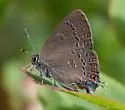
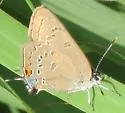
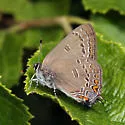
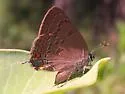
Photo credits: Contributed by Cotinis; Additional contributions by Steve Nanz , Robin McLeod , David Ferguson , marcie oconnor
Frequently Asked Questions About Edwards' Hairstreak - Hodges#4281
What is Edwards' Hairstreak - Hodges#4281?
Edwards' Hairstreak - Hodges#4281 (Satyrium edwardsii) is a species in the family Lycaenidae, within the order Lepidoptera.
How big is Edwards' Hairstreak - Hodges#4281?
Wingspan 19-38 mm
How do you identify Edwards' Hairstreak - Hodges#4281?
Adult: dark brown above, sometimes with an orange spot above the tail. The underside is pale brown. It is best distinguished from most similar hairstreaks by the row of white-rimmed rounded spots on the undersides (in some specimens, this chain is reduced or absent). Another defining characteristic is the long orange mark along the inner margin of the hindwing underside. Similar species mostly have only a small amount of orange. [modified from Butterflies of Canada] The lack of an orange cap on the blue spot on the hindwing underside means that the Edwards' Hairstreak is mostly likely to be confused with the Banded and Hickory Hairstreaks ( S. calanus and S. caryaevorum ). In both of these species the dark spots beneath are more sharply rectangular and mostly fused to form a band rather than being broken into rounded spots, and there is only a small amount of orange on the inner margin of the hindwing beneath. King Hairstreak ( Satyrium kingi ) is similar, but with a red cap on the large blue spot. It has a pattern more similar to that of Banded and Hickory Hairstreaks, and it mostly occurs further south than Edwards Hairstreak. The Acadian Hairstreak ( Sayrium acadicum ) has smaller more nearly circular black spots mostly completely ringed in white, and is less brownish in overall coloring (distinctly gray). It has a red cap on the large blue thecla spot on the lower hind wing, and is associated with Willows ( Salix species). Larva: dark greenish-brown with pale oblique dashes
Where is Edwards' Hairstreak - Hodges#4281 found?
| Feature | Details |
|---|---|
| Habitat | Dry woods, thickets, with oaks. |
| Range | Northeastern and north-central North America |
What does Edwards' Hairstreak - Hodges#4281 eat?
The diet of the Edwards' Hairstreak - Hodges#4281 includes Larvae feed on leaves of oak: especially Scrub Oak ( Quercus ilicifolia ) and Black Oak ( Q. velutina ); also White Oak ( Q. alba ) in southern Ontario, Red Oak ( Q. rubra ) in Quebec, and Bur Oak ( Q. macrocarpa ) in Manitoba. Adults take nectar from a variety of flowers, especially milkweed ( Asclepias spp.) and White Sweet Clover ( Melilotus alba )..
When is Edwards' Hairstreak - Hodges#4281 active?
Edwards' Hairstreak - Hodges#4281: seasonal activity - Adults fly from May to July in the south (one brood); late June into August in Canada..
What is the life cycle of a Edwards' Hairstreak - Hodges#4281?
Eggs are laid in crevices and wounds in the bark. First- and second-instar larvae feed during the day, older larvae only at night, spending the day in shelters built by ants at the base of the tree, where they are tended and protected by ants; they later pupate there. [Butterflies of Canada]