
Oak Hairstreak - Hodges#4331
Satyrium favonius
This record describes Satyrium favonius (species). Recorded family: Lycaenidae. Recorded order: Lepidoptera.
Identification and Appearance
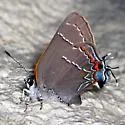
Adult: upperside dark brown with dim orange spot near outer margin of forewing, and brighter orange spot near outer margin of hindwing between tails; underside light grayish-brown with jagged black and white line forming a W shape near margin of hindwing, distinctive tapering orange submarginal band, orange-capped black spot between tails, and large blue patch below tails at anal angle. As with many hairstreaks, antennae-like tails on hindwings are wiggled by gentle brushing together of the hindwings when the butterfly is at rest. Larva: small, sluglike, yellowish-green with green dorsal stripes and yellow lateral stripe. Regarding the common name, a PDF checklist (2nd edition, 2001) by the North American Butterfly Association states: Prior to the First Edition, almost all authors treated Satyrium favonius and Satyrium ontario as separate species, using the English names, southern hairstreak and northern hairstreak, respectively. When these taxa were lumped in the First Edition, the Committee tried to develop an acceptable English name for the combined taxa, but was unable to do so. The Committee then decided to use the name Southern Hairstreak for the lumped taxa. This has created quite a bit of confusion and awkwardness, causing people to refer to the 'Northern' Southern Hairstreak and 'Southern' Southern Hairstreak. In an attempt to make this situation clear, the Committee has decided to change the English name of this species to Oak Hairstreak. Satyrium favonius favonius is now the 'Southern' Oak Hairstreak and S. f. ontario is now the 'Northern' Oak Hairstreak. Vote 3-1. These names have not become popularized outside of NABA circles; most sources continue to call Satyrium favonius the Southern Hairstreak. In fact, even Jeffrey Glassberg of NABA retains the name Southern Hairstreak in this list of Mexican Butterflies published in September, 2005.
Classification
- Kingdom
- Animalia
- Phylum
- Arthropoda
- Class
- Insecta
- Order
- Lepidoptera (Butterflies and Moths)
- Superfamily
- Papilionoidea
- Family
- Lycaenidae (Blues, Coppers, Hairstreaks, Harvesters)
- Subfamily
- Theclinae
- Tribe
- Eumaeini
- Genus
- Satyrium
Imported taxonomy record. Source availability varies; see the source references and editorial policy below.
Habitat and Range
Habitat
Woodland edges, oak scrub.
Geographic Range
e US (TX-FL-MA-KS) - ( MPG ) Florida westward to eastern Texas and northward into Kansas, Missouri, Illinois, Ohio, Pennsylvania and Massachusetts. Also in southeastern Colorado and northeastern New Mexico. Distribution map at butterfliesandmoths.org shows records from Maine in the northeast, and western Texas and New Mexico in the southwest. The type specimen of subspecies S. f. ontario was collected in southern Ontario in 1868 but there have been no confirmed records of favonius in Canada since that time.
Seasonal Activity
mostly: April-July - ( MPG )
Diet and Behavior
Diet: Larvae feed on young leaves of oak ( Quercus spp.); hawthorn ( Crataegus spp.) may also be a foodplant in the northeast. Adults nectar on flowers such as New Jersey Tea ( Ceanothus americanus ), dogbane ( Apocynum spp.), and White Sweet Clover ( Melilotus alba ).
Life History
One generation per year. Overwinters as an egg, laid on oak twig.
Additional species information
Species notes from the sources
Etymology: Satyrium favonius (J. E. Smith, 1797)
About Butterflies and Moths: the wider group
Order-level background for Lepidoptera, the group containing Satyrium favonius. Species-specific details appear above.
Group overview
Lepidoptera includes approximately 180,000 described species of butterflies and moths. Moths outnumber butterflies roughly 10:1. The monarch butterfly's eastern population has declined by more than 80% since the mid-1990s, and the western population by over 95% since the 1980s. The IUCN lists the migratory monarch as Vulnerable.
Ecological role of the group
Butterflies and moths are essential indicators of ecosystem health. As caterpillars, they are a primary food source for birds - a single nest of blue tit chicks requires ~10,000 caterpillars. Adult moths pollinate many night-blooming plants.
Economic and practical significance of the group
Lepidoptera are critical pollinators. In Europe, grassland butterfly species have declined by almost 50% since the early 1990s. In the UK, three-quarters of butterflies are in decline. In the U.S., five butterfly species have gone extinct since 1950, with 29 listed as endangered.
Recorded sources for this group: IUCN Red List, Xerces Society, USFWS, PNAS, WWF. Imported estimates may describe particular regions or reporting periods.
Photos of Oak Hairstreak - Hodges#4331 (5)
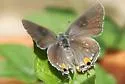
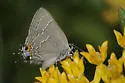
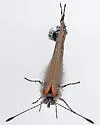
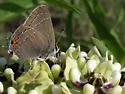
Photo credits: Contributed by Hannah Nendick-Mason; Additional contributions by Robin McLeod , Mike Quinn , Nick Block
Frequently Asked Questions About Oak Hairstreak - Hodges#4331
What is Oak Hairstreak - Hodges#4331?
Oak Hairstreak - Hodges#4331 (Satyrium favonius) is a species in the family Lycaenidae, within the order Lepidoptera.
How big is Oak Hairstreak - Hodges#4331?
wingspan 22-38 mm
How do you identify Oak Hairstreak - Hodges#4331?
Adult: upperside dark brown with dim orange spot near outer margin of forewing, and brighter orange spot near outer margin of hindwing between tails; underside light grayish-brown with jagged black and white line forming a W shape near margin of hindwing, distinctive tapering orange submarginal band, orange-capped black spot between tails, and large blue patch below tails at anal angle. As with many hairstreaks, antennae-like tails on hindwings are wiggled by gentle brushing together of the hindwings when the butterfly is at rest. Larva: small, sluglike, yellowish-green with green dorsal stripes and yellow lateral stripe.
Where is Oak Hairstreak - Hodges#4331 found?
| Feature | Details |
|---|---|
| Habitat | Woodland edges, oak scrub. |
| Range | e US (TX-FL-MA-KS) - ( MPG ) Florida westward to eastern Texas and northward into Kansas, Missouri, Illinois, Ohio, Pennsylvania and Massachusetts. Also in southeastern Colorado and northeastern New Mexico. Distribution map at butterfliesandmoths.org shows records from Maine in the northeast, and western Texas and New Mexico in the southwest. The type specimen of subspecies S. f. ontario was collected in southern Ontario in 1868 but there have been no confirmed records of favonius in Canada since that time. |
What does Oak Hairstreak - Hodges#4331 eat?
The diet of the Oak Hairstreak - Hodges#4331 includes Larvae feed on young leaves of oak ( Quercus spp.); hawthorn ( Crataegus spp.) may also be a foodplant in the northeast. Adults nectar on flowers such as New Jersey Tea ( Ceanothus americanus ), dogbane ( Apocynum spp.), and White Sweet Clover ( Melilotus alba )..
When is Oak Hairstreak - Hodges#4331 active?
Oak Hairstreak - Hodges#4331: seasonal activity - mostly: April-July - ( MPG ).
What is the life cycle of a Oak Hairstreak - Hodges#4331?
One generation per year. Overwinters as an egg, laid on oak twig.