
Northern Crescent - Hodges#4481.1
Phyciodes cocyta
This record describes Phyciodes cocyta (species). Recorded family: Nymphalidae. Recorded order: Lepidoptera.
Identification and Appearance
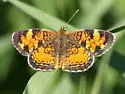
Can often be separated from Pearl Crescent by flight season: in areas of overlap, Northern Crescent flies only in June-July and perhaps early September, whereas the Pearl Crescent produces two or more broods per year, flying all year in the southern US, April to November in the northern US, and May to late September in Canada.
Classification
- Kingdom
- Animalia
- Phylum
- Arthropoda
- Class
- Insecta
- Order
- Lepidoptera (Butterflies and Moths)
- Superfamily
- Papilionoidea
- Family
- Nymphalidae (Brush-footed Butterflies)
- Subfamily
- Nymphalinae
- Tribe
- Melitaeini
- Genus
- Phyciodes (Crescents)
Imported taxonomy record. Source availability varies; see the source references and editorial policy below.
Habitat and Range
Habitat
wide variety of habitat preferences: Moist open areas in rocky places, wooded streams, marsh edges, shale barrens, abandoned city lots, mountain meadows - practically any (usually moist) sunny area where asters grow.
Geographic Range
from Newfoundland and Nunavut to Yukon Territory, south in the western mountains to Utah, southeast Arizona, and southern New Mexico; south in the Appalachians to Pennsylvania, Virginia, and West Virginia
Seasonal Activity
Adults fly in spring or early summer, from June to mid-July in most regions, but often earlier southward. Perhaps with a partial second brood in early September in some regions. September flights may represent a 2nd brood of a closely related yet distinct species [see " not quite Pearl or Nothern " for more discussion.]
Diet and Behavior
Diet: larvae feed on leaves of asters ( Aster spp.)
Life History
eggs laid in bunches of about 40 on underside of host plant leaves; young larvae live and feed communally; third-stage larvae overwinter
Additional species information
Species notes from the sources
Etymology: Formerly called Phyciodes selenis . Scott (1994) considered the names selenis and cocyta as belonging to the same species, with the later being the older name of priority, and thus replacing the name selenis . The name selenis is now considered to represent a subspecies of P. cocyta ; however, that interpretation could change as more is learned, and it is quite likely that more subspecies (and perhaps species) will be distinguished from what is now included in broad concepts of Phyciodes cocyta and ssp. selenis .
About Butterflies and Moths: the wider group
Order-level background for Lepidoptera, the group containing Phyciodes cocyta. Species-specific details appear above.
Group overview
Lepidoptera includes approximately 180,000 described species of butterflies and moths. Moths outnumber butterflies roughly 10:1. The monarch butterfly's eastern population has declined by more than 80% since the mid-1990s, and the western population by over 95% since the 1980s. The IUCN lists the migratory monarch as Vulnerable.
Ecological role of the group
Butterflies and moths are essential indicators of ecosystem health. As caterpillars, they are a primary food source for birds - a single nest of blue tit chicks requires ~10,000 caterpillars. Adult moths pollinate many night-blooming plants.
Economic and practical significance of the group
Lepidoptera are critical pollinators. In Europe, grassland butterfly species have declined by almost 50% since the early 1990s. In the UK, three-quarters of butterflies are in decline. In the U.S., five butterfly species have gone extinct since 1950, with 29 listed as endangered.
Recorded sources for this group: IUCN Red List, Xerces Society, USFWS, PNAS, WWF. Imported estimates may describe particular regions or reporting periods.
Photos of Northern Crescent - Hodges#4481.1 (5)
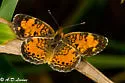
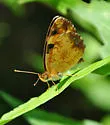
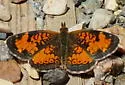
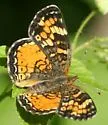
Photo credits: Contributed by tom murray; Additional contributions by cotinis , Tony DiTerlizzi , Steve Nanz , Robin McLeod , Nick Block , David Ferguson
Frequently Asked Questions About Northern Crescent - Hodges#4481.1
What is Northern Crescent - Hodges#4481.1?
Northern Crescent - Hodges#4481.1 (Phyciodes cocyta) is a species in the family Nymphalidae, within the order Lepidoptera.
How big is Northern Crescent - Hodges#4481.1?
wingspan 25-35 mm ( CBIF ) wingspan 32-48 mm ( nearctica.com )
Where is Northern Crescent - Hodges#4481.1 found?
| Feature | Details |
|---|---|
| Habitat | wide variety of habitat preferences: Moist open areas in rocky places, wooded streams, marsh edges, shale barrens, abandoned city lots, mountain meadows - practically any (usually moist) sunny area where asters grow. |
| Range | from Newfoundland and Nunavut to Yukon Territory, south in the western mountains to Utah, southeast Arizona, and southern New Mexico; south in the Appalachians to Pennsylvania, Virginia, and West Virginia |
What does Northern Crescent - Hodges#4481.1 eat?
The diet of the Northern Crescent - Hodges#4481.1 includes larvae feed on leaves of asters ( Aster spp.).
When is Northern Crescent - Hodges#4481.1 active?
Northern Crescent - Hodges#4481.1: seasonal activity - Adults fly in spring or early summer, from June to mid-July in most regions, but often earlier southward. Perhaps with a partial second brood in early September in some regions. September flights may represent a 2nd brood of a closely related yet distinct species [see not quite Pearl or Nothern for more discussion.].
What is the life cycle of a Northern Crescent - Hodges#4481.1?
eggs laid in bunches of about 40 on underside of host plant leaves; young larvae live and feed communally; third-stage larvae overwinter