
Tawny Crescent - Hodges#4482
Phyciodes batesii
This record describes Phyciodes batesii (species). Recorded family: Nymphalidae. Recorded order: Lepidoptera.
Identification and Appearance
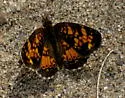
Can be confused with other Phyciodes species , but distinguished by nearly mostly black antennal clubs lacking orange color [often with small white tip and/or grayish on part of underside, rarely with brownish tinge near tip]; under side of front wings with two bold broad black markings near inner margin (one in middle and one near tornus); with apical area of under front wings usually predominated by orange, with little contrasting dark color and no whitish pattern (as often seen on similar species). Under hind wing in males nearly even tawny yellow-orange with marginal dark patch around pale cresent usually poorly developed [female similar, but paler with much more developed pattern of fine dark lines]. Males usually easily identifiable, but females are more likely to be confused with other species. Also: P. cocyta usually has a less developed dark pattern on the front wing and upper hind wing, and has the appical/lower portion of antennal club orange. P. phaon usually has the median area of the upper front wing paler (often nearly white), smaller dark marking on the lower front wing, and a distinctly black and white looking pattern on lower hind wing and apical area of lower front wing. P. tharos is most likely to be confused, but usually has much more orange patterning on on the basal area of the upper wings, as well as smaller dark markings that are usually not as distinctly inter-connected; often (not always) has obvious orange or orange-brown color on antennal clubs. All three species are variable, and there are occasional specimens (usually females) which will be nearly impossible to identify, especially from a photo alone.
Classification
- Kingdom
- Animalia
- Phylum
- Arthropoda
- Class
- Insecta
- Order
- Lepidoptera (Butterflies and Moths)
- Superfamily
- Papilionoidea
- Family
- Nymphalidae (Brush-footed Butterflies)
- Subfamily
- Nymphalinae
- Tribe
- Melitaeini
- Genus
- Phyciodes (Crescents)
Imported taxonomy record. Source availability varies; see the source references and editorial policy below.
Habitat and Range
Habitat
Mostly prairie openings and margins in or adjacent to wooded areas. Most often in areas of somewhat broken or rocky terrain.
Geographic Range
Southern Canada and northern U.S. from Quebec, New England and Pennsylvania to northeast Britisch Columbia, Alberta, Montana, and ne. Wyoming. Occurs on northern Great Plains as scattered colonies, mostly associated with wooded areas in broken terrain south to the Pine Ridge in Nebraska. Presence of the species in the Rocky Mountains (n. WY to n. NM & AZ) depends on interpretation of populations there as members of P. cocyta or P. batesii (see notes above and under P. cocyta ).
Seasonal Activity
Adults in one brood, primarily in June and July.
Diet and Behavior
Diet: Larval hosts - Aster. Adults are avid flower visitors.
About Butterflies and Moths: the wider group
Order-level background for Lepidoptera, the group containing Phyciodes batesii. Species-specific details appear above.
Group overview
Lepidoptera includes approximately 180,000 described species of butterflies and moths. Moths outnumber butterflies roughly 10:1. The monarch butterfly's eastern population has declined by more than 80% since the mid-1990s, and the western population by over 95% since the 1980s. The IUCN lists the migratory monarch as Vulnerable.
Ecological role of the group
Butterflies and moths are essential indicators of ecosystem health. As caterpillars, they are a primary food source for birds - a single nest of blue tit chicks requires ~10,000 caterpillars. Adult moths pollinate many night-blooming plants.
Economic and practical significance of the group
Lepidoptera are critical pollinators. In Europe, grassland butterfly species have declined by almost 50% since the early 1990s. In the UK, three-quarters of butterflies are in decline. In the U.S., five butterfly species have gone extinct since 1950, with 29 listed as endangered.
Recorded sources for this group: IUCN Red List, Xerces Society, USFWS, PNAS, WWF. Imported estimates may describe particular regions or reporting periods.
Photos of Tawny Crescent - Hodges#4482 (5)
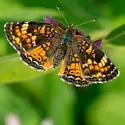
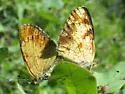
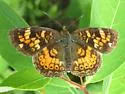
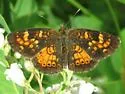
Photo credits: Contributed by Will Cook; Additional contributions by john and jane balaban , Steve Nanz , David Ferguson , KenW
Frequently Asked Questions About Tawny Crescent - Hodges#4482
What is Tawny Crescent - Hodges#4482?
Tawny Crescent - Hodges#4482 (Phyciodes batesii) is a species in the family Nymphalidae, within the order Lepidoptera.
How do you identify Tawny Crescent - Hodges#4482?
Can be confused with other Phyciodes species , but distinguished by nearly mostly black antennal clubs lacking orange color [often with small white tip and/or grayish on part of underside, rarely with brownish tinge near tip]; under side of front wings with two bold broad black markings near inner margin (one in middle and one near tornus); with apical area of under front wings usually predominated by orange, with little contrasting dark color and no whitish pattern (as often seen on similar species). Under hind wing in males nearly even tawny yellow-orange with marginal dark patch around pale cresent usually poorly developed [female similar, but paler with much more developed pattern of fine dark lines]. Males usually easily identifiable, but females are more likely to be confused with other species. Also: P. cocyta usually has a less developed dark pattern on the front wing and upper hind wing, and has the appical/lower portion of antennal club orange. P. phaon usually has the median area of the upper front wing paler (often nearly white), smaller dark marking on the lower front wing, and a distinctly black and white looking pattern on lower hind wing and apical area of lower front wing. P. tharos is most likely to be confused, but usually has much more orange patterning on on the basal area of the upper wings, as well as smaller dark markings that are usually not as distinctly inter-connected; often (not always) has obvious orange or orange-brown color on antennal clubs. All three species are variable, and there are occasional specimens (usually females) which will be nearly impossible to identify, especially from a photo alone.
Where is Tawny Crescent - Hodges#4482 found?
| Feature | Details |
|---|---|
| Habitat | Mostly prairie openings and margins in or adjacent to wooded areas. Most often in areas of somewhat broken or rocky terrain. |
| Range | Southern Canada and northern U.S. from Quebec, New England and Pennsylvania to northeast Britisch Columbia, Alberta, Montana, and ne. Wyoming. Occurs on northern Great Plains as scattered colonies, mostly associated with wooded areas in broken terrain south to the Pine Ridge in Nebraska. Presence of the species in the Rocky Mountains (n. WY to n. NM & AZ) depends on interpretation of populations there as members of P. cocyta or P. batesii (see notes above and under P. cocyta ). |
What does Tawny Crescent - Hodges#4482 eat?
The diet of the Tawny Crescent - Hodges#4482 includes Larval hosts - Aster. Adults are avid flower visitors..
When is Tawny Crescent - Hodges#4482 active?
Tawny Crescent - Hodges#4482: seasonal activity - Adults in one brood, primarily in June and July..