
Orthopodomyia signifera
This record describes Orthopodomyia signifera (species). Recorded family: Culicidae. Recorded order: Diptera.
Identification and Appearance
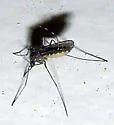
Florida Medical Entomology Laboratory ( 3 ) Adult: Integument dark brown, proboscis dark scaled with row of white scales along dorsolateral edge. Ocular margin delineated with narrow line of white scales. Narrow submedian lines of white scales between acrostichal and dorsocentral rows of setae extending from anterior margin of scutum to prescutellar depression. Another set of lines of white scales extends along lateral portions of scutum from anterior margin, interrupted at scutal angle. A third set of white lines continues submedially from transverse suture to scutellum. Laterally postpronotum has narrow line of white scales parallel to body axis, a similar broader line extends along upper portions of katepisternum with another vertical line along posteroventral margin. Wings marked with patterns of white and dark scales, in this species R4+5 predominantly dark-scaled, base is white-scaled as is base of R2+3. Coxae white-scaled, femora and tibiae with scattered white scale oriented in longitudinal lines, fore-tarsus dark-scaled, middle tarsus dark-scaled except narrow white ring basal on 1st tarsomere, hind tarsomeres white-ringed apically and basally. Almost identical to Or. alba , differing in wing scale pattern. Larva: Head capsule darkly pigmented except around eye, head setae longer than antenna, body with reddish-brown pigment dorsally, segment VI with small irregular sclerite, segments VII and VIII with larger sclerites, that on VIII encircling ¾ of segment and accommodating comb scales, comb scales in 2 rows Medical Importance: Possible vector of eastern equine encephalitis (EEE). - WRBU *Information on this page provided by Sean McCann.
Classification
Habitat and Range
Habitat
Larvae in treeholes and bromeliads, other container habitats less frequently.
Geographic Range
e US to CA (CA-FL-MA-MI) / W. Indies / Mex. , WRBU
Diet and Behavior
Diet: Larvae: Filter feeders. Adults: Little known, males and females feed on nectar, females presumed to seek bloodmeals from birds.
Life History
Multivoltine in parts of their range. Overwinters as late-instar larvae. Larvae can withstand partial drying. Differing accounts say that oviposition occurs on water’s surface or on sides of container.
About Flies: the wider group
Order-level background for Diptera, the group containing Orthopodomyia signifera. Species-specific details appear above.
Group overview
Diptera includes over 150,000 described species of flies, mosquitoes, and midges. Mosquitoes are the deadliest animal on Earth (CDC). Malaria alone causes ~249 million cases and over 608,000 deaths annually, mostly children under 5 (WHO). Vector-borne diseases account for over 17% of all infectious diseases, causing 700,000+ deaths per year.
Ecological role of the group
Despite their disease impact, flies are critical decomposers and pollinators. Hoverflies alone pollinate hundreds of crop and wildflower species. Flies are also the primary food source for many birds, bats, and fish. Forensic entomology relies heavily on fly species for crime scene analysis.
Economic and practical significance of the group
In the U.S., vector-borne disease cases tripled between 2004-2016, with over 640,000 cases reported in that period (CDC). Tickborne diseases doubled from 22,000 to 48,000 annual reports. Globally, mosquito-borne diseases cost billions in healthcare and lost productivity.
Recorded sources for this group: WHO, CDC, PNAS. Imported estimates may describe particular regions or reporting periods.
Photos of Orthopodomyia signifera (5)
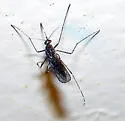
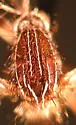
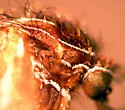
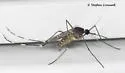
Photo credits: Contributed by Lynette Elliott; Additional contributions by Mike Quinn , Tyler Hedlund
Frequently Asked Questions About Orthopodomyia signifera
What is Orthopodomyia signifera?
Orthopodomyia signifera is a species in the family Culicidae, within the order Diptera.
How big is Orthopodomyia signifera?
female: length 4 mm, wing 3.5 mm
How do you identify Orthopodomyia signifera?
Florida Medical Entomology Laboratory ( 3 ) Adult: Integument dark brown, proboscis dark scaled with row of white scales along dorsolateral edge. Ocular margin delineated with narrow line of white scales. Narrow submedian lines of white scales between acrostichal and dorsocentral rows of setae extending from anterior margin of scutum to prescutellar depression. Another set of lines of white scales extends along lateral portions of scutum from anterior margin, interrupted at scutal angle. A third set of white lines continues submedially from transverse suture to scutellum. Laterally postpronotum has narrow line of white scales parallel to body axis, a similar broader line extends along upper portions of katepisternum with another vertical line along posteroventral margin. Wings marked with patterns of white and dark scales, in this species R4+5 predominantly dark-scaled, base is white-scaled as is base of R2+3. Coxae white-scaled, femora and tibiae with scattered white scale oriented in longitudinal lines, fore-tarsus dark-scaled, middle tarsus dark-scaled except narrow white ring basal on 1st tarsomere, hind tarsomeres white-ringed apically and basally. Almost identical to Or. alba , differing in wing scale pattern. Larva: Head capsule darkly pigmented except around eye, head setae longer than antenna, body with reddish-brown pigment dorsally, segment VI with small irregular sclerite, segments VII and VIII with larger sclerites, that on VIII encircling ¾ of segment and accommodating comb scales, comb scales in 2 rows
Where is Orthopodomyia signifera found?
| Feature | Details |
|---|---|
| Habitat | Larvae in treeholes and bromeliads, other container habitats less frequently. |
| Range | e US to CA (CA-FL-MA-MI) / W. Indies / Mex. , WRBU |
What does Orthopodomyia signifera eat?
The diet of the Orthopodomyia signifera includes Larvae: Filter feeders. Adults: Little known, males and females feed on nectar, females presumed to seek bloodmeals from birds..
What is the life cycle of a Orthopodomyia signifera?
Multivoltine in parts of their range. Overwinters as late-instar larvae. Larvae can withstand partial drying. Differing accounts say that oviposition occurs on water’s surface or on sides of container.