
Asian Tiger Mosquito
Aedes albopictus
This record describes Aedes albopictus (species). Recorded family: Culicidae. Recorded order: Diptera.
Identification and Appearance
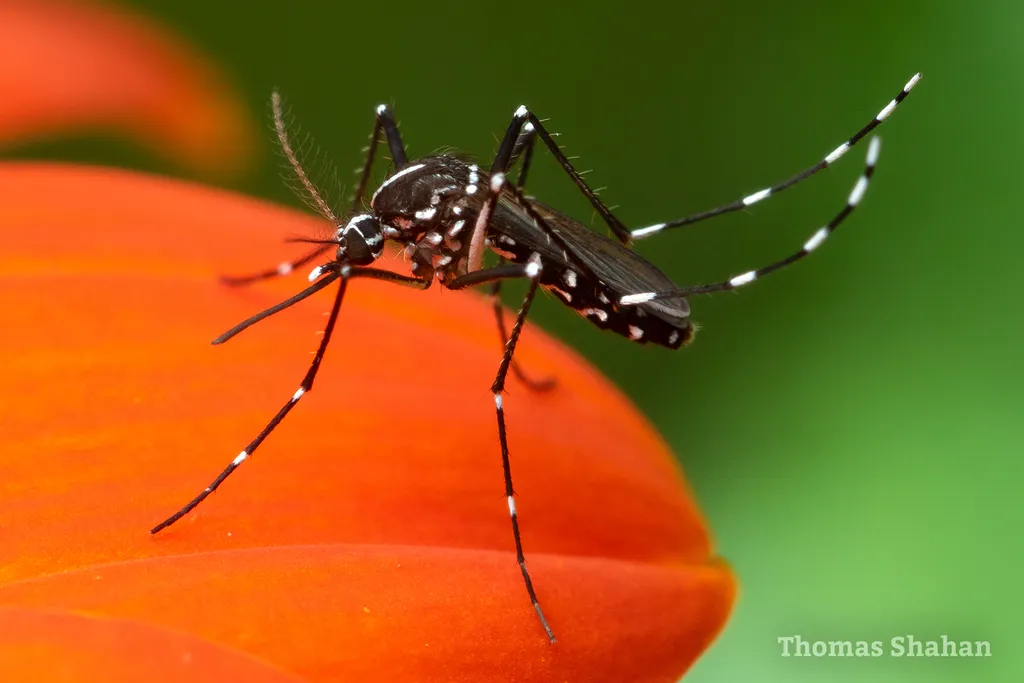
recognized by bold black shiny scales and distinct silver white scales on the palpus and tarsi. The scutum is black with a distinctive white stripe down the center beginning at the dorsal surface of the head and continuing along the thorax. Florida Medical Entomology Laboratory The Asian tiger mosquito is an invasive and aggressive species that was introduced to the United States during the mid-1980s. Major declines in the abundance of Ae. aegypti have been associated with the expansion of Ae. albopictus in both urban and rural areas Medical importance Aedes albopictus is most well known for transmitting dengue and chikungunya viruses but it has also been found infected in nature with the following viruses: West Nile, Eastern equine encephalitis, Japanese encephalitis. It can also transmit dog heartworm parasites. ( CDC ) Ae. albopictus is a competent laboratory vector of at least 22 arboviruses. Ae. albopictus may have played a major role in ZIKV transmission in Gabon in 2007. Armstrong et al. tested > 34,000 Ae. albopictus from New Jersey over a 3-yr period to evaluate its importance as a regional arbovirus vector. Despite an intensive sampling effort during a period of WNV amplification, no WNv was detected, but see discussion. There is no evidence that this mosquito is the vector of human disease in the United States. - CDC, 2023
Wikipedia reference for Aedes albopictus: http://en.wikipedia.org/wiki/Aedes_albopictus.
Classification
Habitat and Range
Habitat
most commonly in medium volumes of water in buckets, tires and plant saucers but rarely collected in small volumes of water found in trash items such as discarded cups and cans. They were also absent from large volumes of water such as in abandoned swimming pools and catch basins ( 8 )
Geographic Range
e US (TX-FL-NH-NE) / Mex. ( 3 ) First breeding population was recorded in Houston in 1985, where surprisingly, Ae. albopictus was found to be both the most abundant and frequently collected species. ( 4 ) This overwhelming abundance in Harris Co., TX and a single female collected earlier in a cemetery in Memphis, Tenn. in 1983 ( 5 ) suggests that the Asian tiger mosquito was already rapidly spreading across the e US. And in fact, surveys in 1986 found breeding populations established in 11 states. ( 6 ) By 1987, 15 states were infested and by 1997, the ATM was recorded in 25 states ( 7 )
Seasonal Activity
mostly: May-Sept (BG data)
Diet and Behavior
Diet: Adult females feed on the blood of birds, humans, and domestic & wild mammals. The larvae feed on fine particulate organic matter in the water.
Life History
The ATM differs from most other mosquitoes in that it's diurnal (active during the day). Eggs are laid singly above the water surface on the sides of water-holding containers such as tires, animal watering dishes, birdbaths, flowerpots and natural holes in vegetation. Multiple generations per year; overwinters in the egg stage in temperate climates. The indiscriminate feeding of female ATMs may make them poor vectors for dengue, Chikungunya and Zika but perhaps fine vectors for WNv.
Additional species information
Species notes from the sources
Etymology: The Asian Tiger Mosquito is so named because of its conspicuous stripes, ferocious feeding behavior and its Asian origin.
About Flies: the wider group
Order-level background for Diptera, the group containing Aedes albopictus. Species-specific details appear above.
Group overview
Diptera includes over 150,000 described species of flies, mosquitoes, and midges. Mosquitoes are the deadliest animal on Earth (CDC). Malaria alone causes ~249 million cases and over 608,000 deaths annually, mostly children under 5 (WHO). Vector-borne diseases account for over 17% of all infectious diseases, causing 700,000+ deaths per year.
Ecological role of the group
Despite their disease impact, flies are critical decomposers and pollinators. Hoverflies alone pollinate hundreds of crop and wildflower species. Flies are also the primary food source for many birds, bats, and fish. Forensic entomology relies heavily on fly species for crime scene analysis.
Economic and practical significance of the group
In the U.S., vector-borne disease cases tripled between 2004-2016, with over 640,000 cases reported in that period (CDC). Tickborne diseases doubled from 22,000 to 48,000 annual reports. Globally, mosquito-borne diseases cost billions in healthcare and lost productivity.
Recorded sources for this group: WHO, CDC, PNAS. Imported estimates may describe particular regions or reporting periods.
Photos of Asian Tiger Mosquito (2)
Photo credits: Contributed by Richard Leung; Additional contributions by Hannah Nendick-Mason , Robin McLeod , Chris Wirth , Mike Quinn
Frequently Asked Questions About Asian Tiger Mosquito
What is Asian Tiger Mosquito?
Asian Tiger Mosquito (Aedes albopictus) is a species in the family Culicidae, within the order Diptera.
How do you identify Asian Tiger Mosquito?
recognized by bold black shiny scales and distinct silver white scales on the palpus and tarsi. The scutum is black with a distinctive white stripe down the center beginning at the dorsal surface of the head and continuing along the thorax. Florida Medical Entomology Laboratory
Where is Asian Tiger Mosquito found?
| Feature | Details |
|---|---|
| Habitat | most commonly in medium volumes of water in buckets, tires and plant saucers but rarely collected in small volumes of water found in trash items such as discarded cups and cans. They were also absent from large volumes of water such as in abandoned swimming pools and catch basins ( 8 ) |
| Range | e US (TX-FL-NH-NE) / Mex. ( 3 ) First breeding population was recorded in Houston in 1985, where surprisingly, Ae. albopictus was found to be both the most abundant and frequently collected species. ( 4 ) This overwhelming abundance in Harris Co., TX and a single female collected earlier in a cemetery in Memphis, Tenn. in 1983 ( 5 ) suggests that the Asian tiger mosquito was already rapidly spreading across the e US. And in fact, surveys in 1986 found breeding populations established in 11 states. ( 6 ) By 1987, 15 states were infested and by 1997, the ATM was recorded in 25 states ( 7 ) |
What does Asian Tiger Mosquito eat?
The diet of the Asian Tiger Mosquito includes Adult females feed on the blood of birds, humans, and domestic & wild mammals. The larvae feed on fine particulate organic matter in the water..
When is Asian Tiger Mosquito active?
Asian Tiger Mosquito: seasonal activity - mostly: May-Sept (BG data).
What is the life cycle of a Asian Tiger Mosquito?
The ATM differs from most other mosquitoes in that it's diurnal (active during the day). Eggs are laid singly above the water surface on the sides of water-holding containers such as tires, animal watering dishes, birdbaths, flowerpots and natural holes in vegetation. Multiple generations per year; overwinters in the egg stage in temperate climates. The indiscriminate feeding of female ATMs may make them poor vectors for dengue, Chikungunya and Zika but perhaps fine vectors for WNv.