
Walker's Cicada
Megatibicen pronotalis
This record describes Megatibicen pronotalis (species). Recorded family: Cicadidae. Recorded order: Hemiptera.
Identification and Appearance
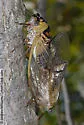
1) Songs of pronotalis and dealbatus are identical. 2) Appears to cross with dealbatus - with which it may be conspecific (?). 3) Both pronotalis and dealbatus will call well after sunset (during the day upto ~10:00pm or later), an unusual behavior for most US cicada species. HYPOTHETICAL: Based on call, behaviors, host affinities and morphology, Tibicen dealbatus (Davis 1915), Plains Cicada (no accepted common name applies) and Tibicen pronotalis Davis 1938 - [syn. marginalis (Walker 1852)], Walker's Cicada are possibly conspecific and represnt a cline . 4) There are several color forms ranging from bright green to dull straw-yellow + intermediates. 5) There are two poorly defined subspecies. These ssp. or forms are perhaps better described as clinal variants with overlapping coloration & varying degrees of pattern. Tibicen pronotalis pronotalis (North & West) & Tibicen pronotalis walkeri (South and East) NOTE: The observed differences appear to represent individual variation. Although some of these variants exhibit phenotypic tendencies with strong geographic affiliations (i.e. clinal ), they are not likely representative of subspecies.
Classification
- Kingdom
- Animalia
- Phylum
- Arthropoda
- Class
- Insecta
- Order
- Hemiptera (True Bugs, Cicadas, Hoppers, Aphids and Allies)
- Suborder
- Auchenorrhyncha
- Superfamily
- Cicadoidea
- Family
- Cicadidae (Cicadas)
- Subfamily
- Cicadinae
- Tribe
- Tacuini
- Genus
- Megatibicen
Imported taxonomy record. Source availability varies; see the source references and editorial policy below.
Habitat and Range
Habitat
usu. Riparian ecosystems with large quantities of Cottonwoods & Willows (often sycamores + associated Hardwood forests)
Geographic Range
West of the Appalachians incl. Mid-South, Lower Mid-West and eastern Plains States e. Texas, e. Oklahoma, Louisiana, Arkansas, Missouri, e. Kansas, e. Nebraska, Iowa, South Dakota, North Dakota, Illinois, Indiana, Ohio, w. Kentucky, w. Tennessee, Mississippi, Alabama, sw. Georgia and extreme n. Florida (nr. the tri-states - GA, FL, & AL jnc.)
Seasonal Activity
For most parts of the range, July-Sept June-Oct across the Gulf States
Diet and Behavior
Diet: This species (& related taxa - dealbatus & cultriformis) seem to prefer cottonwoods & willow (Salicaceae) T. pronotalis and allied taxa are also reported from sycamore (Platanaceae) Less commonly associated with maples and misc. other flood plain hardwoods.
Life History
eggs usually laid in dead twigs, wood or bark (occasionally eggs may be laid in living stems and twigs) eggs hatch and nymphs burrow into the soil nymphs feed on the sap in roots for several years (prefer Pines) Final instar nymphs emerge and develop into winged adults (emergence for this species usu. occurs at night)
About True Bugs, Cicadas, Hoppers, Aphids and Allies: the wider group
Order-level background for Hemiptera, the group containing Megatibicen pronotalis. Species-specific details appear above.
Group overview
Hemiptera (true bugs) includes over 80,000 described species across cicadas, aphids, leafhoppers, shield bugs, and bed bugs. Aphids alone cost global agriculture an estimated $2.5 billion annually in crop losses.
Ecological role of the group
Many Hemiptera are essential food sources for birds and predatory insects. Cicadas provide massive nutrient pulses during emergence events - a single Brood X emergence can involve trillions of individuals across 15 states.
Economic and practical significance of the group
The brown marmorated stink bug (Halyomorpha halys) caused $37 million in apple crop losses in a single year in the U.S. Mid-Atlantic region. Bed bug infestations in the U.S. increased by 500% between 2001-2010, costing the hotel industry hundreds of millions annually.
Recorded sources for this group: USDA, EPA, University research. Imported estimates may describe particular regions or reporting periods.
Photos of Walker's Cicada (5)
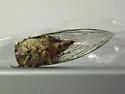
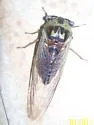
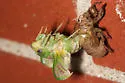
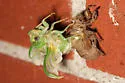
Photo credits: Contributed by Eric R. Eaton; Additional contributions by john and jane balaban , Ron M. , David Ferguson , Bill Reynolds
Frequently Asked Questions About Walker's Cicada
What is Walker's Cicada?
Walker's Cicada (Megatibicen pronotalis) is a species in the family Cicadidae, within the order Hemiptera.
How big is Walker's Cicada?
Tibicen pronotalis (including both ssp. pronotalis & walkeri ) is one of the largest cicadas in the eastern USA. This taxon is best described as having a robust body, relatively narrow head (as compared to the thorax), and boldly patterned with black & brightly colored with greens and reddish-browns or orange and tan. body length 3 to 4cm forewing length ~5cm wingspan 10-13cm
Where is Walker's Cicada found?
| Feature | Details |
|---|---|
| Habitat | usu. Riparian ecosystems with large quantities of Cottonwoods & Willows (often sycamores + associated Hardwood forests) |
| Range | West of the Appalachians incl. Mid-South, Lower Mid-West and eastern Plains States e. Texas, e. Oklahoma, Louisiana, Arkansas, Missouri, e. Kansas, e. Nebraska, Iowa, South Dakota, North Dakota, Illinois, Indiana, Ohio, w. Kentucky, w. Tennessee, Mississippi, Alabama, sw. Georgia and extreme n. Florida (nr. the tri-states - GA, FL, & AL jnc.) |
What does Walker's Cicada eat?
The diet of the Walker's Cicada includes This species (& related taxa - dealbatus & cultriformis) seem to prefer cottonwoods & willow (Salicaceae) T. pronotalis and allied taxa are also reported from sycamore (Platanaceae) Less commonly associated with maples and misc. other flood plain hardwoods..
When is Walker's Cicada active?
Walker's Cicada: seasonal activity - For most parts of the range, July-Sept June-Oct across the Gulf States.
What is the life cycle of a Walker's Cicada?
eggs usually laid in dead twigs, wood or bark (occasionally eggs may be laid in living stems and twigs) eggs hatch and nymphs burrow into the soil nymphs feed on the sap in roots for several years (prefer Pines) Final instar nymphs emerge and develop into winged adults (emergence for this species usu. occurs at night)