
Red Widow
Latrodectus bishopi
This record describes Latrodectus bishopi (species). Recorded family: Theridiidae. Recorded order: Araneae.
Identification and Appearance

The red widow spider has a reddish-orange head, thorax and legs with a black abdomen. The top of the abdomen usually has a row of red spots with yellow borders. This spider lacks a complete hourglass on the underside of the abdomen and instead usually has one or two small red marks. The egg sac is white and smooth. (Net Ref ) Caution: This spider is venomous and can be harmful to people. The female's venom is a neurotoxin which causes sustained muscle spasm rather than local tissue injury. Note from J. Hollenbeck: A clear lymph fluid also oozes from the pores surrounding the bite. The muscle spasms are permanent, (at least my case) reoccurring several times a year for several minutes at a time. The bite was treated as L. mactans, although treatment may have been unnecessary, as spasms, oozing, and localized redness were the only effects of the bite. Males and immatures do not bite. For more general information about the Widow spider, please refer to the Latrodectus genus info page . If you are bitten by a widow spp. spider: Precautions: Be very careful when working around areas where widow spiders may be established. Take proper precautions-wear gloves and pay attention to where you are working. The reaction to a widow bite can be painful, and the victim should go to the doctor immediately for treatment.
Classification
- Kingdom
- Animalia
- Phylum
- Arthropoda
- Class
- Arachnida
- Order
- Araneae (Spiders)
- Family
- Theridiidae (Cobweb Spiders)
- Genus
- Latrodectus (Widow Spiders)
Imported taxonomy record. Source availability varies; see the source references and editorial policy below.
Habitat and Range
Habitat
The red widow constructs its web in palmettos, rosemary, scrub oak, and other shrubs. The webs of adults are generally located 3' to 10' above the ground, (spiderlings and immatures build their webs close to the ground) and the main area of the web can extend up to 4' from the females retreat. It is basically a cobweb sheet with a large number of snare lines extending upwards. Their prey flies into these snares, and usually falls to the sheet. The widow then rushes out to make the capture.
Geographic Range
It has been found primarily in sand-pine scrub habitats in central and southeast Florida, specifically from Marion County to Martin County. (Net Ref and )
Diet and Behavior
Diet: Adult females of this species specialize in capturing flying insects.
About Spiders: the wider group
Order-level background for Araneae, the group containing Latrodectus bishopi. Species-specific details appear above.
Group overview
As of 2023, 51,673 spider species in 136 families have been recorded, though an estimated 150,000 species exist. Spiders rank 7th in total species diversity among all organism orders. Only 0.5% of spider species pose any risk to human health.
Ecological role of the group
Spider venom contains complex peptides with diverse pharmacological activities, making them valuable for drug development research. Spiders produce up to 7 types of silk from specialized glands. Spider silk genes have been inserted into mammals and plants for biotech applications.
Economic and practical significance of the group
The global spider community kills an estimated 400-800 million tons of prey annually (2017 study). Spiders provide billions of dollars in natural pest control for agriculture. Spider silk is 5× stronger than steel of the same diameter, driving a biomaterials research industry.
Recorded sources for this group: World Spider Catalog, PNAS, Nature, ScienceDirect. Imported estimates may describe particular regions or reporting periods.
Photos of Red Widow (5)
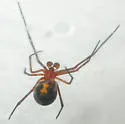
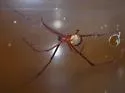
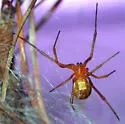
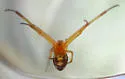
Photo credits: Contributed by john and jane balaban; Additional contributions by Lynette Elliott , Jay Barnes , Christopher Hunt , Jeff Hollenbeck , cheins
Frequently Asked Questions About Red Widow
What is Red Widow?
Red Widow (Latrodectus bishopi) is a species in the family Theridiidae, within the order Araneae.
How do you identify Red Widow?
The red widow spider has a reddish-orange head, thorax and legs with a black abdomen. The top of the abdomen usually has a row of red spots with yellow borders. This spider lacks a complete hourglass on the underside of the abdomen and instead usually has one or two small red marks. The egg sac is white and smooth. (Net Ref )
Where is Red Widow found?
| Feature | Details |
|---|---|
| Habitat | The red widow constructs its web in palmettos, rosemary, scrub oak, and other shrubs. The webs of adults are generally located 3' to 10' above the ground, (spiderlings and immatures build their webs close to the ground) and the main area of the web can extend up to 4' from the females retreat. It is basically a cobweb sheet with a large number of snare lines extending upwards. Their prey flies into these snares, and usually falls to the sheet. The widow then rushes out to make the capture. |
| Range | It has been found primarily in sand-pine scrub habitats in central and southeast Florida, specifically from Marion County to Martin County. (Net Ref and ) |
What does Red Widow eat?
The diet of the Red Widow includes Adult females of this species specialize in capturing flying insects..