
Idiocerus wiyotus
This record describes Idiocerus wiyotus (species). Recorded family: Cicadellidae. Recorded order: Hemiptera.
Identification and Appearance
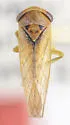
| Feature | Description |
|---|---|
| Additional details | Resembling amoenus V. D. but larger, with elongate antennal discs and extensive black markings in the male. Face long as in suturalis Fh. with the genae nearly straightmargined and exceeded by the apically expanded clypellus. Clypeus convex. Male antennal discs elongate-oval, 2 1/2 times as long as wide. Female seventh sternite a little produced at middle, trisinuate, relatively long. Color of body and legs bright green in life, sometimes fading to yellow. |
| Eyes | Eyes dark brown. |
| Pronotum | Pronotum and scutellum fulvous. Male face and vertex green, or yellowish in some dried specimens, with a brown stripe beneath either eye. Female face unicolorous, green or yellowish, the vertex fulvous. Male usually with four small black spots arranged in a forwardly arcuated semicircle on pronotum near anterior margin. Scutellum with heavy black triangles and two black median spots on disc. Black markings lacking in female, scutellar triangles being represented by a darkening of the ground color. Tip of scutellum green, elytra pale brownish, subhyaline, scutellar and sutural margins infuscated, white saddlemark absent. (Bliven, 1954) Bliven's (1966) rebuttal to Freytag's (1965) synonymy with Idiocerus amoemus Van Duzee, 1894: The male genitalia of wiyotus were illustrated in connection with the original description. In placing this species in synonymy with amoenus [sic], Freytag has disregarded the fact that the genitalia do not even faintly resemble his figures of amoenus [sic] which, as I have pointed out, are indistinguishable from those for the lectotype of nervatus . The Y-shaped connective of wiyotus is unique among described species. |
Classification
- Kingdom
- Animalia
- Phylum
- Arthropoda
- Class
- Insecta
- Order
- Hemiptera (True Bugs, Cicadas, Hoppers, Aphids and Allies)
- Suborder
- Auchenorrhyncha
- Superfamily
- Membracoidea
- Family
- Cicadellidae (Typical Leafhoppers)
- Subfamily
- Eurymelinae
- Tribe
- Idiocerini
- Genus
- Idiocerus
Imported taxonomy record. Source availability varies; see the source references and editorial policy below.
Habitat and Range
Geographic Range
California (type locality: Shively)
Diet and Behavior
Diet: Sequoia sempervirens (coast redwood)
Additional species information
Species notes from the sources
Etymology: Idiocerus wiyotus Bliven, 1954
About True Bugs, Cicadas, Hoppers, Aphids and Allies: the wider group
Order-level background for Hemiptera, the group containing Idiocerus wiyotus. Species-specific details appear above.
Group overview
Hemiptera (true bugs) includes over 80,000 described species across cicadas, aphids, leafhoppers, shield bugs, and bed bugs. Aphids alone cost global agriculture an estimated $2.5 billion annually in crop losses.
Ecological role of the group
Many Hemiptera are essential food sources for birds and predatory insects. Cicadas provide massive nutrient pulses during emergence events - a single Brood X emergence can involve trillions of individuals across 15 states.
Economic and practical significance of the group
The brown marmorated stink bug (Halyomorpha halys) caused $37 million in apple crop losses in a single year in the U.S. Mid-Atlantic region. Bed bug infestations in the U.S. increased by 500% between 2001-2010, costing the hotel industry hundreds of millions annually.
Recorded sources for this group: USDA, EPA, University research. Imported estimates may describe particular regions or reporting periods.
Frequently Asked Questions About Idiocerus wiyotus
What is Idiocerus wiyotus?
Idiocerus wiyotus is a species in the family Cicadellidae, within the order Hemiptera.
How do you identify Idiocerus wiyotus?
| Feature | Description |
|---|---|
| Additional details | Resembling amoenus V. D. but larger, with elongate antennal discs and extensive black markings in the male. Face long as in suturalis Fh. with the genae nearly straightmargined and exceeded by the apically expanded clypellus. Clypeus convex. Male antennal discs elongate-oval, 2 1/2 times as long as wide. Female seventh sternite a little produced at middle, trisinuate, relatively long. Color of body and legs bright green in life, sometimes fading to yellow. |
| Eyes | Eyes dark brown. |
| Pronotum | Pronotum and scutellum fulvous. Male face and vertex green, or yellowish in some dried specimens, with a brown stripe beneath either eye. Female face unicolorous, green or yellowish, the vertex fulvous. Male usually with four small black spots arranged in a forwardly arcuated semicircle on pronotum near anterior margin. Scutellum with heavy black triangles and two black median spots on disc. Black markings lacking in female, scutellar triangles being represented by a darkening of the ground color. Tip of scutellum green, elytra pale brownish, subhyaline, scutellar and sutural margins infuscated, white saddlemark absent. (Bliven, 1954) |
Where is Idiocerus wiyotus found?
Range: California (type locality: Shively)
What does Idiocerus wiyotus eat?
The diet of the Idiocerus wiyotus includes Sequoia sempervirens (coast redwood).