
Episyron quinquenotatus
This record describes Episyron quinquenotatus (species). Recorded family: Pompilidae. Recorded order: Hymenoptera.
Identification and Appearance
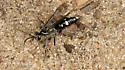
body mostly black with white markings: a thin line behind each eye, another line on side of face bordering inner edge of eye, a thin crescent along anterior edge of thorax broken by black in the middle, and three white wedge-shaped markings on side of abdomen (the middle marking is larger than adjacent ones, and may meet in the midline to form a continuous band, narrowed in the middle); a small white spot may be present at tip of abdomen and at base of each wing; wings smoky brown or blackish, darker toward the tips; female front tarsus with a comb of 4 to 6 spines, used for digging the soil Adults search for orb weaver spiders and paralyze captured prey by stinging the underside of the spider's cephalothorax. The wasp digs a burrow in the soil and drags the paralyzed spider into it, then lays an egg on its abdomen. The egg hatches in two or three days, and the larva feeds on the soft contents of the spider.
Classification
- Kingdom
- Animalia
- Phylum
- Arthropoda
- Class
- Insecta
- Order
- Hymenoptera (Ants, Bees, Wasps and Sawflies)
- Superfamily
- Pompiloidea
- Family
- Pompilidae (Spider Wasps)
- Subfamily
- Pompilinae
- Tribe
- Episyronini
- Genus
- Episyron
Imported taxonomy record. Source availability varies; see the source references and editorial policy below.
Habitat and Range
Habitat
sandy areas; especially common along the shores of the Great Lakes
Geographic Range
coast to coast in southern Canada plus Yukon and Northwest Territories, south to California, Texas, Alabama, North Carolina
Seasonal Activity
spring through fall
Diet and Behavior
Diet: adult females provision their burrows with orb weaver spiders
Life History
females dig and provision burrows throughout the season, laying eggs on prey shortly after placement in burrow; if a larva hatches late in the season, it feeds for a few days and then enters a resting stage (diapause) until the following spring
Additional species information
Species notes from the sources
Etymology: QUINQUENOTATUS: from the Latin "quinque" (five) + "notatus" past participle of "notare" (to mark); probably a reference to the white marks on the abdomen - three sets of two, with the middle pair joining in the midline to form a single mark, reducing the total to five
About Flies: the wider group
Order-level background for Hymenoptera, the group containing Episyron quinquenotatus. Species-specific details appear above.
Group overview
Hymenoptera includes over 150,000 described species of ants, bees, wasps, and sawflies. Earth harbors approximately 20 quadrillion (20×10^15) ants, with a combined biomass of ~12 megatons of dry carbon - exceeding the combined biomass of all wild birds and mammals (PNAS, 2022).
Ecological role of the group
About 35% of the world's food crops depend on animal pollinators. The chocolate industry, valued at over $100 billion, depends on pollinating flies and midges. Ants are the dominant soil engineers in most terrestrial ecosystems, turning more soil than earthworms in many habitats.
Economic and practical significance of the group
Pollinators contribute $235-577 billion worth of annual global food production (FAO). In the U.S., bee pollination alone benefits crops valued at $18 billion annually, and honey bees are responsible for $5.4 billion in agricultural productivity. Between April 2023-2024, 55.1% of managed honey bee colonies were lost. The U.S. bee population dropped from 5 million to 2.5 million.
Recorded sources for this group: FAO, USDA, EPA, PNAS (2022), US Fish & Wildlife Service. Imported estimates may describe particular regions or reporting periods.
Photos of Episyron quinquenotatus (5)
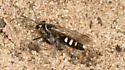
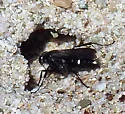
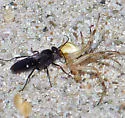
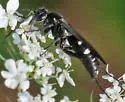
Photo credits: Contributed by Robin McLeod
Frequently Asked Questions About Episyron quinquenotatus
What is Episyron quinquenotatus?
Episyron quinquenotatus is a species in the family Pompilidae, within the order Hymenoptera.
How big is Episyron quinquenotatus?
body length about 10 mm
How do you identify Episyron quinquenotatus?
body mostly black with white markings: a thin line behind each eye, another line on side of face bordering inner edge of eye, a thin crescent along anterior edge of thorax broken by black in the middle, and three white wedge-shaped markings on side of abdomen (the middle marking is larger than adjacent ones, and may meet in the midline to form a continuous band, narrowed in the middle); a small white spot may be present at tip of abdomen and at base of each wing; wings smoky brown or blackish, darker toward the tips; female front tarsus with a comb of 4 to 6 spines, used for digging the soil
Where is Episyron quinquenotatus found?
| Feature | Details |
|---|---|
| Habitat | sandy areas; especially common along the shores of the Great Lakes |
| Range | coast to coast in southern Canada plus Yukon and Northwest Territories, south to California, Texas, Alabama, North Carolina |
What does Episyron quinquenotatus eat?
The diet of the Episyron quinquenotatus includes adult females provision their burrows with orb weaver spiders.
When is Episyron quinquenotatus active?
Episyron quinquenotatus: seasonal activity - spring through fall.
What is the life cycle of a Episyron quinquenotatus?
females dig and provision burrows throughout the season, laying eggs on prey shortly after placement in burrow; if a larva hatches late in the season, it feeds for a few days and then enters a resting stage (diapause) until the following spring