
Carlinian Snapper
Circotettix carlinianus
This record describes Circotettix carlinianus (species). Recorded family: Acrididae. Recorded order: Orthoptera.
Identification and Appearance
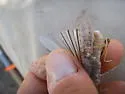
Easily recognized by it's very loud and harsh interrupted buzzing crepitation while in flight, and by the black coloring on the otherwise clear wings. No other species within it's range is similar enough to confuse with it if wings are seen. However, other species of Circotettix and some Trimerotropis may be confusingly similar if wings are folded. C. carlinianus is a stockier insect than any of those species, and has somewhat narrower tegmina than is usual in other Circotettix species found with it. Another aerial acrobat that makes loud harsh noises while in flight. Males will often hover or dance about in the air, while producing their loud harsh buzzing, sometimes 20 or 30 feet up, for several minutes at a time.
Classification
- Kingdom
- Animalia
- Phylum
- Arthropoda
- Class
- Insecta
- Order
- Orthoptera (Grasshoppers, Crickets, Katydids)
- Suborder
- Caelifera
- Family
- Acrididae (Short-horned Grasshoppers)
- Subfamily
- Oedipodinae
- Tribe
- Trimerotropini
- Genus
- Circotettix
Imported taxonomy record. Source availability varies; see the source references and editorial policy below.
Habitat and Range
Habitat
Bare eroded areas in grassland and desert, most often sloping or elevated, but sometimes flat. Often with adobe, clay, or shaley soils.
Geographic Range
Southern Canada from British Columbia to Saskatchewan and southward to western Kansas, northern New Mexico, Utah, Nevada, and eastern California; east from the base of the Sierra Nevada and Cascades into the Great Plains. Recorded also from near Victoria in British Columbia, which seems a bit out of range.
Diet and Behavior
Life History
Overwinters as eggs. Adults in summer and autumn. Most common in July and August.
Additional species information
Species notes from the sources
Etymology: The subspecies carlinianus is distinguished by somewhat stockier proportions, and by proportionately shorter wings, with rougly the basal third to half of the hind wings typically (but not always) pigmented distinctly blackish. It occurs on the eastern part of the species range (mostly east from the Rocky Mountains). The subspecies strepitus is a tad more slender with stronger sculpuring on head and pronotum, with proportionately longer wings, and with hind wings that are most often clear to the base with only the veins black. It is found more to the west, mostly in the Great Basin. The two intergrade over a fairly wide area, mostly in the Colorado Plateaus and the western valleys of the Rocky Mountains.
About Grasshoppers, Crickets, Katydids: the wider group
Order-level background for Orthoptera, the group containing Circotettix carlinianus. Species-specific details appear above.
Group overview
Orthoptera includes ~28,000 described species of grasshoppers, crickets, and katydids. Desert locusts can form swarms covering 460 square miles containing up to 80 million individuals per square kilometer.
Ecological role of the group
Grasshoppers and crickets are a primary food source for birds, reptiles, and small mammals. Cricket farming is a growing industry - crickets require 12× less feed than cattle to produce the same amount of protein, using 2,000× less water.
Economic and practical significance of the group
A single large locust swarm can consume the same amount of food in one day as 35,000 people. The 2019-2021 East Africa locust crisis affected food security for 42 million people across multiple countries. Global crop losses from locusts can reach billions annually.
Recorded sources for this group: FAO, UN World Food Programme, research publications. Imported estimates may describe particular regions or reporting periods.
Photos of Carlinian Snapper (5)
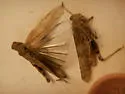
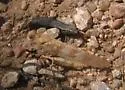
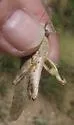
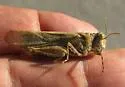
Photo credits: Contributed by Eric R. Eaton; Additional contributions by David Ferguson
Frequently Asked Questions About Carlinian Snapper
What is Carlinian Snapper?
Carlinian Snapper (Circotettix carlinianus) is a species in the family Acrididae, within the order Orthoptera.
How big is Carlinian Snapper?
males and females about 30-45 mm
How do you identify Carlinian Snapper?
Easily recognized by it's very loud and harsh interrupted buzzing crepitation while in flight, and by the black coloring on the otherwise clear wings. No other species within it's range is similar enough to confuse with it if wings are seen. However, other species of Circotettix and some Trimerotropis may be confusingly similar if wings are folded. C. carlinianus is a stockier insect than any of those species, and has somewhat narrower tegmina than is usual in other Circotettix species found with it.
Where is Carlinian Snapper found?
| Feature | Details |
|---|---|
| Habitat | Bare eroded areas in grassland and desert, most often sloping or elevated, but sometimes flat. Often with adobe, clay, or shaley soils. |
| Range | Southern Canada from British Columbia to Saskatchewan and southward to western Kansas, northern New Mexico, Utah, Nevada, and eastern California; east from the base of the Sierra Nevada and Cascades into the Great Plains. Recorded also from near Victoria in British Columbia, which seems a bit out of range. |
What is the life cycle of a Carlinian Snapper?
Overwinters as eggs. Adults in summer and autumn. Most common in July and August.