
Sprinkled Grasshopper
Chloealtis conspersa
This record describes Chloealtis conspersa (species). Recorded family: Acrididae. Recorded order: Orthoptera.
Identification and Appearance
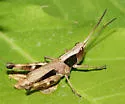
This is a species with the face distinctly slanting and the head somewhat pointed. The top of the head has raised edges and a distinct raised mid-line on the fastigium, and the lateral faveolae to its front edge are not visible from directly above. The top of the pronotum has roughly parallel sides, not distinctly pinched in in the middle. Chloealtis abdominalis is very similar, and the two species often occur together. That species, lacks the distinctly darkened sides of the bases of abdomen and inner hind femora. Male C. conspersa usually have the lateral lobes of the pronotum entirely blackish, while in C. abdominalis they are usually only blackish in the upper part. C. conspersa males often have the abdomen distinctly more reddish. Dichromorpha viridis usually favors warmer, more open grassy habitats, but may sometimes be found in the same places. It is highly varied in color, but hind tibiae are not red or reddish; the bases of the abdomen and inner hind femur are usually not darkened, the sides of the male pronotum are rarely entirely blackish, nor the abdomen reddish; the antennae of adults are more slender; fastigium of adults usually has median ridge absent to inconspicuous; male front and middle femora are distinctly swollen in Dichromorpha ; adult male tegmina are not broadly widened at the front (lower) edge; wings are often (not always) longer. Often most easily located by listening for the raspy song of males during the day.
Classification
- Kingdom
- Animalia
- Phylum
- Arthropoda
- Class
- Insecta
- Order
- Orthoptera (Grasshoppers, Crickets, Katydids)
- Suborder
- Caelifera
- Family
- Acrididae (Short-horned Grasshoppers)
- Subfamily
- Gomphocerinae
- Genus
- Chloealtis
Imported taxonomy record. Source availability varies; see the source references and editorial policy below.
Habitat and Range
Habitat
Most often in grassy patches in old growth wooded areas where there is plenty of brush and old downed wood nearby. Often favors sides of steep gullies and partly shaded slopes.
Geographic Range
Northern U.S. and southern Canada, eastward from the Rocky Mountains. South in the Rockies as far as northern New Mexico.
Diet and Behavior
Life History
Overwinters as eggs, apparently usually laid in old wood on or near ground; hatching in spring or early summer; with adults mostly from June to August, but with some living well into autumn.
About Grasshoppers, Crickets, Katydids: the wider group
Order-level background for Orthoptera, the group containing Chloealtis conspersa. Species-specific details appear above.
Group overview
Orthoptera includes ~28,000 described species of grasshoppers, crickets, and katydids. Desert locusts can form swarms covering 460 square miles containing up to 80 million individuals per square kilometer.
Ecological role of the group
Grasshoppers and crickets are a primary food source for birds, reptiles, and small mammals. Cricket farming is a growing industry - crickets require 12× less feed than cattle to produce the same amount of protein, using 2,000× less water.
Economic and practical significance of the group
A single large locust swarm can consume the same amount of food in one day as 35,000 people. The 2019-2021 East Africa locust crisis affected food security for 42 million people across multiple countries. Global crop losses from locusts can reach billions annually.
Recorded sources for this group: FAO, UN World Food Programme, research publications. Imported estimates may describe particular regions or reporting periods.
Photos of Sprinkled Grasshopper (5)
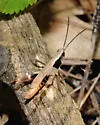
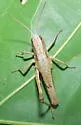

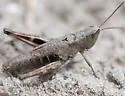
Photo credits: Contributed by tom murray; Additional contributions by David Ferguson
Frequently Asked Questions About Sprinkled Grasshopper
What is Sprinkled Grasshopper?
Sprinkled Grasshopper (Chloealtis conspersa) is a species in the family Acrididae, within the order Orthoptera.
How do you identify Sprinkled Grasshopper?
This is a species with the face distinctly slanting and the head somewhat pointed. The top of the head has raised edges and a distinct raised mid-line on the fastigium, and the lateral faveolae to its front edge are not visible from directly above. The top of the pronotum has roughly parallel sides, not distinctly pinched in in the middle. Chloealtis abdominalis is very similar, and the two species often occur together. That species, lacks the distinctly darkened sides of the bases of abdomen and inner hind femora. Male C. conspersa usually have the lateral lobes of the pronotum entirely blackish, while in C. abdominalis they are usually only blackish in the upper part. C. conspersa males often have the abdomen distinctly more reddish. Dichromorpha viridis usually favors warmer, more open grassy habitats, but may sometimes be found in the same places. It is highly varied in color, but hind tibiae are not red or reddish; the bases of the abdomen and inner hind femur are usually not darkened, the sides of the male pronotum are rarely entirely blackish, nor the abdomen reddish; the antennae of adults are more slender; fastigium of adults usually has median ridge absent to inconspicuous; male front and middle femora are distinctly swollen in Dichromorpha ; adult male tegmina are not broadly widened at the front (lower) edge; wings are often (not always) longer.
Where is Sprinkled Grasshopper found?
| Feature | Details |
|---|---|
| Habitat | Most often in grassy patches in old growth wooded areas where there is plenty of brush and old downed wood nearby. Often favors sides of steep gullies and partly shaded slopes. |
| Range | Northern U.S. and southern Canada, eastward from the Rocky Mountains. South in the Rockies as far as northern New Mexico. |
What is the life cycle of a Sprinkled Grasshopper?
Overwinters as eggs, apparently usually laid in old wood on or near ground; hatching in spring or early summer; with adults mostly from June to August, but with some living well into autumn.