
Sandia Hairstreak - Hodges#4321
Callophrys mcfarlandi
This record describes Callophrys mcfarlandi (species). Recorded family: Lycaenidae. Recorded order: Lepidoptera.
Identification and Appearance
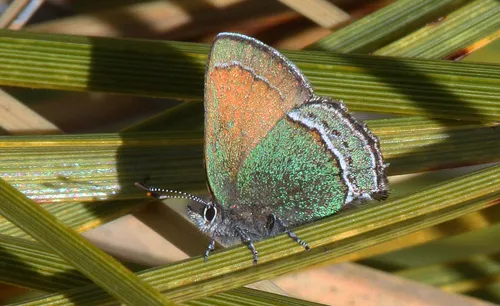
Green below with no tails, rounded wing margins, a bold postedian stripe across all wings - white edged rich brown, wing margins below edged black and white, hind wing with a row of black submarginal spots between white marginal and postmedian stripes. Top fairly even grayish to rusty brown. Often flies with C. gryneus siva , and can be confused except for tails and zig-zag shape of the postmedian stripes of hind wings on that species. The Siva or Juniper Hairstreak is closely tied to Juniperus & Cupressus trees, which may grow with the Nolina . Other tailless green hairstreaks are rare in the same areas, generally found at higher elevations, but if seen together would have none of the markings near the wing margins below, with the postmedian stripes below less bold, nearly absent on the front wings. Usually numerous where found, and closely associated with their larval host plants. They rarely stray far from Nolina plants, but are attracted to nearby streamsides, puddles, sap, and flowers.
Classification
- Kingdom
- Animalia
- Phylum
- Arthropoda
- Class
- Insecta
- Order
- Lepidoptera (Butterflies and Moths)
- Superfamily
- Papilionoidea
- Family
- Lycaenidae (Blues, Coppers, Hairstreaks, Harvesters)
- Subfamily
- Theclinae
- Tribe
- Eumaeini
- Genus
- Callophrys
Imported taxonomy record. Source availability varies; see the source references and editorial policy below.
Habitat and Range
Habitat
Mostly rocky slopes, always where Nolina plants grow.
Geographic Range
se. Colorado (barely in state) south through New Mexico (mostly east of Rio Grande) and Trans-Pecos Texas to at least Nuevo Leon, Zacatecas, Durango (states), Mexico. NW to w. TX / Mex. - Map (MPG)
Seasonal Activity
adults emerge in early spring (flying mostly late February to early April, depending somewhat on location and weather), with an apparent second flight sometimes in May - June. It is unclear if this is a second emergence from overwintering individuals, or if it is an extended first flight. In many years there is no later flight, in some years the early flight may apparently be wiped out by unseasonable cold winter weather.
Diet and Behavior
Diet: Adults visit damp ground and avidly nectar at available flowers (including of their larval host plants - if in bloom). Larvae feed on Nolina texana (= N. greenei ) and perhaps other closely related species in Mexico. They have not been verified to use any other species of Nolina in the U.S., though they may use certain closely related species in s. New Mexico and w. Texas.
About Butterflies and Moths: the wider group
Order-level background for Lepidoptera, the group containing Callophrys mcfarlandi. Species-specific details appear above.
Group overview
Lepidoptera includes approximately 180,000 described species of butterflies and moths. Moths outnumber butterflies roughly 10:1. The monarch butterfly's eastern population has declined by more than 80% since the mid-1990s, and the western population by over 95% since the 1980s. The IUCN lists the migratory monarch as Vulnerable.
Ecological role of the group
Butterflies and moths are essential indicators of ecosystem health. As caterpillars, they are a primary food source for birds - a single nest of blue tit chicks requires ~10,000 caterpillars. Adult moths pollinate many night-blooming plants.
Economic and practical significance of the group
Lepidoptera are critical pollinators. In Europe, grassland butterfly species have declined by almost 50% since the early 1990s. In the UK, three-quarters of butterflies are in decline. In the U.S., five butterfly species have gone extinct since 1950, with 29 listed as endangered.
Recorded sources for this group: IUCN Red List, Xerces Society, USFWS, PNAS, WWF. Imported estimates may describe particular regions or reporting periods.
Photos of Sandia Hairstreak - Hodges#4321 (2)
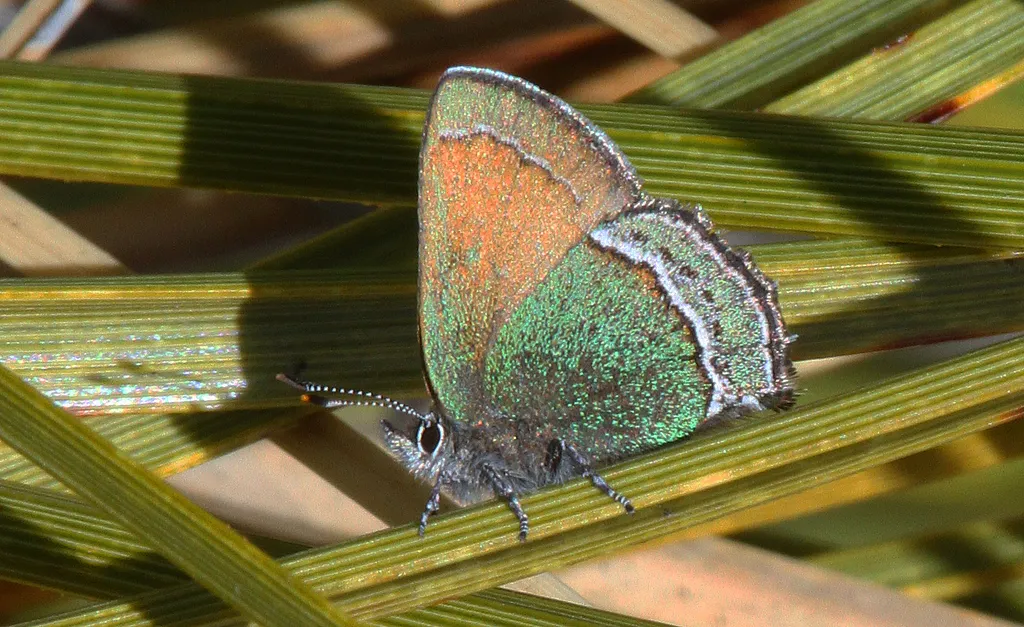
Photo credits: Contributed by Brad Barnd; Additional contributions by Steve Nanz , Mike Quinn , David Ferguson , Edward Ruden
Frequently Asked Questions About Sandia Hairstreak - Hodges#4321
What is Sandia Hairstreak - Hodges#4321?
Sandia Hairstreak - Hodges#4321 (Callophrys mcfarlandi) is a species in the family Lycaenidae, within the order Lepidoptera.
How do you identify Sandia Hairstreak - Hodges#4321?
Green below with no tails, rounded wing margins, a bold postedian stripe across all wings - white edged rich brown, wing margins below edged black and white, hind wing with a row of black submarginal spots between white marginal and postmedian stripes. Top fairly even grayish to rusty brown. Often flies with C. gryneus siva , and can be confused except for tails and zig-zag shape of the postmedian stripes of hind wings on that species. The Siva or Juniper Hairstreak is closely tied to Juniperus & Cupressus trees, which may grow with the Nolina . Other tailless green hairstreaks are rare in the same areas, generally found at higher elevations, but if seen together would have none of the markings near the wing margins below, with the postmedian stripes below less bold, nearly absent on the front wings.
Where is Sandia Hairstreak - Hodges#4321 found?
| Feature | Details |
|---|---|
| Habitat | Mostly rocky slopes, always where Nolina plants grow. |
| Range | se. Colorado (barely in state) south through New Mexico (mostly east of Rio Grande) and Trans-Pecos Texas to at least Nuevo Leon, Zacatecas, Durango (states), Mexico. NW to w. TX / Mex. - Map (MPG) |
What does Sandia Hairstreak - Hodges#4321 eat?
The diet of the Sandia Hairstreak - Hodges#4321 includes Adults visit damp ground and avidly nectar at available flowers (including of their larval host plants - if in bloom). Larvae feed on Nolina texana (= N. greenei ) and perhaps other closely related species in Mexico. They have not been verified to use any other species of Nolina in the U.S., though they may use certain closely related species in s. New Mexico and w. Texas..
When is Sandia Hairstreak - Hodges#4321 active?
Sandia Hairstreak - Hodges#4321: seasonal activity - adults emerge in early spring (flying mostly late February to early April, depending somewhat on location and weather), with an apparent second flight sometimes in May - June. It is unclear if this is a second emergence from overwintering individuals, or if it is an extended first flight. In many years there is no later flight, in some years the early flight may apparently be wiped out by unseasonable cold winter weather..