
Brown Elfin - Hodges#4322
Callophrys augustinus
This record describes Callophrys augustinus (species). Recorded family: Lycaenidae. Recorded order: Lepidoptera.
Identification and Appearance
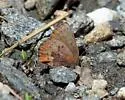
Adult: Has no tails. Upperside of male grayish-brown; female more reddish-brown. Underside of forewing chestnut brown with dark irregular postmedian line. Underside of hindwing sharply divided between dark brown basal half and light chestnut brown distal half. Larva: olive green to yellow green, with a yellow line down the back, and oblique lines on the sides. Often flies in company with other elfins, and likes to sip moisture from wet sand and earth.
Classification
- Kingdom
- Animalia
- Phylum
- Arthropoda
- Class
- Insecta
- Order
- Lepidoptera (Butterflies and Moths)
- Superfamily
- Papilionoidea
- Family
- Lycaenidae (Blues, Coppers, Hairstreaks, Harvesters)
- Subfamily
- Theclinae
- Tribe
- Eumaeini
- Genus
- Callophrys
Imported taxonomy record. Source availability varies; see the source references and editorial policy below.
Habitat and Range
Habitat
Varied: barrens, bogs, mixed coniferous/deciduous woodlands; almost any place where acidic soils predominate and the larval foodplants occur.
Geographic Range
Much of North America, north to Alaska and Newfoundland. Absent from Great Plains, midwest.
Seasonal Activity
Adults from May-July (north); February-April (south)
Diet and Behavior
Diet: Larvae feed on flowers, fruits, and leaves of wide variety of plants, mainly Ericaceae, including blueberry ( Vaccinium spp.), Manzanitas ( Arctostaphylos spp. ), Leatherleaf ( Chamaedaphne calyculata ), Labrador Tea ( Ledum groenlandicum ), madrone ( Arbutus menziesii , and salal ( Gaultheria shallon ). In California, it also uses soap plant ( Chlorogalum pomeridianum ), California lilac ( Ceanothus spp. ), and even the parasitic vine dodder ( Cuscuta spp. ). Adults take nectar.
Additional species information
Species notes from the sources
Etymology: Named after a Canadian Inuit who was called Augustus by the members of the nineteenth-century John Franklin expedition. John Richardson , the naturalist on the Franklin Arctic Expedition. honoured Augustus for his devoted duty to the expedition members (The entomologist William Kirby wrote the actual description) The name chosen, Thecla augustus , had unfortunately already been used to describe another butterfly, so John Obadiah Westwood proposed a slightly modified version, Thecla augustinus , which became the official original name for the species.
About Butterflies and Moths: the wider group
Order-level background for Lepidoptera, the group containing Callophrys augustinus. Species-specific details appear above.
Group overview
Lepidoptera includes approximately 180,000 described species of butterflies and moths. Moths outnumber butterflies roughly 10:1. The monarch butterfly's eastern population has declined by more than 80% since the mid-1990s, and the western population by over 95% since the 1980s. The IUCN lists the migratory monarch as Vulnerable.
Ecological role of the group
Butterflies and moths are essential indicators of ecosystem health. As caterpillars, they are a primary food source for birds - a single nest of blue tit chicks requires ~10,000 caterpillars. Adult moths pollinate many night-blooming plants.
Economic and practical significance of the group
Lepidoptera are critical pollinators. In Europe, grassland butterfly species have declined by almost 50% since the early 1990s. In the UK, three-quarters of butterflies are in decline. In the U.S., five butterfly species have gone extinct since 1950, with 29 listed as endangered.
Recorded sources for this group: IUCN Red List, Xerces Society, USFWS, PNAS, WWF. Imported estimates may describe particular regions or reporting periods.
Photos of Brown Elfin - Hodges#4322 (5)
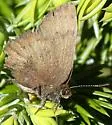
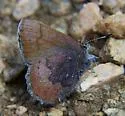
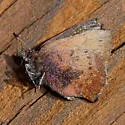
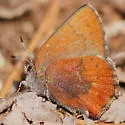
Photo credits: Contributed by Cotinis; Additional contributions by Steve Nanz , Robin McLeod , Chuck Entz , Aaron Schusteff
Frequently Asked Questions About Brown Elfin - Hodges#4322
What is Brown Elfin - Hodges#4322?
Brown Elfin - Hodges#4322 (Callophrys augustinus) is a species in the family Lycaenidae, within the order Lepidoptera.
How big is Brown Elfin - Hodges#4322?
Wingspan 19-29 mm
How do you identify Brown Elfin - Hodges#4322?
Adult: Has no tails. Upperside of male grayish-brown; female more reddish-brown. Underside of forewing chestnut brown with dark irregular postmedian line. Underside of hindwing sharply divided between dark brown basal half and light chestnut brown distal half. Larva: olive green to yellow green, with a yellow line down the back, and oblique lines on the sides.
Where is Brown Elfin - Hodges#4322 found?
| Feature | Details |
|---|---|
| Habitat | Varied: barrens, bogs, mixed coniferous/deciduous woodlands; almost any place where acidic soils predominate and the larval foodplants occur. |
| Range | Much of North America, north to Alaska and Newfoundland. Absent from Great Plains, midwest. |
What does Brown Elfin - Hodges#4322 eat?
The diet of the Brown Elfin - Hodges#4322 includes Larvae feed on flowers, fruits, and leaves of wide variety of plants, mainly Ericaceae, including blueberry ( Vaccinium spp.), Manzanitas ( Arctostaphylos spp. ), Leatherleaf ( Chamaedaphne calyculata ), Labrador Tea ( Ledum groenlandicum ), madrone ( Arbutus menziesii , and salal ( Gaultheria shallon ). In California, it also uses soap plant ( Chlorogalum pomeridianum ), California lilac ( Ceanothus spp. ), and even the parasitic vine dodder ( Cuscuta spp. ). Adults take nectar..
When is Brown Elfin - Hodges#4322 active?
Brown Elfin - Hodges#4322: seasonal activity - Adults from May-July (north); February-April (south).