
Juniper Hairstreak - Hodges#4318
Callophrys gryneus
This record describes Callophrys gryneus (species). Recorded family: Lycaenidae. Recorded order: Lepidoptera.
Identification and Appearance
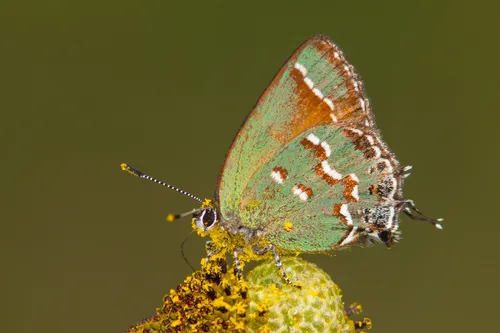
Det. M. A. Quinn, 2010 Shows regional variation, with those east from the Great Plains usually largely green below, and with distinct markings in the discal area of the lower hind wing. West from the Great Plains the white discal markings vanish, and west from the Rockies (except in mountains of the desert Southwest) the under side is usually brownish instead of green (often suffused purplish or pinkish). In sw. California and Baja California the discal markings reappear in mostly brownish populations. Many subspecies names have been given based on coloration, geographical location, and host plant preference. Where populations in the same area use different host plants, they may look different, showing at least partial racial segegration. As broadly defined here, C. gryneus may include several cryptic species, but opinions vary. For the present, various names are all (except hesselli ) listed here at the same subspecies ranking, this seems the most consistent and least confusing treatment, at least until relative degrees of distinctness are much better understood. C. hesselli is part of this complex, but has always been treated as a distinct species.
Identification notes
Det. M. A. Quinn, 2010
Classification
- Kingdom
- Animalia
- Phylum
- Arthropoda
- Class
- Insecta
- Order
- Lepidoptera (Butterflies and Moths)
- Superfamily
- Papilionoidea
- Family
- Lycaenidae (Blues, Coppers, Hairstreaks, Harvesters)
- Subfamily
- Theclinae
- Tribe
- Eumaeini
- Genus
- Callophrys
Imported taxonomy record. Source availability varies; see the source references and editorial policy below.
Habitat and Range
Habitat
semi-open areas, closely associated with hostplants in family Cupressaceae.
Geographic Range
widely dist. across US, s. BC & s. ON - Map (MPG)
Seasonal Activity
mostly: Mar-Aug (MPG)
Diet and Behavior
Diet: Larval hosts are in the Cypress family (Cupressaceae), and vary from region to region. Juniperus is used by most but not all subspecies. Others use Calocedrus, Cupressus, Chamaecyparis, Thuja , etc. Some C. gryneus subspecies are closely tied to one species of larval host plant, but several have been shown to utilize alternate hosts when available (as in plantings near wild populations). Adults take nectar and will sometimes visit mud. [note from David J. Ferguson; 11-16-13] It is interesting to wonder how a member of a group of butterflies that normally utilizes Dicots for larval hosts has adapted to using Conifers (family Cupressaceae). It could be that (as in some closest relatives) their ancestors once used Mistletoes growing on Conifers, and that the butterflies adapted to use of the Conifers via their parasitic Mistletoe larval hosts. This shift seems that it could have been advantageous in allowing for a more permanent and reliable larval host than were the more transient parasitic Mistletoe plants (which are more likely to die, or to blow off of the trees).
Additional species information
Species notes from the sources
Etymology: Callophrys gryneus (Hübner, [1819])
About Butterflies and Moths: the wider group
Order-level background for Lepidoptera, the group containing Callophrys gryneus. Species-specific details appear above.
Group overview
Lepidoptera includes approximately 180,000 described species of butterflies and moths. Moths outnumber butterflies roughly 10:1. The monarch butterfly's eastern population has declined by more than 80% since the mid-1990s, and the western population by over 95% since the 1980s. The IUCN lists the migratory monarch as Vulnerable.
Ecological role of the group
Butterflies and moths are essential indicators of ecosystem health. As caterpillars, they are a primary food source for birds - a single nest of blue tit chicks requires ~10,000 caterpillars. Adult moths pollinate many night-blooming plants.
Economic and practical significance of the group
Lepidoptera are critical pollinators. In Europe, grassland butterfly species have declined by almost 50% since the early 1990s. In the UK, three-quarters of butterflies are in decline. In the U.S., five butterfly species have gone extinct since 1950, with 29 listed as endangered.
Recorded sources for this group: IUCN Red List, Xerces Society, USFWS, PNAS, WWF. Imported estimates may describe particular regions or reporting periods.
Photos of Juniper Hairstreak - Hodges#4318 (2)
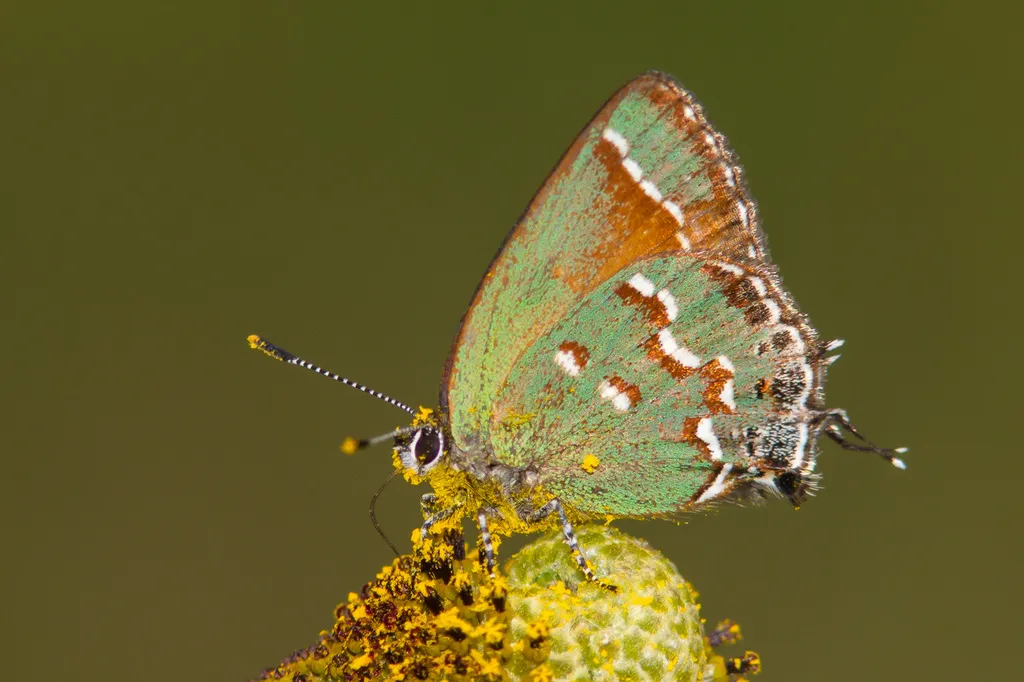
Photo credits: Contributed by Cotinis; Additional contributions by Mike Quinn , David Ferguson
Frequently Asked Questions About Juniper Hairstreak - Hodges#4318
What is Juniper Hairstreak - Hodges#4318?
Juniper Hairstreak - Hodges#4318 (Callophrys gryneus) is a species in the family Lycaenidae, within the order Lepidoptera.
How big is Juniper Hairstreak - Hodges#4318?
27-32 mm
How do you identify Juniper Hairstreak - Hodges#4318?
Det. M. A. Quinn, 2010
Where is Juniper Hairstreak - Hodges#4318 found?
| Feature | Details |
|---|---|
| Habitat | semi-open areas, closely associated with hostplants in family Cupressaceae. |
| Range | widely dist. across US, s. BC & s. ON - Map (MPG) |
What does Juniper Hairstreak - Hodges#4318 eat?
The diet of the Juniper Hairstreak - Hodges#4318 includes Larval hosts are in the Cypress family (Cupressaceae), and vary from region to region. Juniperus is used by most but not all subspecies. Others use Calocedrus, Cupressus, Chamaecyparis, Thuja , etc. Some C. gryneus subspecies are closely tied to one species of larval host plant, but several have been shown to utilize alternate hosts when available (as in plantings near wild populations). Adults take nectar and will sometimes visit mud. [note from David J. Ferguson; 11-16-13] It is interesting to wonder how a member of a group of butterflies that normally utilizes Dicots for larval hosts has adapted to using Conifers (family Cupressaceae). It could be that (as in some closest relatives) their ancestors once used Mistletoes growing on Conifers, and that the butterflies adapted to use of the Conifers via their parasitic Mistletoe larval hosts. This shift seems that it could have been advantageous in allowing for a more permanent and reliable larval host than were the more transient parasitic Mistletoe plants (which are more likely to die, or to blow off of the trees)..
When is Juniper Hairstreak - Hodges#4318 active?
Juniper Hairstreak - Hodges#4318: seasonal activity - mostly: Mar-Aug (MPG).