
Hessel's Hairstreak - Hodges#4319
Callophrys hesseli
This record describes Callophrys hesseli (species). Recorded family: Lycaenidae. Recorded order: Lepidoptera.
Identification and Appearance
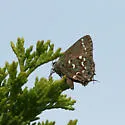
Very similar to Juniper Hairstreak - Callophrys (Mitoura) gryneus . Distinguished by close association with a different larval host plant and by coloration. In this species the white markings on the underside are often more striking with stronger reddish brown borders, and are more irregularly arranged on the hind wing, creating a more checkered appearance. The two spots near the base of the hind wing are typically more crescent-shaped. The white band on the front wing is usually nearly straight in C. gryneus , and usually distinctly offset in C. hesseli . From the original description (Rawson & Ziegler, 1950): We take pleasure in naming the new species in honor of Mr. Sidney A. Hessel, of Woodmere, N. Y., an enthusiastic collector and student of the Lepidoptera, in whose genial company we took our spring series. More on Hessel from an Internet source : Sidney A. Hessel, (1907-1974) was a resident of Washington Connecticut. A rubber importer, Mr. Hessel was also an amateur lepidopterist who discovered a butterfly variety that was named Hessel's Hairstreak. Yale University Archives gives biographical information: Hessel, Sidney Adolphus, 01/01/1907-01/01/1974". However the birth and death days do not look accurate. Gordh and Headrick list a brief obituary in News of the Lepidopterist's Society 1974:9, available from Yale University : OBITUARY Sidney A. Hessel Just before publication, word came of the death of Sidney Hessel, on November 11. He had been in good health until October 16, when he had emergency surgery, and never fully recovered. Sidney Hessel was a charter member of the Lepidopterists' Society and a strong force in its formation and progress. His counsel will sorely be missed. Most recently, he had served as editor of the Memoirs, and handled back issue supplies and orders. More details will follow in a later issue.
Classification
- Kingdom
- Animalia
- Phylum
- Arthropoda
- Class
- Insecta
- Order
- Lepidoptera (Butterflies and Moths)
- Superfamily
- Papilionoidea
- Family
- Lycaenidae (Blues, Coppers, Hairstreaks, Harvesters)
- Subfamily
- Theclinae
- Tribe
- Eumaeini
- Genus
- Callophrys
Imported taxonomy record. Source availability varies; see the source references and editorial policy below.
Habitat and Range
Geographic Range
Occurs within the natural distribution of the larval host plant, primarily on the Gulf and Atlantic coastal plain from Louisiana to Maine.
Diet and Behavior
Diet: Larval host is Atlantic Whitecedar (Atlantic Cypress) - Chamaecyparis thyoides
Additional species information
Species notes from the sources
Etymology: Patronym for American lepidopterist Sidney A. Hessel (1907-1974). See Remarks for more information.
About Butterflies and Moths: the wider group
Order-level background for Lepidoptera, the group containing Callophrys hesseli. Species-specific details appear above.
Group overview
Lepidoptera includes approximately 180,000 described species of butterflies and moths. Moths outnumber butterflies roughly 10:1. The monarch butterfly's eastern population has declined by more than 80% since the mid-1990s, and the western population by over 95% since the 1980s. The IUCN lists the migratory monarch as Vulnerable.
Ecological role of the group
Butterflies and moths are essential indicators of ecosystem health. As caterpillars, they are a primary food source for birds - a single nest of blue tit chicks requires ~10,000 caterpillars. Adult moths pollinate many night-blooming plants.
Economic and practical significance of the group
Lepidoptera are critical pollinators. In Europe, grassland butterfly species have declined by almost 50% since the early 1990s. In the UK, three-quarters of butterflies are in decline. In the U.S., five butterfly species have gone extinct since 1950, with 29 listed as endangered.
Recorded sources for this group: IUCN Red List, Xerces Society, USFWS, PNAS, WWF. Imported estimates may describe particular regions or reporting periods.
Photos of Hessel's Hairstreak - Hodges#4319 (5)
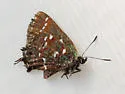
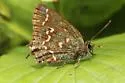
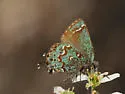
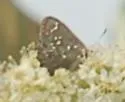
Photo credits: Contributed by Tom Bentley; Additional contributions by cotinis , Steve Nanz , David Ferguson
Frequently Asked Questions About Hessel's Hairstreak - Hodges#4319
What is Hessel's Hairstreak - Hodges#4319?
Hessel's Hairstreak - Hodges#4319 (Callophrys hesseli) is a species in the family Lycaenidae, within the order Lepidoptera.
How do you identify Hessel's Hairstreak - Hodges#4319?
Very similar to Juniper Hairstreak - Callophrys (Mitoura) gryneus . Distinguished by close association with a different larval host plant and by coloration. In this species the white markings on the underside are often more striking with stronger reddish brown borders, and are more irregularly arranged on the hind wing, creating a more checkered appearance. The two spots near the base of the hind wing are typically more crescent-shaped. The white band on the front wing is usually nearly straight in C. gryneus , and usually distinctly offset in C. hesseli .
Where is Hessel's Hairstreak - Hodges#4319 found?
Range: Occurs within the natural distribution of the larval host plant, primarily on the Gulf and Atlantic coastal plain from Louisiana to Maine.
What does Hessel's Hairstreak - Hodges#4319 eat?
The diet of the Hessel's Hairstreak - Hodges#4319 includes Larval host is Atlantic Whitecedar (Atlantic Cypress) - Chamaecyparis thyoides.