
Ebony Grasshopper
Boopedon nubilum
This record describes Boopedon nubilum (species). Recorded family: Acrididae. Recorded order: Orthoptera.
Identification and Appearance
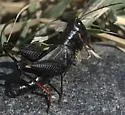
Highly varied in color, but males are usually black with little pattern and females brown with a distinct pattern, though other hues such as grays and greens are not uncommon among females. Black females that look like the males are rare, and typically when found they are actually extremely dark green females (with the green barely showing). Very rarely males can be brown, gray, or green like females, in which case their pattern is similar to the normal female pattern. Even though males are a fraction the size of females, they are very active, jump active, sort of fly sometimes, and are much more likely to be seen. While females tend to lumber around and stay hidden in the grass. This can be a very abundant species in some years, being sometimes considered as a pest on grazing lands.
Classification
- Kingdom
- Animalia
- Phylum
- Arthropoda
- Class
- Insecta
- Order
- Orthoptera (Grasshoppers, Crickets, Katydids)
- Suborder
- Caelifera
- Family
- Acrididae (Short-horned Grasshoppers)
- Subfamily
- Gomphocerinae
- Genus
- Boopedon (Boopies)
Imported taxonomy record. Source availability varies; see the source references and editorial policy below.
Habitat and Range
Habitat
Mostly areas of rank taller grass within short grass prairies (steppes). They tend to be common along low areas to which extra water drains during rain, along road ditches, bases of slopes, etc.
Geographic Range
Great Plains from near the Canadian border (Alberta, Montana and North Dakota) southward east of the Rockies almost to the Gulf Coast in Texas and into northern Mexico. West across New Mexico and northern Chihuahua into Sonora and Arizona.
Seasonal Activity
Overwinter as eggs, with adults in late spring or summer and usually living until after the first frosts.
Diet and Behavior
Diet: Primarily grasses.
About Grasshoppers, Crickets, Katydids: the wider group
Order-level background for Orthoptera, the group containing Boopedon nubilum. Species-specific details appear above.
Group overview
Orthoptera includes ~28,000 described species of grasshoppers, crickets, and katydids. Desert locusts can form swarms covering 460 square miles containing up to 80 million individuals per square kilometer.
Ecological role of the group
Grasshoppers and crickets are a primary food source for birds, reptiles, and small mammals. Cricket farming is a growing industry - crickets require 12× less feed than cattle to produce the same amount of protein, using 2,000× less water.
Economic and practical significance of the group
A single large locust swarm can consume the same amount of food in one day as 35,000 people. The 2019-2021 East Africa locust crisis affected food security for 42 million people across multiple countries. Global crop losses from locusts can reach billions annually.
Recorded sources for this group: FAO, UN World Food Programme, research publications. Imported estimates may describe particular regions or reporting periods.
Photos of Ebony Grasshopper (5)
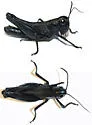
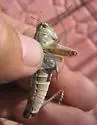
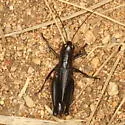
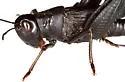
Photo credits: Contributed by Tom Bentley; Additional contributions by David Ferguson
Frequently Asked Questions About Ebony Grasshopper
What is Ebony Grasshopper?
Ebony Grasshopper (Boopedon nubilum) is a species in the family Acrididae, within the order Orthoptera.
Where is Ebony Grasshopper found?
| Feature | Details |
|---|---|
| Habitat | Mostly areas of rank taller grass within short grass prairies (steppes). They tend to be common along low areas to which extra water drains during rain, along road ditches, bases of slopes, etc. |
| Range | Great Plains from near the Canadian border (Alberta, Montana and North Dakota) southward east of the Rockies almost to the Gulf Coast in Texas and into northern Mexico. West across New Mexico and northern Chihuahua into Sonora and Arizona. |
What does Ebony Grasshopper eat?
The diet of the Ebony Grasshopper includes Primarily grasses..
When is Ebony Grasshopper active?
Ebony Grasshopper: seasonal activity - Overwinter as eggs, with adults in late spring or summer and usually living until after the first frosts..