
Purplish Fritillary - Hodges#4475
Boloria chariclea
This record describes Boloria chariclea (species). Recorded family: Nymphalidae. Recorded order: Lepidoptera.
Identification and Appearance
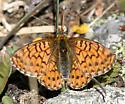
Adult: upperside of wings orange with black spots, bars, and chevron-shaped markings, similar to many other Lesser Fritillaries. The hindwing underside of the two boreal forest subspecies ( grandis and rainieri ) is purplish or reddish-brown with a broken yellowish to rust-colored band across the wing; it has white marginal spots capped with black chevron-shaped marks and a row of black spots above these. The hindwing underside of the two tundra subspecies ( arctica and butleri ) has a distinct white band (sometimes silvered) across the middle, and the black submarginal spots and chevron marks are reduced or absent. The New Hampshire subspecies montinus is dark rusty brown with no purplish markings. Larva: body gray with black stripes and orange spines In the arctic, the western mountains, and in some bogs, it is the most abundant Lesser Fritillary. In New Hampshire, there's no mistaking this species for any other fritillary, because of its geographic location atop Mount Washington and several other peaks in the White Mountains.
Classification
- Kingdom
- Animalia
- Phylum
- Arthropoda
- Class
- Insecta
- Order
- Lepidoptera (Butterflies and Moths)
- Superfamily
- Papilionoidea
- Family
- Nymphalidae (Brush-footed Butterflies)
- Subfamily
- Heliconiinae
- Tribe
- Argynnini
- Genus
- Boloria (Lesser Fritillaries)
Imported taxonomy record. Source availability varies; see the source references and editorial policy below.
Habitat and Range
Habitat
Varies according to subspecies and location, but includes arctic tundra, taiga (boreal forest), acid bogs, and moist alpine meadows.
Geographic Range
Circumboreal Alaska and all of Canada, including arctic islands; extends into the continental US in Maine, New Hampshire, Minnesota, Washington state, and south in the Rockies to New Mexico (see distribution maps for Canada and continental United States )
Seasonal Activity
Adults fly from June to August (one brood).
Diet and Behavior
Diet: Larvae feed on scrub willow, violets, Western Bistort ( Polygonum bistortoides ), and blueberry.
Life History
It takes two years to develop in the colder parts of its range, but can be found every year in most areas.
Additional species information
Species notes from the sources
Etymology: Includes montinus as a subspecies, following the classification of Opler and Warren and All-Leps (see discussion in Taxonomy Forum). Many authors consider B. montinus to represent a distinct more southerly species, and some still use the Eurasian name B. titania for this "other species". In this sense B. chariclea is more northerly in distribution. There is some merit to this separation, as the two types overlap in distribution and sometimes occur in the same area while remaining distinctly different. The names boisduvalii, grandis, and rainieri belong to the more southerly type. While the subspecies helena & ingens are generally asigned to the southern " montinus type", they are rather distinctive, resemble the more northern "Arctic type" in some ways, and could perhaps be considered to make up yet a third "type".
About Butterflies and Moths: the wider group
Order-level background for Lepidoptera, the group containing Boloria chariclea. Species-specific details appear above.
Group overview
Lepidoptera includes approximately 180,000 described species of butterflies and moths. Moths outnumber butterflies roughly 10:1. The monarch butterfly's eastern population has declined by more than 80% since the mid-1990s, and the western population by over 95% since the 1980s. The IUCN lists the migratory monarch as Vulnerable.
Ecological role of the group
Butterflies and moths are essential indicators of ecosystem health. As caterpillars, they are a primary food source for birds - a single nest of blue tit chicks requires ~10,000 caterpillars. Adult moths pollinate many night-blooming plants.
Economic and practical significance of the group
Lepidoptera are critical pollinators. In Europe, grassland butterfly species have declined by almost 50% since the early 1990s. In the UK, three-quarters of butterflies are in decline. In the U.S., five butterfly species have gone extinct since 1950, with 29 listed as endangered.
Recorded sources for this group: IUCN Red List, Xerces Society, USFWS, PNAS, WWF. Imported estimates may describe particular regions or reporting periods.
Photos of Purplish Fritillary - Hodges#4475 (5)
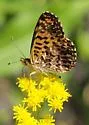
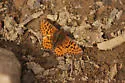
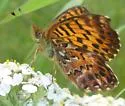
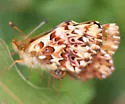
Photo credits: Contributed by tom murray; Additional contributions by Steve Nanz , Robin McLeod , Hartmut Wisch , David Ferguson
Frequently Asked Questions About Purplish Fritillary - Hodges#4475
What is Purplish Fritillary - Hodges#4475?
Purplish Fritillary - Hodges#4475 (Boloria chariclea) is a species in the family Nymphalidae, within the order Lepidoptera.
How big is Purplish Fritillary - Hodges#4475?
wingspan 31-39 mm in United States ( nearctica.com ); 32-44 mm in Canada ( CBIF )
How do you identify Purplish Fritillary - Hodges#4475?
Adult: upperside of wings orange with black spots, bars, and chevron-shaped markings, similar to many other Lesser Fritillaries. The hindwing underside of the two boreal forest subspecies ( grandis and rainieri ) is purplish or reddish-brown with a broken yellowish to rust-colored band across the wing; it has white marginal spots capped with black chevron-shaped marks and a row of black spots above these. The hindwing underside of the two tundra subspecies ( arctica and butleri ) has a distinct white band (sometimes silvered) across the middle, and the black submarginal spots and chevron marks are reduced or absent. The New Hampshire subspecies montinus is dark rusty brown with no purplish markings. Larva: body gray with black stripes and orange spines
Where is Purplish Fritillary - Hodges#4475 found?
| Feature | Details |
|---|---|
| Habitat | Varies according to subspecies and location, but includes arctic tundra, taiga (boreal forest), acid bogs, and moist alpine meadows. |
| Range | Circumboreal Alaska and all of Canada, including arctic islands; extends into the continental US in Maine, New Hampshire, Minnesota, Washington state, and south in the Rockies to New Mexico (see distribution maps for Canada and continental United States ) |
What does Purplish Fritillary - Hodges#4475 eat?
The diet of the Purplish Fritillary - Hodges#4475 includes Larvae feed on scrub willow, violets, Western Bistort ( Polygonum bistortoides ), and blueberry..
When is Purplish Fritillary - Hodges#4475 active?
Purplish Fritillary - Hodges#4475: seasonal activity - Adults fly from June to August (one brood)..
What is the life cycle of a Purplish Fritillary - Hodges#4475?
It takes two years to develop in the colder parts of its range, but can be found every year in most areas.