
Cyna Blue - Hodges#4355
Zizula cyna
This record describes Zizula cyna (species). Recorded family: Lycaenidae. Recorded order: Lepidoptera.
Identification and Appearance
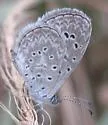
When alive the eyes of Zizula are gray. They are black in our other Blues (except for Brephidium ), as well as in most other Lycaenidae. Holds antennae with ends curved down (most Blues hold them approximately straight or even slightly upturned near the tip). Hemiargus (Echinargus) isola is similar below, but black spots making up the arc are more cicular (crescent-shaped on Cyna). Cyna Blue does not have conspicuous large dark spots at lower border of hind wing (present in H. isola ), and has a dark bar (usually split into two spots) across the middle of the discal cell on the lower front wing (absent in H. isola ). Celastrina species may look similar, but average larger in size, have forwings less rounded, and have spots in postmedian row usually narrower and less bold. Celastrina species lack the mark in the middle of the discal cell on the lower front wing. Not likely to be found in same areas, but possible. Males are among our smallest Butterflies. The smaller butterflies of Brephidium (with perhaps congeneric Oraidium in Africa), are apparently very closely related to Zizula , even though the color pattern is quite different. They share the character (rare in North American Blues) of having non-black (gray) eyes while living.
Classification
- Kingdom
- Animalia
- Phylum
- Arthropoda
- Class
- Insecta
- Order
- Lepidoptera (Butterflies and Moths)
- Superfamily
- Papilionoidea
- Family
- Lycaenidae (Blues, Coppers, Hairstreaks, Harvesters)
- Subfamily
- Polyommatinae
- Genus
- Zizula
Imported taxonomy record. Source availability varies; see the source references and editorial policy below.
Habitat and Range
Geographic Range
s. TX to Argentina. Also strays from AZ to n. TX, CO - Map (MPG)
Seasonal Activity
records for most months in Texas (MPG)
Diet and Behavior
Diet: Larvae on flower buds of Acanthaceae. Recorded as ovipositing on Dyschoriste linearis (Acanthaceae) in Arizona [Jim Brock]. Adults nectar at flowers and visit mud and puddles.
Life History
Caterpillars feed on flower buds of Acanthaceae
About Butterflies and Moths: the wider group
Order-level background for Lepidoptera, the group containing Zizula cyna. Species-specific details appear above.
Group overview
Lepidoptera includes approximately 180,000 described species of butterflies and moths. Moths outnumber butterflies roughly 10:1. The monarch butterfly's eastern population has declined by more than 80% since the mid-1990s, and the western population by over 95% since the 1980s. The IUCN lists the migratory monarch as Vulnerable.
Ecological role of the group
Butterflies and moths are essential indicators of ecosystem health. As caterpillars, they are a primary food source for birds - a single nest of blue tit chicks requires ~10,000 caterpillars. Adult moths pollinate many night-blooming plants.
Economic and practical significance of the group
Lepidoptera are critical pollinators. In Europe, grassland butterfly species have declined by almost 50% since the early 1990s. In the UK, three-quarters of butterflies are in decline. In the U.S., five butterfly species have gone extinct since 1950, with 29 listed as endangered.
Recorded sources for this group: IUCN Red List, Xerces Society, USFWS, PNAS, WWF. Imported estimates may describe particular regions or reporting periods.
Photos of Cyna Blue - Hodges#4355 (5)
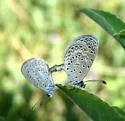
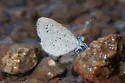
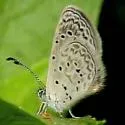
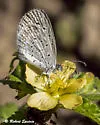
Photo credits: Contributed by Joshua Stuart Rose; Additional contributions by Mike Quinn , David Ferguson
Frequently Asked Questions About Cyna Blue - Hodges#4355
What is Cyna Blue - Hodges#4355?
Cyna Blue - Hodges#4355 (Zizula cyna) is a species in the family Lycaenidae, within the order Lepidoptera.
How do you identify Cyna Blue - Hodges#4355?
When alive the eyes of Zizula are gray. They are black in our other Blues (except for Brephidium ), as well as in most other Lycaenidae. Holds antennae with ends curved down (most Blues hold them approximately straight or even slightly upturned near the tip). Hemiargus (Echinargus) isola is similar below, but black spots making up the arc are more cicular (crescent-shaped on Cyna). Cyna Blue does not have conspicuous large dark spots at lower border of hind wing (present in H. isola ), and has a dark bar (usually split into two spots) across the middle of the discal cell on the lower front wing (absent in H. isola ). Celastrina species may look similar, but average larger in size, have forwings less rounded, and have spots in postmedian row usually narrower and less bold. Celastrina species lack the mark in the middle of the discal cell on the lower front wing. Not likely to be found in same areas, but possible.
Where is Cyna Blue - Hodges#4355 found?
Range: s. TX to Argentina. Also strays from AZ to n. TX, CO - Map (MPG)
What does Cyna Blue - Hodges#4355 eat?
The diet of the Cyna Blue - Hodges#4355 includes Larvae on flower buds of Acanthaceae. Recorded as ovipositing on Dyschoriste linearis (Acanthaceae) in Arizona [Jim Brock]. Adults nectar at flowers and visit mud and puddles..
When is Cyna Blue - Hodges#4355 active?
Cyna Blue - Hodges#4355: seasonal activity - records for most months in Texas (MPG).
What is the life cycle of a Cyna Blue - Hodges#4355?
Caterpillars feed on flower buds of Acanthaceae