
Brown Argus
Aricia agestis
This record describes Aricia agestis (species). Recorded family: Lycaenidae. Recorded order: Lepidoptera.
Identification and Appearance
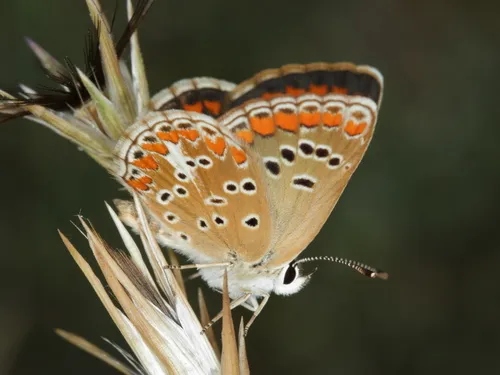
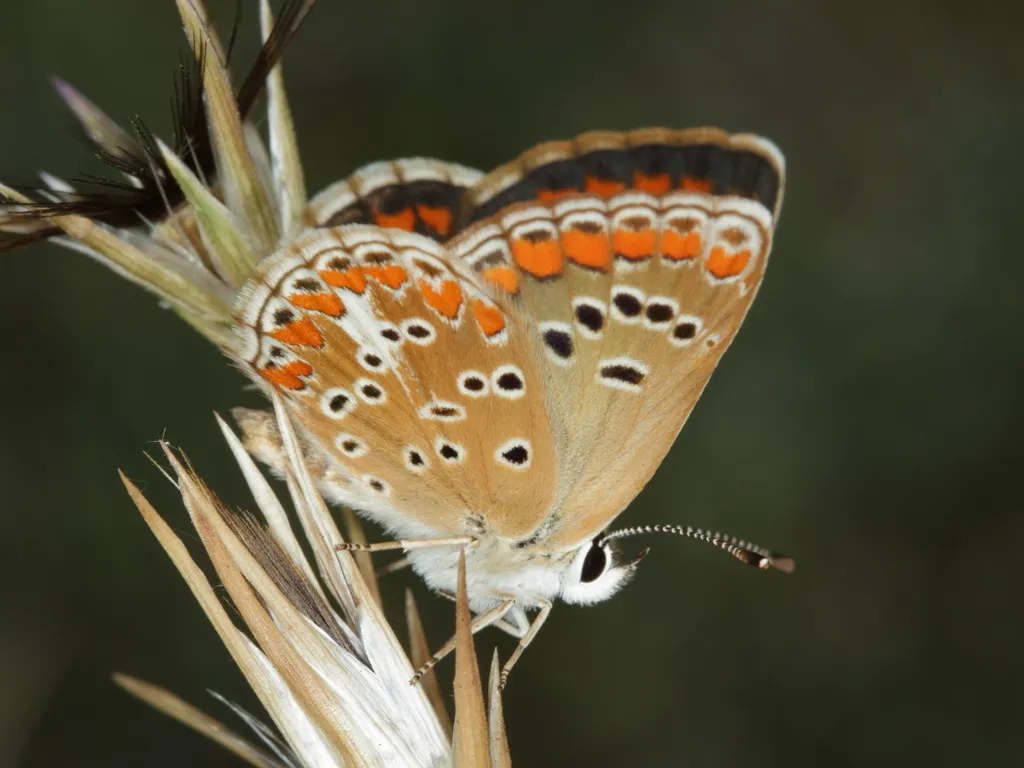
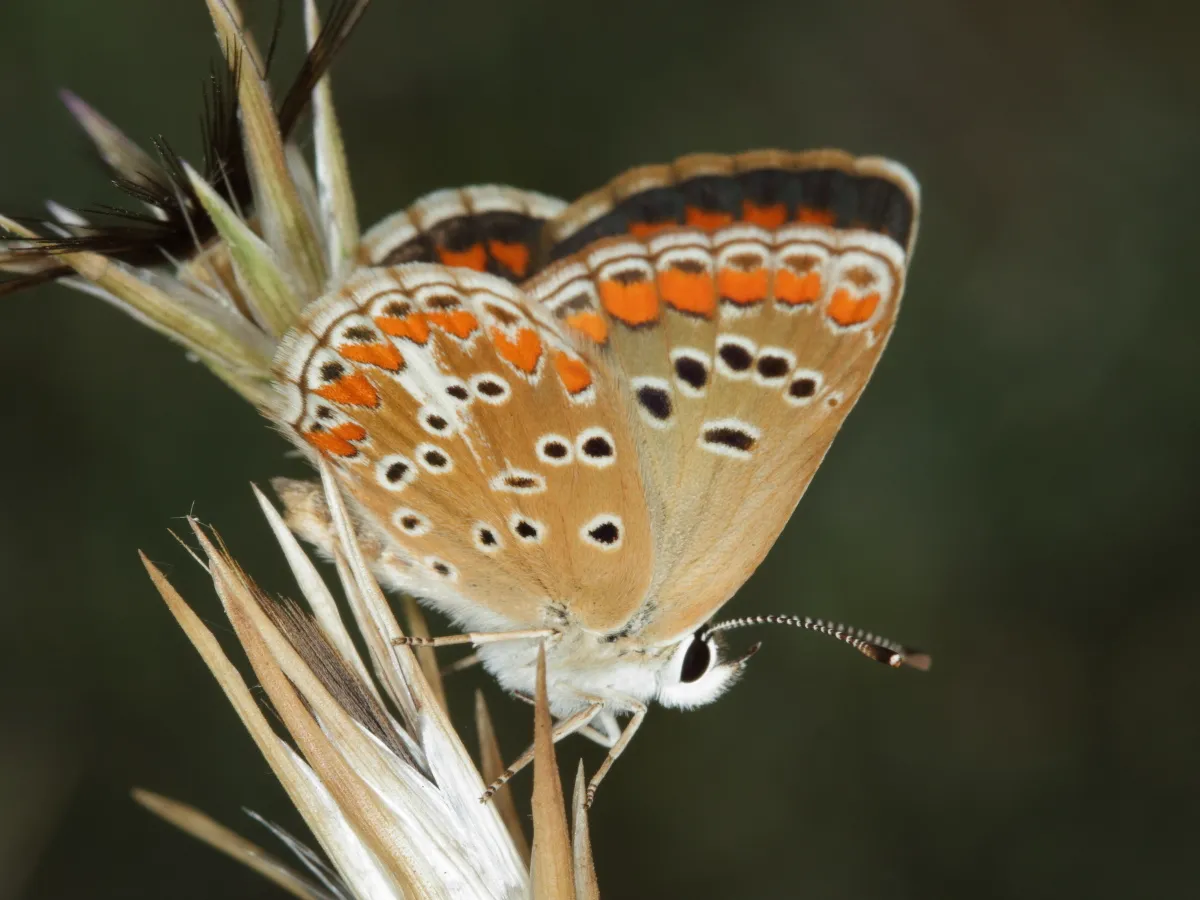
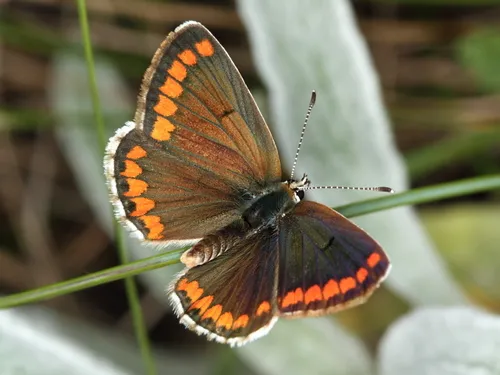
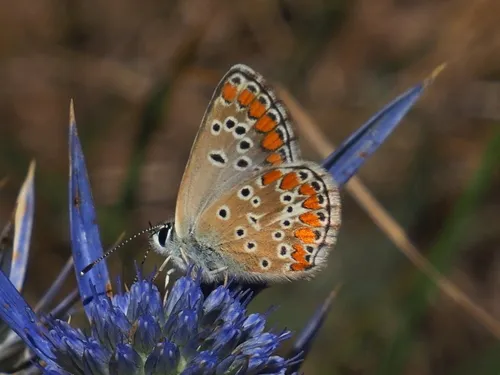
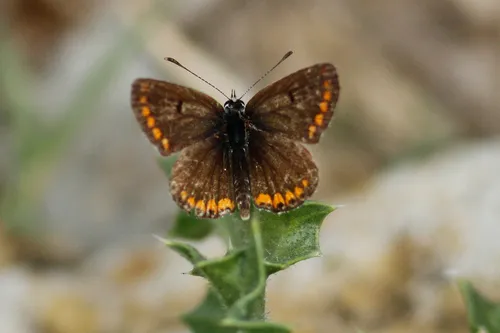
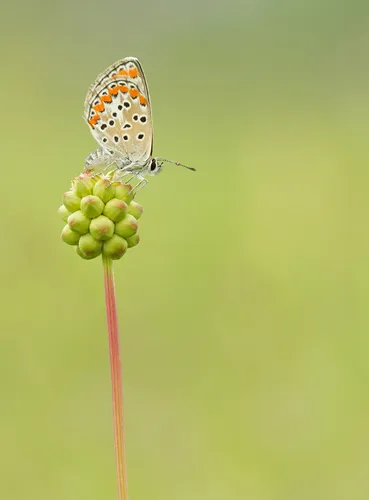
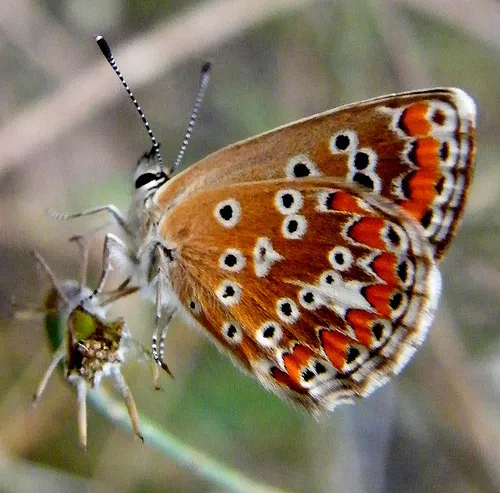
Unlike most other 'blues', the Brown Argus has no blue scales on its upper side, both sexes being primarily brown in colour as its common name suggests, although the butterfly does exhibit a blue sheen when at certain angles to the light. On the underside of the forewing, there are no black spots closer to the base than the central spot (unlike Common Blue). Also, on the underside of the hindwing, the arc of black spots is not smooth, the 2nd spot from the leading edge being closer to the body such that the 1st and 2nd spots look like a colon mark (:). The female Common Blue can be confused with the Brown Argus. However Brown Argus has no blue on its wings (though may have ahint on the body) and has a border of clear orange spots across both wings (in the female Small Blue these are less promounced or even partly missing). If the underwing is visible they can still be separated by the pattern of spots. The Brown Argus has two spots on the rear wing that are close together almost forming a figure of 8. These spots are more widely spaced on the Common Blue. Colonies are typically found on chalk or limestone downland where the food plant is abundant. However, this species can also be found on heathland and in open woodland. This species generally has two broods a year in central and southern England, with only a partial second brood in North Wales and the north of England. In good years, a partial 3rd generation may appear in the south. The adults emerge first in central and southern England in early May, peaking at the end of May and beginning of June, and giving rise to a second brood that emerges at the end of July. In North Wales and northern England, the first emergence starts in early June with any second brood appearing in early August. This species occurs in small, compact colonies, and is not a great wanderer, only travelling a couple of hundred metres, at most, from where it emerged. The main larval foodplant is Common Rock-rose ( Helianthemum nummularium ). Common Stork's-bill ( Erodium cicutarium ) and Dove's-foot Crane's-bill ( Geranium molle ) are also used. Found mainly in southern England, north eastern England and in some parts of Wales.
Wikipedia reference for Aricia agestis: https://en.wikipedia.org/wiki/Aricia agestis.
Classification
- Kingdom
- Animalia
- Phylum
- Arthropoda
- Class
- Insecta
- Order
- Lepidoptera (Butterflies and Moths)
- Superfamily
- Papilionoidea
- Family
- Lycaenidae (Gossamer-winged Butterflies)
- Subfamily
- Polyommatinae
- Tribe
- Polyommatini
- Genus
- Aricia
Imported taxonomy record. Source availability varies; see the source references and editorial policy below.
Habitat and Range
Habitat
Colonies are typically found on chalk or limestone downland where the food plant is abundant. However, this species can also be found on heathland and in open woodland.
Diet and Behavior
Life History
This species occurs in small, compact colonies, and is not a great wanderer, only travelling a couple of hundred metres, at most, from where it emerged. The main larval foodplant is Common Rock-rose (
Additional species information
Recorded status
Found mainly in southern England, north eastern England and in some parts of Wales.
About Butterflies and Moths: the wider group
Order-level background for Lepidoptera, the group containing Aricia agestis. Species-specific details appear above.
Group overview
Lepidoptera includes approximately 180,000 described species of butterflies and moths. Moths outnumber butterflies roughly 10:1. The monarch butterfly's eastern population has declined by more than 80% since the mid-1990s, and the western population by over 95% since the 1980s. The IUCN lists the migratory monarch as Vulnerable.
Ecological role of the group
Butterflies and moths are essential indicators of ecosystem health. As caterpillars, they are a primary food source for birds - a single nest of blue tit chicks requires ~10,000 caterpillars. Adult moths pollinate many night-blooming plants.
Economic and practical significance of the group
Lepidoptera are critical pollinators. In Europe, grassland butterfly species have declined by almost 50% since the early 1990s. In the UK, three-quarters of butterflies are in decline. In the U.S., five butterfly species have gone extinct since 1950, with 29 listed as endangered.
Recorded sources for this group: IUCN Red List, Xerces Society, USFWS, PNAS, WWF. Imported estimates may describe particular regions or reporting periods.
Photos of Brown Argus (8)
Frequently Asked Questions About Brown Argus
What is Brown Argus?
Brown Argus (Aricia agestis) is a species in the family Lycaenidae, within the order Lepidoptera.
Where is Brown Argus found?
Habitat: Colonies are typically found on chalk or limestone downland where the food plant is abundant. However, this species can also be found on heathland and in open woodland.
What is the life cycle of a Brown Argus?
This species occurs in small, compact colonies, and is not a great wanderer, only travelling a couple of hundred metres, at most, from where it emerged. The main larval foodplant is Common Rock-rose (