
Wyeomyia mitchellii
This record describes Wyeomyia mitchellii (species). Recorded family: Culicidae. Recorded order: Diptera.
Identification and Appearance
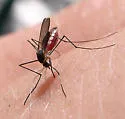
Adult: wings, legs, proboscis, and palps dark; palps very short; hindlegs held high over body and curving forward over head as though mimicking antennae; abdomen dark above, light below, with sharp dividing line along the side; tarsi of middle leg pale-scaled, contrasting with dark remainder of leg dark purplish or black scales on antepronotum (anterior edge of pronotum), and pale scales on vertex (top of head) are distinguishing features Larva: siphon short with many single hairs; saddle with tuft of short hairs, plus pair of long hairs and shorter wider gills than W. vanduzeei pupa lacks pigmented areas on second and third abdominal segments [circular pigmented areas are present in vanduzeei pupae]
Classification
Habitat and Range
Habitat
Larvae develop only in water-holding leaf axils (tanks) of bromeliads, which grow as epiphytes on trees. Adults are found near the host plants.
Geographic Range
North American range restricted to Florida - southern half plus a small area near the Georgia border (see distribution map at Walter Reed Biosystematics Unit)
Diet and Behavior
Diet: Larvae filter small particles of organic matter, mostly at the water surface in bromeliad tanks. Adult females feed until late afternoon but not after dark, taking blood meals from warm-blooded animals, including humans.
Life History
Multiple generations per year. Females deposit eggs on water surface or above waterline on leaves of bromeliads. Adult lifespan is about 3 weeks.
About Flies: the wider group
Order-level background for Diptera, the group containing Wyeomyia mitchellii. Species-specific details appear above.
Group overview
Diptera includes over 150,000 described species of flies, mosquitoes, and midges. Mosquitoes are the deadliest animal on Earth (CDC). Malaria alone causes ~249 million cases and over 608,000 deaths annually, mostly children under 5 (WHO). Vector-borne diseases account for over 17% of all infectious diseases, causing 700,000+ deaths per year.
Ecological role of the group
Despite their disease impact, flies are critical decomposers and pollinators. Hoverflies alone pollinate hundreds of crop and wildflower species. Flies are also the primary food source for many birds, bats, and fish. Forensic entomology relies heavily on fly species for crime scene analysis.
Economic and practical significance of the group
In the U.S., vector-borne disease cases tripled between 2004-2016, with over 640,000 cases reported in that period (CDC). Tickborne diseases doubled from 22,000 to 48,000 annual reports. Globally, mosquito-borne diseases cost billions in healthcare and lost productivity.
Recorded sources for this group: WHO, CDC, PNAS. Imported estimates may describe particular regions or reporting periods.
Photos of Wyeomyia mitchellii (5)
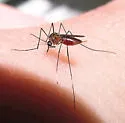
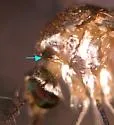
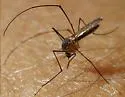
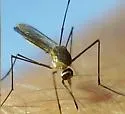
Photo credits: Contributed by Robin McLeod
Frequently Asked Questions About Wyeomyia mitchellii
What is Wyeomyia mitchellii?
Wyeomyia mitchellii is a species in the family Culicidae, within the order Diptera.
How big is Wyeomyia mitchellii?
adult body length 3-4 mm
How do you identify Wyeomyia mitchellii?
Adult: wings, legs, proboscis, and palps dark; palps very short; hindlegs held high over body and curving forward over head as though mimicking antennae; abdomen dark above, light below, with sharp dividing line along the side; tarsi of middle leg pale-scaled, contrasting with dark remainder of leg dark purplish or black scales on antepronotum (anterior edge of pronotum), and pale scales on vertex (top of head) are distinguishing features Larva: siphon short with many single hairs; saddle with tuft of short hairs, plus pair of long hairs and shorter wider gills than W. vanduzeei pupa lacks pigmented areas on second and third abdominal segments [circular pigmented areas are present in vanduzeei pupae]
Where is Wyeomyia mitchellii found?
| Feature | Details |
|---|---|
| Habitat | Larvae develop only in water-holding leaf axils (tanks) of bromeliads, which grow as epiphytes on trees. Adults are found near the host plants. |
| Range | North American range restricted to Florida - southern half plus a small area near the Georgia border (see distribution map at Walter Reed Biosystematics Unit) |
What does Wyeomyia mitchellii eat?
The diet of the Wyeomyia mitchellii includes Larvae filter small particles of organic matter, mostly at the water surface in bromeliad tanks. Adult females feed until late afternoon but not after dark, taking blood meals from warm-blooded animals, including humans..
What is the life cycle of a Wyeomyia mitchellii?
Multiple generations per year. Females deposit eggs on water surface or above waterline on leaves of bromeliads. Adult lifespan is about 3 weeks.