
Tabanus fuscopunctatus
This record describes Tabanus fuscopunctatus (species). Recorded family: Tabanidae. Recorded order: Diptera.
Identification and Appearance
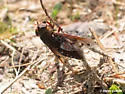
| Feature | Details |
|---|---|
| Head | Frons parallel sided, about 3x as high as width at base; large triangular shiny patch at vertex; median callus shiny, relatively long; basal callus shiny brown, higher than wide and not touching eyes. Antennae: uniformly orange brown,basal portion of 3rd segment with prominent forward-projecting dorsal process. Palps: orange brown, of moderate length and evenly tapered. |
| Thorax | dark reddish brown. Wings: basal part of wing and costal cell heavily tinted, cross veins and furcation infuscated. |
| Legs | orange brown to dark reddish brown. |
| Abdomen | dark reddish brown with a median row of small white triangles, largest on 2nd segment Part of a complex consisting of Tabanus imitans , Tabanus fuscopunctatus fuscopunctatus , and Tabanus fuscopunctatus pechumani . T. imitans ranges from Texas to New Jersey and Florida; T. f. fuscopunctatus ranges from South Carolina to Florida, and T. f. pechumani ranges from North Carolina to Florida. Unclear to me how 2 ssp. can co-exist (in SC GA and FL) and yet remain distinct. |
Classification
Habitat and Range
Geographic Range
North Carolina to Florida
Seasonal Activity
seems to be an early-season species, March-June; but confusion with other species may affect its apparent flight period.
Additional species information
Species notes from the sources
Etymology: Tabanus fuscopunctatus Macquart 1850
About Flies: the wider group
Order-level background for Diptera, the group containing Tabanus fuscopunctatus. Species-specific details appear above.
Group overview
Diptera includes over 150,000 described species of flies, mosquitoes, and midges. Mosquitoes are the deadliest animal on Earth (CDC). Malaria alone causes ~249 million cases and over 608,000 deaths annually, mostly children under 5 (WHO). Vector-borne diseases account for over 17% of all infectious diseases, causing 700,000+ deaths per year.
Ecological role of the group
Despite their disease impact, flies are critical decomposers and pollinators. Hoverflies alone pollinate hundreds of crop and wildflower species. Flies are also the primary food source for many birds, bats, and fish. Forensic entomology relies heavily on fly species for crime scene analysis.
Economic and practical significance of the group
In the U.S., vector-borne disease cases tripled between 2004-2016, with over 640,000 cases reported in that period (CDC). Tickborne diseases doubled from 22,000 to 48,000 annual reports. Globally, mosquito-borne diseases cost billions in healthcare and lost productivity.
Recorded sources for this group: WHO, CDC, PNAS. Imported estimates may describe particular regions or reporting periods.
Photos of Tabanus fuscopunctatus (3)
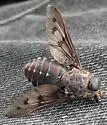
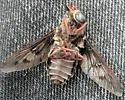
Photo credits: Contributed by Tony; Additional contributions by v belov
Frequently Asked Questions About Tabanus fuscopunctatus
What is Tabanus fuscopunctatus?
Tabanus fuscopunctatus is a species in the family Tabanidae, within the order Diptera.
How big is Tabanus fuscopunctatus?
20-24 mm
How do you identify Tabanus fuscopunctatus?
| Feature | Details |
|---|---|
| Head | Frons parallel sided, about 3x as high as width at base; large triangular shiny patch at vertex; median callus shiny, relatively long; basal callus shiny brown, higher than wide and not touching eyes. Antennae: uniformly orange brown,basal portion of 3rd segment with prominent forward-projecting dorsal process. Palps: orange brown, of moderate length and evenly tapered. |
| Thorax | dark reddish brown. Wings: basal part of wing and costal cell heavily tinted, cross veins and furcation infuscated. |
| Legs | orange brown to dark reddish brown. |
| Abdomen | dark reddish brown with a median row of small white triangles, largest on 2nd segment |
Where is Tabanus fuscopunctatus found?
Range: North Carolina to Florida
When is Tabanus fuscopunctatus active?
Tabanus fuscopunctatus: seasonal activity - seems to be an early-season species, March-June; but confusion with other species may affect its apparent flight period..