
Tabanus abdominalis
This record describes Tabanus abdominalis (species). Recorded family: Tabanidae. Recorded order: Diptera.
Identification and Appearance
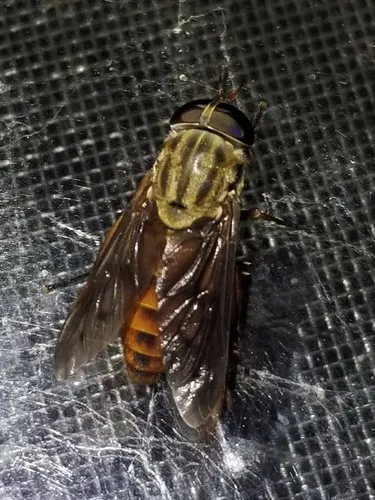
Specimens of T. abdominalis have proved difficult to identify due mainly to the variation between individuals and the similarity to other variable species, particularly T. limbatinevris and T. sulcifrons but including T. gladiator and T. nefarius . Osten Sacken (1876) was aware of the difficulty of delimiting the variation of T. abdominalis . He described the species from 3 females which I take to be nearest to the original type of Fabricius's description. He then described different forms from 14 females which may be either mere varieties or distinct species. However, in 1878, Osten Sacken re-described T. abdominalis from 19 females from Kentucky and Georgia, stating that As my description of T. abdominalis was principally based on a small and very abnormally colored specimen, I prefer to give a description of both species. The 2nd species he refers to was thought by him to be Tabanus sulcifrons . Pechuman et al (1983) believe Osten Sacken's earlier (1876) description was actually based on a specimen of T. limbatinevris and not T. sulcifrons . Jumping ahead to 1990, Hoppe et al. (1990) proved the distinctiveness of T. abdominalis, T. limbatinervis , and T. sulcifrons based on an analysis of cuticular hydrocarbons (Internet ref below). At the present time it is probably impossible to separate these 3 species based solely on photographs. Museum specimens stand a good chance of being identified based on measurements of the ratio of length of the frons divided by its length, the condition of the 5th posterior cell in the wing, and the length:width ratio of the palps (Pechuman et al. 1983).
Classification
Additional species information
Species notes from the sources
Etymology: Tabanus abdominalis Fabricius 1805
About Flies: the wider group
Order-level background for Diptera, the group containing Tabanus abdominalis. Species-specific details appear above.
Group overview
Diptera includes over 150,000 described species of flies, mosquitoes, and midges. Mosquitoes are the deadliest animal on Earth (CDC). Malaria alone causes ~249 million cases and over 608,000 deaths annually, mostly children under 5 (WHO). Vector-borne diseases account for over 17% of all infectious diseases, causing 700,000+ deaths per year.
Ecological role of the group
Despite their disease impact, flies are critical decomposers and pollinators. Hoverflies alone pollinate hundreds of crop and wildflower species. Flies are also the primary food source for many birds, bats, and fish. Forensic entomology relies heavily on fly species for crime scene analysis.
Economic and practical significance of the group
In the U.S., vector-borne disease cases tripled between 2004-2016, with over 640,000 cases reported in that period (CDC). Tickborne diseases doubled from 22,000 to 48,000 annual reports. Globally, mosquito-borne diseases cost billions in healthcare and lost productivity.
Recorded sources for this group: WHO, CDC, PNAS. Imported estimates may describe particular regions or reporting periods.
Photos of Tabanus abdominalis (2)
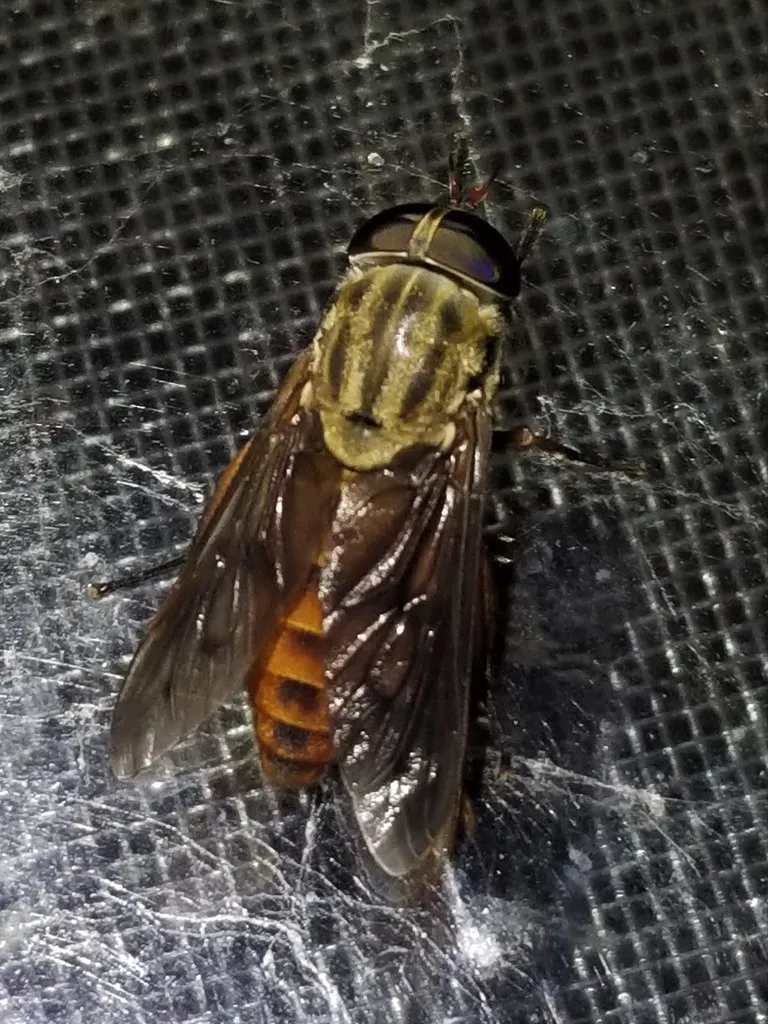
Photo credits: Contributed by Tony; Additional contributions by Chuck Entz , v belov