
Stamnodes deceptiva - Hodges#7355
Stamnodes deceptiva
This record describes Stamnodes deceptiva (species). Recorded family: Geometridae. Recorded order: Lepidoptera.
Identification and Appearance
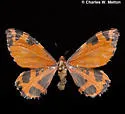
Very closely similar to S. fervefactaria , but usually found at lower elevations and apparently not ranging so far northward nor eastward. Averaging smaller in size. Light coloring variable in hue, but most commonly prevalently orange, and often distinctly pinkish (especially below). Pattern variable, but front wing with light markings near apex normally forming roughly a V shape, with arms separated to near a very wide base and without a distinct trunk below the diverging arms; with outer arm much the narrower and usually distinctly irregular along outer margin, but rarely (if ever?) absent; costa at base of wing gray. Hind wing with large dark zone near costa on outer half of wing smaller, vertically narrower than tall (crossing axis of wing). Specimens from central Texas are much like both S. deceptiva & S. fervefactaria , but seem to represent a distinct taxon from both. [ note by D.J. Ferguson ] As of October 14, 2012, Bold Systems samples under the name of Stamnodes fervefactaria are a mix of two or perhaps three species. Those from Arizona (Cochise & Santa Cruz Counties), and the one labeled as JLB-0127 & JLB-0273, are S. deceptiva ; those from Colorado (El Paso County) are S. fervefactaria ; while those from Sonora are most like S. fervefactaria , but have a distinct wing shape with slightly different pattern, and may represent a third species, or perhaps a subspecies. The same specimens are referenced here These are all clearly very closely related, and DNA samples will likely be very similar, and perhaps not separable by barcode methods. Specimens images duplicated under both the names S. fervifactaria and S. deceptiva at 'Moth Photographer's Group are by wing pattern characters referable to S. deceptiva .
Classification
- Kingdom
- Animalia
- Phylum
- Arthropoda
- Class
- Insecta
- Order
- Lepidoptera (Butterflies and Moths)
- Superfamily
- Geometroidea
- Family
- Geometridae (Geometrid Moths)
- Subfamily
- Larentiinae
- Tribe
- Stamnodini
- Genus
- Stamnodes
Imported taxonomy record. Source availability varies; see the source references and editorial policy below.
Habitat and Range
Geographic Range
northward from Mexico into southern New Mexico and Arizona.
Seasonal Activity
adults in summer, records from June thru August
About Butterflies and Moths: the wider group
Order-level background for Lepidoptera, the group containing Stamnodes deceptiva. Species-specific details appear above.
Group overview
Lepidoptera includes approximately 180,000 described species of butterflies and moths. Moths outnumber butterflies roughly 10:1. The monarch butterfly's eastern population has declined by more than 80% since the mid-1990s, and the western population by over 95% since the 1980s. The IUCN lists the migratory monarch as Vulnerable.
Ecological role of the group
Butterflies and moths are essential indicators of ecosystem health. As caterpillars, they are a primary food source for birds - a single nest of blue tit chicks requires ~10,000 caterpillars. Adult moths pollinate many night-blooming plants.
Economic and practical significance of the group
Lepidoptera are critical pollinators. In Europe, grassland butterfly species have declined by almost 50% since the early 1990s. In the UK, three-quarters of butterflies are in decline. In the U.S., five butterfly species have gone extinct since 1950, with 29 listed as endangered.
Recorded sources for this group: IUCN Red List, Xerces Society, USFWS, PNAS, WWF. Imported estimates may describe particular regions or reporting periods.
Photos of Stamnodes deceptiva - Hodges#7355 (5)
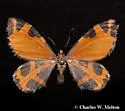
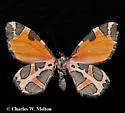
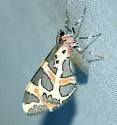
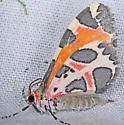
Photo credits: Contributed by David J. Ferguson
Frequently Asked Questions About Stamnodes deceptiva - Hodges#7355
What is Stamnodes deceptiva - Hodges#7355?
Stamnodes deceptiva - Hodges#7355 (Stamnodes deceptiva) is a species in the family Geometridae, within the order Lepidoptera.
How do you identify Stamnodes deceptiva - Hodges#7355?
Very closely similar to S. fervefactaria , but usually found at lower elevations and apparently not ranging so far northward nor eastward. Averaging smaller in size. Light coloring variable in hue, but most commonly prevalently orange, and often distinctly pinkish (especially below). Pattern variable, but front wing with light markings near apex normally forming roughly a V shape, with arms separated to near a very wide base and without a distinct trunk below the diverging arms; with outer arm much the narrower and usually distinctly irregular along outer margin, but rarely (if ever?) absent; costa at base of wing gray. Hind wing with large dark zone near costa on outer half of wing smaller, vertically narrower than tall (crossing axis of wing).
Where is Stamnodes deceptiva - Hodges#7355 found?
Range: northward from Mexico into southern New Mexico and Arizona.
When is Stamnodes deceptiva - Hodges#7355 active?
Stamnodes deceptiva - Hodges#7355: seasonal activity - adults in summer, records from June thru August.