
Spined Mason Bee
Osmia spinulosa
This record describes Osmia spinulosa (species). Recorded family: Megachilidae. Recorded order: Hymenoptera.
Identification and Appearance
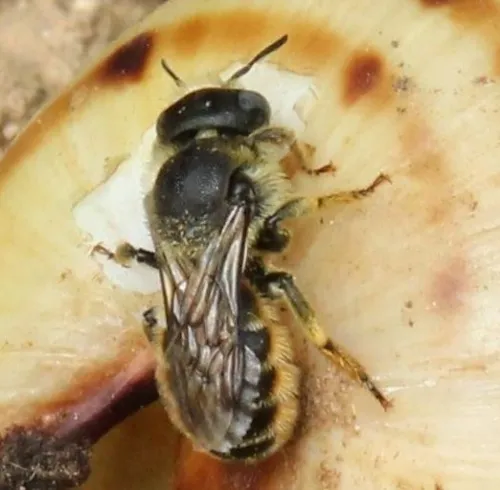
The taxonomy of Osmia spinulosa has been the subject of considerable debate. Recent genetic work carried out in Switzerland by Mueller, shows that this taxon should correctly be placed within the genus Osmia rather than left within Hoplitis . Records should include a photo, or set of photos, showing the key characters. We will accept records identified by a recognised local or national expert, or that have been identified via the BWARS’ Facebook group noting the name of the person/organisation identifying the record (e.g. ‘Stuart Roberts, BWARS Facebook’). It is found in a range of open neutral or calcareous grassland habitats, provided that there are plenty of Asteraceae flowering and a degree of litter build-up around tussocks. This is where the snails, whose shells provide the nest site, live out their lives. Hay-cut and hard-grazed grasslands are not suitable for this bee. Nests are made within medium sized old snail shells, such as those of Cepea nemoralis. The cells are made within the spiral from chewed plant material. Widespread mainly south of a line from The Wash through to South Wales, although not always frequently found even in these areas. No additional images available for this species.
Classification
- Kingdom
- Animalia
- Phylum
- Arthropoda
- Class
- Insecta
- Order
- Hymenoptera
- Family
- Megachilidae
- Genus
- Osmia
Imported taxonomy record. Source availability varies; see the source references and editorial policy below.
Habitat and Range
Habitat
It is found in a range of open neutral or calcareous grassland habitats, provided that there are plenty of Asteraceae flowering and a degree of litter build-up around tussocks. This is where the snails, whose shells provide the nest site, live out their lives. Hay-cut and hard-grazed grasslands are not suitable for this bee.
Seasonal Activity
From mid May to late September.
Diet and Behavior
Life History
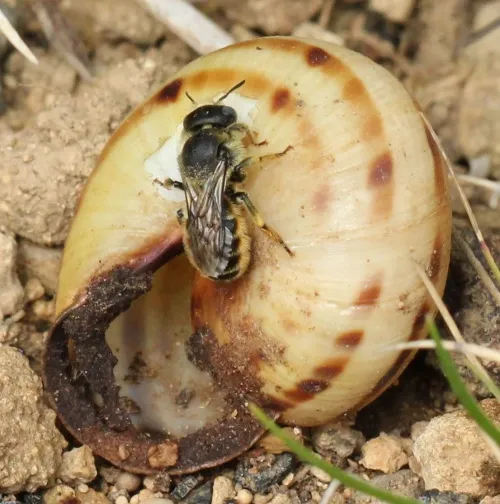
Nests are made within medium sized old snail shells, such as those of Cepea nemoralis. The cells are made within the spiral from chewed plant material.
Additional species information
Recorded status
Widespread mainly south of a line from The Wash through to South Wales, although not always frequently found even in these areas.
About Flies: the wider group
Order-level background for Hymenoptera, the group containing Osmia spinulosa. Species-specific details appear above.
Group overview
Hymenoptera includes over 150,000 described species of ants, bees, wasps, and sawflies. Earth harbors approximately 20 quadrillion (20×10^15) ants, with a combined biomass of ~12 megatons of dry carbon - exceeding the combined biomass of all wild birds and mammals (PNAS, 2022).
Ecological role of the group
About 35% of the world's food crops depend on animal pollinators. The chocolate industry, valued at over $100 billion, depends on pollinating flies and midges. Ants are the dominant soil engineers in most terrestrial ecosystems, turning more soil than earthworms in many habitats.
Economic and practical significance of the group
Pollinators contribute $235-577 billion worth of annual global food production (FAO). In the U.S., bee pollination alone benefits crops valued at $18 billion annually, and honey bees are responsible for $5.4 billion in agricultural productivity. Between April 2023-2024, 55.1% of managed honey bee colonies were lost. The U.S. bee population dropped from 5 million to 2.5 million.
Recorded sources for this group: FAO, USDA, EPA, PNAS (2022), US Fish & Wildlife Service. Imported estimates may describe particular regions or reporting periods.
Photos of Spined Mason Bee (2)
Frequently Asked Questions About Spined Mason Bee
What is Spined Mason Bee?
Spined Mason Bee (Osmia spinulosa) is a species in the family Megachilidae, within the order Hymenoptera.
Where is Spined Mason Bee found?
Habitat: It is found in a range of open neutral or calcareous grassland habitats, provided that there are plenty of Asteraceae flowering and a degree of litter build-up around tussocks. This is where the snails, whose shells provide the nest site, live out their lives. Hay-cut and hard-grazed grasslands are not suitable for this bee.
When is Spined Mason Bee active?
Spined Mason Bee: seasonal activity - From mid May to late September..
What is the life cycle of a Spined Mason Bee?
Nests are made within medium sized old snail shells, such as those of Cepea nemoralis. The cells are made within the spiral from chewed plant material.