
Red Mason Bee
Osmia bicornis
This record describes Osmia bicornis (species). Recorded family: Megachilidae. Recorded order: Hymenoptera.
Identification and Appearance
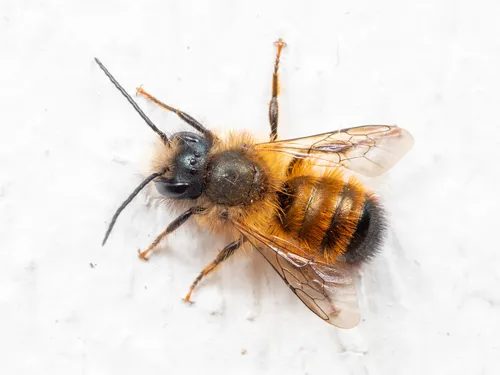
Greyish-brown hair on the thorax and orange-red on the abdomen. The head features two inwardly-curved facial horns below the antennae. The only other British Osmia species with this feature is O. cornuta, which resembles a large black and bright orange version of bicornis. Males resemble females but are smaller and less robust with much longer antennae. The males are smaller than the females (6mm versus 11mm). Detailed photos show key identification features required. In a variety of habitats, often in parks and gardens, likes bee hotels. Important pollinators of fruit trees. The Red Mason Bee is active from early spring, the males being first to appear when the weather becomes mild in March, the female emerging later. Adults fly from March until July. It is a solitary bee, each nest being the work of a single female bee working alone. They nest in pre-existing cavities such as hollow plant stems, old garden canes, air bricks, and even old nail holes in fence posts, lining the inside of the cavity with mud. Widespread and fairly frequent in England and Wales, less records from further north. https://www.flickr.com/photos/63075200@N07/albums/72157633278113867/
Wikipedia reference for Osmia bicornis: https://en.wikipedia.org/wiki/Osmia_bicornis.
Classification
- Kingdom
- Animalia
- Phylum
- Arthropoda
- Class
- Insecta
- Order
- Hymenoptera
- Family
- Megachilidae
- Genus
- Osmia
Imported taxonomy record. Source availability varies; see the source references and editorial policy below.
Habitat and Range
Habitat
In a variety of habitats, often in parks and gardens, likes bee hotels. Important pollinators of fruit trees.
Seasonal Activity
The Red Mason Bee is active from early spring, the males being first to appear when the weather becomes mild in March, the female emerging later. Adults fly from March until July.
Diet and Behavior
Life History
It is a solitary bee, each nest being the work of a single female bee working alone. They nest in pre-existing cavities such as hollow plant stems, old garden canes, air bricks, and even old nail holes in fence posts, lining the inside of the cavity with mud.
Additional species information
Recorded status
Widespread and fairly frequent in England and Wales, less records from further north.
About Flies: the wider group
Order-level background for Hymenoptera, the group containing Osmia bicornis. Species-specific details appear above.
Group overview
Hymenoptera includes over 150,000 described species of ants, bees, wasps, and sawflies. Earth harbors approximately 20 quadrillion (20×10^15) ants, with a combined biomass of ~12 megatons of dry carbon - exceeding the combined biomass of all wild birds and mammals (PNAS, 2022).
Ecological role of the group
About 35% of the world's food crops depend on animal pollinators. The chocolate industry, valued at over $100 billion, depends on pollinating flies and midges. Ants are the dominant soil engineers in most terrestrial ecosystems, turning more soil than earthworms in many habitats.
Economic and practical significance of the group
Pollinators contribute $235-577 billion worth of annual global food production (FAO). In the U.S., bee pollination alone benefits crops valued at $18 billion annually, and honey bees are responsible for $5.4 billion in agricultural productivity. Between April 2023-2024, 55.1% of managed honey bee colonies were lost. The U.S. bee population dropped from 5 million to 2.5 million.
Recorded sources for this group: FAO, USDA, EPA, PNAS (2022), US Fish & Wildlife Service. Imported estimates may describe particular regions or reporting periods.
Frequently Asked Questions About Red Mason Bee
What is Red Mason Bee?
Red Mason Bee (Osmia bicornis) is a species in the family Megachilidae, within the order Hymenoptera.
Where is Red Mason Bee found?
Habitat: In a variety of habitats, often in parks and gardens, likes bee hotels. Important pollinators of fruit trees.
When is Red Mason Bee active?
Red Mason Bee: seasonal activity - The Red Mason Bee is active from early spring, the males being first to appear when the weather becomes mild in March, the female emerging later. Adults fly from March until July..
What is the life cycle of a Red Mason Bee?
It is a solitary bee, each nest being the work of a single female bee working alone. They nest in pre-existing cavities such as hollow plant stems, old garden canes, air bricks, and even old nail holes in fence posts, lining the inside of the cavity with mud.