
Horse Lubber
Romalea eques
This record describes Romalea eques (species). Recorded family: Romaleidae. Recorded order: Orthoptera.
Identification and Appearance
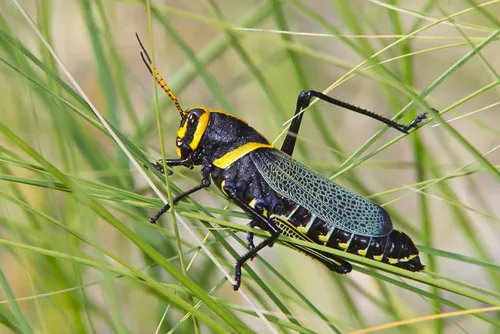
| Feature | Description |
|---|---|
| Additional details | Large and shiny, mostly black. Tegmina (front wings) with yellow veins and with variable contrasting yellow to orange stripes on body, legs and head. Face sometimes mostly yellow or orange. |
| Antennae | Antennae yellow to red-orange with black rings and tip (sometimes mostly black). |
| Hindwings | Hindwings red with black borders. There are pale-colored forms (greenish, yellowish, or even somewhat orangey) that in extreme development have black color reduced to markings on an overall lighter background, but the body shape, large size, and red hind wings still make these unmistakable as belonging to this species. Light individuals are rarely encountered in the U.S. (most likely in se. Arizona), but are locally more common in Mexico. A photo of one such light specimen may be seen on the Birdspiders.com web site here . Specimens intermediate to the dark and light extremes are often striking and quite beautiful. So far R. microptera and R. eques are not known to overlap distributions, but they could conceivably meet in southern Texas, and the two could be confused. R. microptera has a low pronotal crest and mostly comes in lighter and more broken color patterns (though black individuals occur too). It is more likely to be seen as adult through a longer portion of the year (and often earlier) than is R. eques . Too bulky to properly fly, though long-winged males can coast a short distance. Males make clicking sound apparently with wings. Length of wings varies greatly, with some individuals having fully developed wings that exceed the tips of the abdomen and hind femora. Some of these long-winged individuals can briefly take to the air, but not so as it can be properly called flight. In others the wings are much shorter, and they can be used for little more than a threat display. These insects (especially males) will not hesitate to rear up, wave their front legs, spread their wings, make hissing sounds, and even lunge toward perceived threats. This can be quite entertaining for us humans, but apparently it is an effective defensive behavior. In addition the insects' bold coloration is believed to be aposematic in nature, an advertisement of unpalatable or toxic chemicals contained within the insects' bodies. |
Classification
- Kingdom
- Animalia
- Phylum
- Arthropoda
- Class
- Insecta
- Order
- Orthoptera (Grasshoppers, Crickets, Katydids)
- Suborder
- Caelifera
- Family
- Romaleidae (Lubber Grasshoppers)
- Genus
- Romalea (Lubber Grasshoppers)
Imported taxonomy record. Source availability varies; see the source references and editorial policy below.
Habitat and Range
Habitat
Desert shrub, grassland, and oak areas.
Geographic Range
Southeastern Arizona, southern New Mexico, and west Texas, south into at least Hidalgo, Guanajuato, and Jalisco, Mexico.
Seasonal Activity
Varying somewhat from year to year and with local weather conditions. Nymphs hatch in spring or summer (usually following warm season rains) and mature in summer or late summer, often present at least into November or December.
Diet and Behavior
Diet: Various shrubs, broadleaf weeds, and dead insects.
Additional species information
Species notes from the sources
Etymology: eques is Latin for "(horse) rider, knight, horse and rider" The bright lines on the head make it look from the side like a horse's head with a bridle, and the overall effect is reminiscent of the armor, harness and other equipment on a medieval knight's horse- which probably explains both the common and scientific names.
About Grasshoppers, Crickets, Katydids: the wider group
Order-level background for Orthoptera, the group containing Romalea eques. Species-specific details appear above.
Group overview
Orthoptera includes ~28,000 described species of grasshoppers, crickets, and katydids. Desert locusts can form swarms covering 460 square miles containing up to 80 million individuals per square kilometer.
Ecological role of the group
Grasshoppers and crickets are a primary food source for birds, reptiles, and small mammals. Cricket farming is a growing industry - crickets require 12× less feed than cattle to produce the same amount of protein, using 2,000× less water.
Economic and practical significance of the group
A single large locust swarm can consume the same amount of food in one day as 35,000 people. The 2019-2021 East Africa locust crisis affected food security for 42 million people across multiple countries. Global crop losses from locusts can reach billions annually.
Recorded sources for this group: FAO, UN World Food Programme, research publications. Imported estimates may describe particular regions or reporting periods.
Photos of Horse Lubber (3)
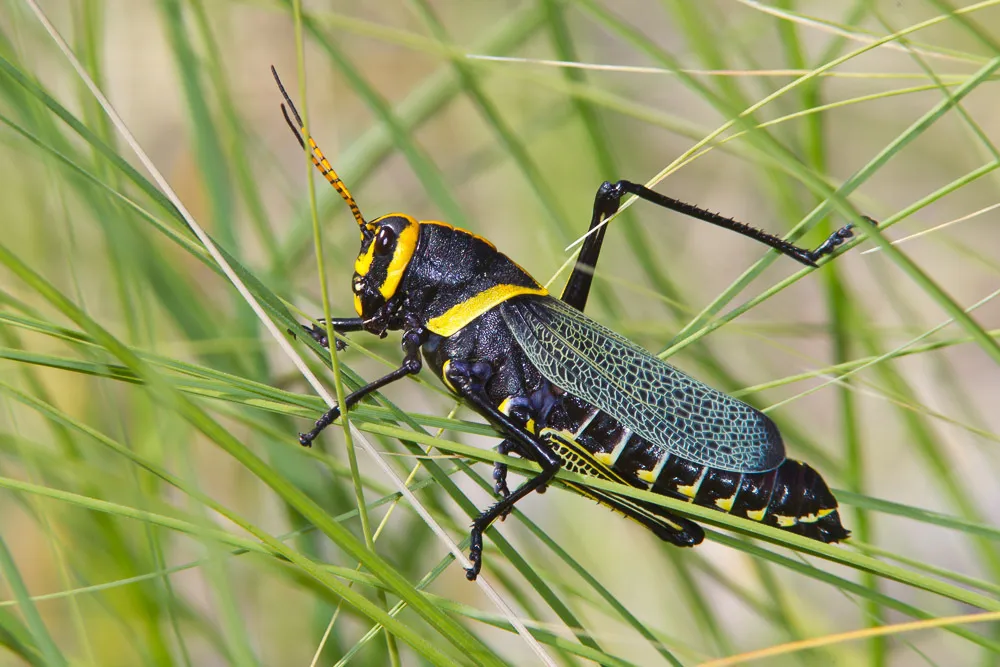
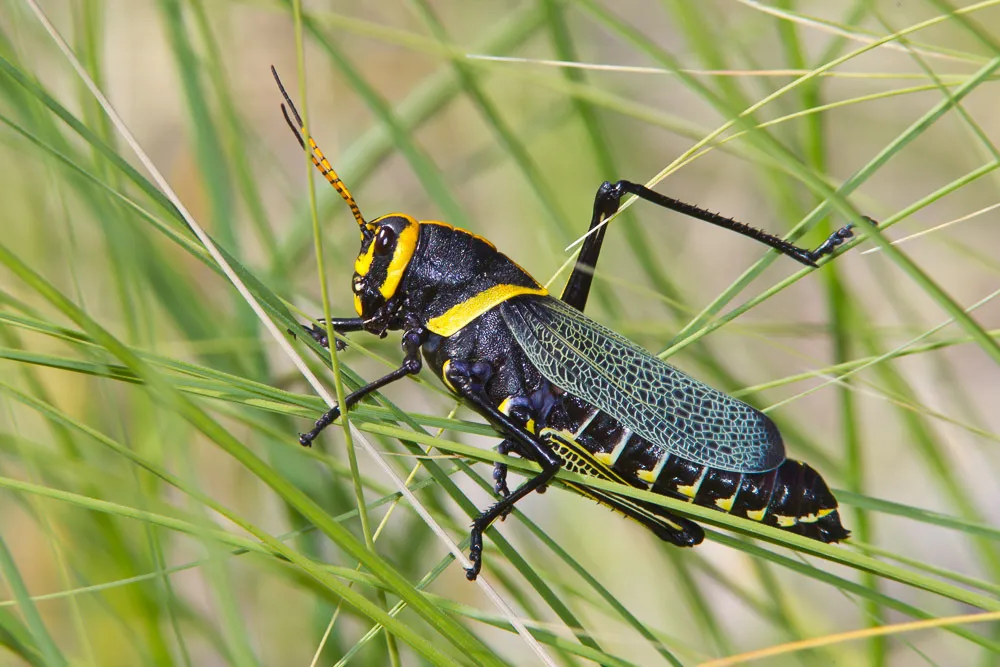
Photo credits: Contributed by Eric R. Eaton; Additional contributions by Mike Boone , Tom Bentley , Chuck Entz , David Ferguson , metrioptera , Tyler Hedlund
Frequently Asked Questions About Horse Lubber
What is Horse Lubber?
Horse Lubber (Romalea eques) is a species in the family Romaleidae, within the order Orthoptera.
How do you identify Horse Lubber?
| Feature | Description |
|---|---|
| Additional details | Large and shiny, mostly black. Tegmina (front wings) with yellow veins and with variable contrasting yellow to orange stripes on body, legs and head. Face sometimes mostly yellow or orange. |
| Antennae | Antennae yellow to red-orange with black rings and tip (sometimes mostly black). |
| Hindwings | Hindwings red with black borders. There are pale-colored forms (greenish, yellowish, or even somewhat orangey) that in extreme development have black color reduced to markings on an overall lighter background, but the body shape, large size, and red hind wings still make these unmistakable as belonging to this species. Light individuals are rarely encountered in the U.S. (most likely in se. Arizona), but are locally more common in Mexico. A photo of one such light specimen may be seen on the Birdspiders.com web site here . Specimens intermediate to the dark and light extremes are often striking and quite beautiful. So far R. microptera and R. eques are not known to overlap distributions, but they could conceivably meet in southern Texas, and the two could be confused. R. microptera has a low pronotal crest and mostly comes in lighter and more broken color patterns (though black individuals occur too). It is more likely to be seen as adult through a longer portion of the year (and often earlier) than is R. eques . |
Where is Horse Lubber found?
| Feature | Details |
|---|---|
| Habitat | Desert shrub, grassland, and oak areas. |
| Range | Southeastern Arizona, southern New Mexico, and west Texas, south into at least Hidalgo, Guanajuato, and Jalisco, Mexico. |
What does Horse Lubber eat?
The diet of the Horse Lubber includes Various shrubs, broadleaf weeds, and dead insects..
When is Horse Lubber active?
Horse Lubber: seasonal activity - Varying somewhat from year to year and with local weather conditions. Nymphs hatch in spring or summer (usually following warm season rains) and mature in summer or late summer, often present at least into November or December..