
Hoary Comma - Hodges#4427
Polygonia gracilis
This record describes Polygonia gracilis (species). Recorded family: Nymphalidae. Recorded order: Lepidoptera.
Identification and Appearance
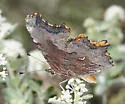
Adult: eastern subspecies best distinguished by dark inner part of underside of wings, contrasting strongly with gray, hoary outer part; hindwing upperside with bright yellow spots in dark wing margin; silver comma on underside of hindwing thin and pointed at both ends Larva: dark brown with reddish dorsal streaks and spines on front half of body, and whitish dorsal patches and spines on rear half Subspecies P. g. zephyrus (until recently considered a separate species by most authors) has a western distribution from southern British Columbia, Alberta, and the Cypress Hills of Saskatchewan, south to California and New Mexico. The underside of its wings are dark silvery-gray, showing less contrast than in the eastern subspecies P. g. gracilis The nominate subspecies ( P. g. gracilis ) occurs in the east from Manitoba to Labrador and Nova Scotia, south to New England states. The underside of its wings are dark brown in the basal half, contrasting sharply with the hoary gray outer half. An unnamed intermediate form occurs from Alaska to Nunavut, south to Manitoba and central British Columbia, where it intergrades with subspecies zephyrus . Its wings are grayish-brown beneath with a moderate line of contrast separating the two halves.
Classification
- Kingdom
- Animalia
- Phylum
- Arthropoda
- Class
- Insecta
- Order
- Lepidoptera (Butterflies and Moths)
- Superfamily
- Papilionoidea
- Family
- Nymphalidae (Brush-footed Butterflies)
- Subfamily
- Nymphalinae
- Tribe
- Nymphalini
- Genus
- Polygonia (Commas, Question Mark)
Imported taxonomy record. Source availability varies; see the source references and editorial policy below.
Habitat and Range
Habitat
forest openings and edges, woodland streamsides, brushlands from foothills to treeline in mountains in the south; boreal forest south of the tundra in the north
Geographic Range
Alaska (south of the tundra) to Nunavut and Labrador, south in the east to New England, and south in the west to California and New Mexico
Seasonal Activity
adults found in spring until June have overwintered; the new generation flies from July to September, then overwinters
Diet and Behavior
Diet: Larvae feed on currant and gooseberry ( Ribes spp.), elm, Mock Azalea ( Menziesia glabella ), and Western Azalea ( Rhododendron occidentale ). Adults sometimes take nectar from flowers such as aster and everlasting ( Gnaphalium spp.), unlike other members of this genus.
Life History
one generation per year; overwinters as an adult; adult females emerge in spring and lay eggs until June, then die
Additional species information
Species notes from the sources
Etymology: GRACILIS: from "gracile", meaning slender or gracefully slender; probably a reference to the slender silver "comma" mark on the underside of the hindwing
About Butterflies and Moths: the wider group
Order-level background for Lepidoptera, the group containing Polygonia gracilis. Species-specific details appear above.
Group overview
Lepidoptera includes approximately 180,000 described species of butterflies and moths. Moths outnumber butterflies roughly 10:1. The monarch butterfly's eastern population has declined by more than 80% since the mid-1990s, and the western population by over 95% since the 1980s. The IUCN lists the migratory monarch as Vulnerable.
Ecological role of the group
Butterflies and moths are essential indicators of ecosystem health. As caterpillars, they are a primary food source for birds - a single nest of blue tit chicks requires ~10,000 caterpillars. Adult moths pollinate many night-blooming plants.
Economic and practical significance of the group
Lepidoptera are critical pollinators. In Europe, grassland butterfly species have declined by almost 50% since the early 1990s. In the UK, three-quarters of butterflies are in decline. In the U.S., five butterfly species have gone extinct since 1950, with 29 listed as endangered.
Recorded sources for this group: IUCN Red List, Xerces Society, USFWS, PNAS, WWF. Imported estimates may describe particular regions or reporting periods.
Photos of Hoary Comma - Hodges#4427 (5)
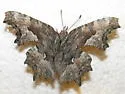
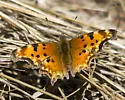
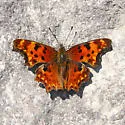
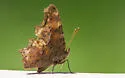
Photo credits: Contributed by Cotinis; Additional contributions by Steve Nanz , Robin McLeod , David Ferguson
Frequently Asked Questions About Hoary Comma - Hodges#4427
What is Hoary Comma - Hodges#4427?
Hoary Comma - Hodges#4427 (Polygonia gracilis) is a species in the family Nymphalidae, within the order Lepidoptera.
How big is Hoary Comma - Hodges#4427?
Wingspan 37-57 mm
How do you identify Hoary Comma - Hodges#4427?
Adult: eastern subspecies best distinguished by dark inner part of underside of wings, contrasting strongly with gray, hoary outer part; hindwing upperside with bright yellow spots in dark wing margin; silver comma on underside of hindwing thin and pointed at both ends Larva: dark brown with reddish dorsal streaks and spines on front half of body, and whitish dorsal patches and spines on rear half
Where is Hoary Comma - Hodges#4427 found?
| Feature | Details |
|---|---|
| Habitat | forest openings and edges, woodland streamsides, brushlands from foothills to treeline in mountains in the south; boreal forest south of the tundra in the north |
| Range | Alaska (south of the tundra) to Nunavut and Labrador, south in the east to New England, and south in the west to California and New Mexico |
What does Hoary Comma - Hodges#4427 eat?
The diet of the Hoary Comma - Hodges#4427 includes Larvae feed on currant and gooseberry ( Ribes spp.), elm, Mock Azalea ( Menziesia glabella ), and Western Azalea ( Rhododendron occidentale ). Adults sometimes take nectar from flowers such as aster and everlasting ( Gnaphalium spp.), unlike other members of this genus..
When is Hoary Comma - Hodges#4427 active?
Hoary Comma - Hodges#4427: seasonal activity - adults found in spring until June have overwintered; the new generation flies from July to September, then overwinters.
What is the life cycle of a Hoary Comma - Hodges#4427?
one generation per year; overwinters as an adult; adult females emerge in spring and lay eggs until June, then die