
Comma
Polygonia c-album
This record describes Polygonia c-album (species). Recorded family: Nymphalidae. Recorded order: Lepidoptera.
Identification and Appearance
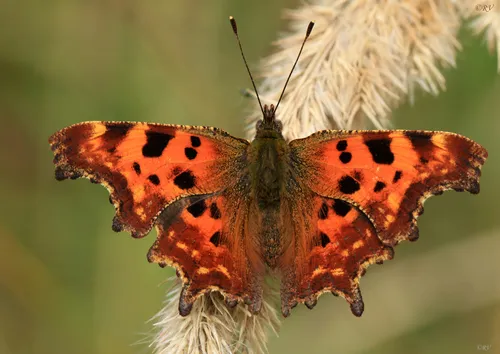
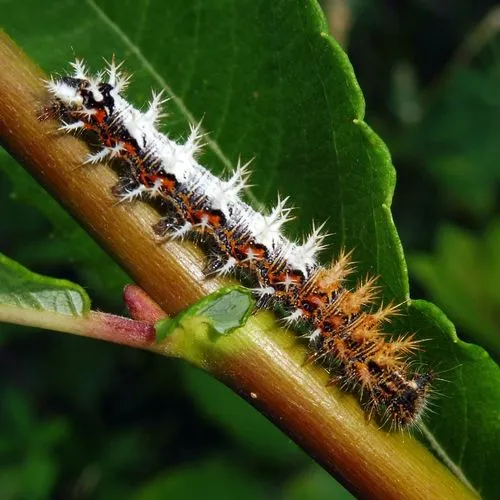
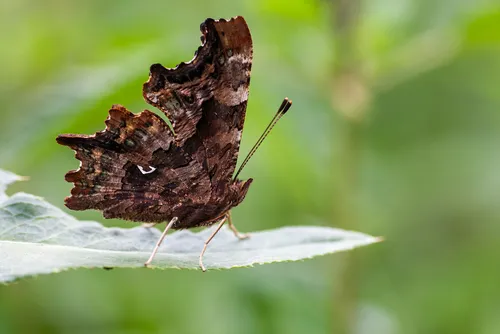
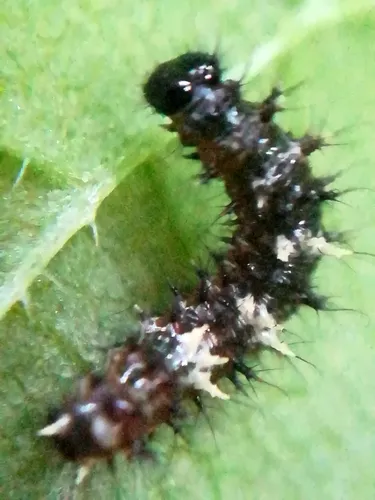
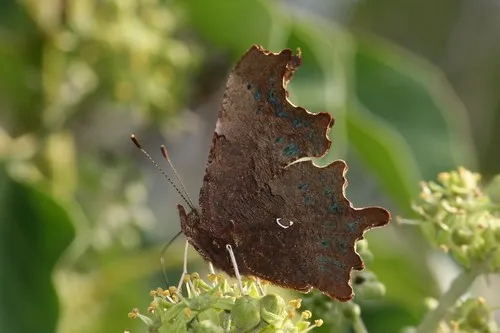
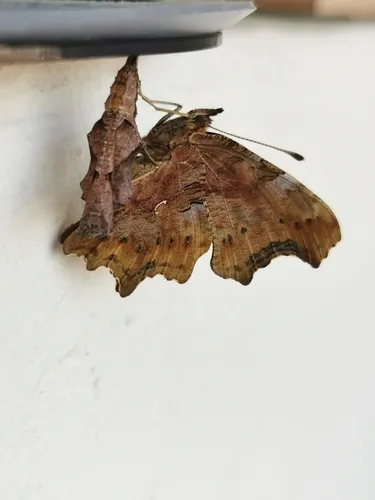
Looking like a tatty Small Tortoiseshell, the Comma is now a familiar sight throughout most of England and Wales and is one of the few species that is bucking the trend by expanding its range. The butterfly gets its name from the white mark on its underside, which resembles a comma. When resting with wings closed this butterfly has excellent camouflage - the jagged outline of the wings giving the appearance of a withered leaf, making the butterfly inconspicuous when resting on a tree trunk or when hibernating. As with most butterflies, there are aberrant forms and with the Comma there are 18 recognised aberrants, eg ab. delta-album below. This is primarily a woodland butterfly, where it can be seen along woodland rides and country lanes. However, especially in late summer, the butterfly is frequently seen in gardens where it feeds in on nectar sources to build up its fat reserves before entering hibernation. All year round but mainly March to October. The butterfly can be seen at any time of the year, occasionally awakening on warm winter days. The butterfly emerges from hibernation in March, breeding to produce the next generation, which appear at the end of June and the start of July. The majority of the offspring have dark undersides and these go on to hibernate. However, some offspring have lighter undersides and brighter upper sides, and are known as the form hutchinsoni . These don't hibernate but instead go on produce a second brood in late summer. The larvae, which resemble bird droppings, feed mainly on nettles. Once confined to the Welsh border counties, this species is now found throughout England and Wales and has recently reached Scotland.
Wikipedia reference for Polygonia c-album: https://en.wikipedia.org/wiki/Polygonia c-album.
Classification
- Kingdom
- Animalia
- Phylum
- Arthropoda
- Class
- Insecta
- Order
- Lepidoptera (Butterflies and Moths)
- Superfamily
- Papilionoidea
- Family
- Nymphalidae (Brush-footed Butterflies)
- Subfamily
- Nymphalinae
- Tribe
- Nymphalini
- Genus
- Polygonia (Commas)
Imported taxonomy record. Source availability varies; see the source references and editorial policy below.
Habitat and Range
Habitat
This is primarily a woodland butterfly, where it can be seen along woodland rides and country lanes. However, especially in late summer, the butterfly is frequently seen in gardens where it feeds in on nectar sources to build up its fat reserves before entering hibernation.
Seasonal Activity
All year round but mainly March to October.
Diet and Behavior
Life History
The butterfly can be seen at any time of the year, occasionally awakening on warm winter days. The butterfly emerges from hibernation in March, breeding to produce the next generation, which appear at the end of June and the start of July. The majority of the offspring have dark undersides and these go on to hibernate. However, some offspring have lighter undersides and brighter upper sides, and are known as the form
Additional species information
Recorded status
Once confined to the Welsh border counties, this species is now found throughout England and Wales and has recently reached Scotland.
About Butterflies and Moths: the wider group
Order-level background for Lepidoptera, the group containing Polygonia c-album. Species-specific details appear above.
Group overview
Lepidoptera includes approximately 180,000 described species of butterflies and moths. Moths outnumber butterflies roughly 10:1. The monarch butterfly's eastern population has declined by more than 80% since the mid-1990s, and the western population by over 95% since the 1980s. The IUCN lists the migratory monarch as Vulnerable.
Ecological role of the group
Butterflies and moths are essential indicators of ecosystem health. As caterpillars, they are a primary food source for birds - a single nest of blue tit chicks requires ~10,000 caterpillars. Adult moths pollinate many night-blooming plants.
Economic and practical significance of the group
Lepidoptera are critical pollinators. In Europe, grassland butterfly species have declined by almost 50% since the early 1990s. In the UK, three-quarters of butterflies are in decline. In the U.S., five butterfly species have gone extinct since 1950, with 29 listed as endangered.
Recorded sources for this group: IUCN Red List, Xerces Society, USFWS, PNAS, WWF. Imported estimates may describe particular regions or reporting periods.
Photos of Comma (8)
Frequently Asked Questions About Comma
What is Comma?
Comma (Polygonia c-album) is a species in the family Nymphalidae, within the order Lepidoptera.
Where is Comma found?
Habitat: This is primarily a woodland butterfly, where it can be seen along woodland rides and country lanes. However, especially in late summer, the butterfly is frequently seen in gardens where it feeds in on nectar sources to build up its fat reserves before entering hibernation.
When is Comma active?
Comma: seasonal activity - All year round but mainly March to October..
What is the life cycle of a Comma?
The butterfly can be seen at any time of the year, occasionally awakening on warm winter days. The butterfly emerges from hibernation in March, breeding to produce the next generation, which appear at the end of June and the start of July. The majority of the offspring have dark undersides and these go on to hibernate. However, some offspring have lighter undersides and brighter upper sides, and are known as the form