
Physoconops gracilis
This record describes Physoconops gracilis (species). Recorded family: Conopidae. Recorded order: Diptera.
Identification and Appearance
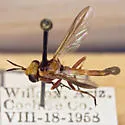
From Camras : This species replaces brachyrhynchus in the western United States, and differs typically in being predominantly reddish with pleural stripe golden, front entirely yellow [but sometimes darkened in the center, see below], and absence of spot in facial grooves. However, most specimens show a trace of the spot in the facial grooves and in some it is very distinct. From Camras & Hurd: In addition to the key characters [frons and cheeks yellow, 1st posterior cell (R5) partly darkened] of this predominantly reddish species, the second and third antennal segments are subequal, the genital plate of the female is short, and there is no distinct postvertical pollinose stripe. The front is sometimes darkened in the center, and the facial grooves sometimes have dark marks at the oral keel, thus showing variation toward the eastern P. brachyrhynchus which it replaces in the western United States.
Classification
Habitat and Range
Geographic Range
From California east to Colorado and Texas , and south from there to Arizona, New Mexico, and into Mexico. Also in Colombia.
About Flies: the wider group
Order-level background for Diptera, the group containing Physoconops gracilis. Species-specific details appear above.
Group overview
Diptera includes over 150,000 described species of flies, mosquitoes, and midges. Mosquitoes are the deadliest animal on Earth (CDC). Malaria alone causes ~249 million cases and over 608,000 deaths annually, mostly children under 5 (WHO). Vector-borne diseases account for over 17% of all infectious diseases, causing 700,000+ deaths per year.
Ecological role of the group
Despite their disease impact, flies are critical decomposers and pollinators. Hoverflies alone pollinate hundreds of crop and wildflower species. Flies are also the primary food source for many birds, bats, and fish. Forensic entomology relies heavily on fly species for crime scene analysis.
Economic and practical significance of the group
In the U.S., vector-borne disease cases tripled between 2004-2016, with over 640,000 cases reported in that period (CDC). Tickborne diseases doubled from 22,000 to 48,000 annual reports. Globally, mosquito-borne diseases cost billions in healthcare and lost productivity.
Recorded sources for this group: WHO, CDC, PNAS. Imported estimates may describe particular regions or reporting periods.
Photos of Physoconops gracilis (5)
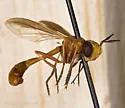
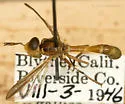
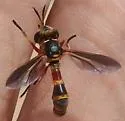
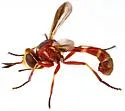
Photo credits: Contributed by Aaron Schusteff