
Physoconops brachyrhynchus
This record describes Physoconops brachyrhynchus (species). Recorded family: Conopidae. Recorded order: Diptera.
Identification and Appearance
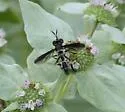
| Feature | Details |
|---|---|
| Head | The frons is medially dark and grades laterally into a paler hue (i.e. whitish or yellowish). The cheeks are uniformly pale (whitish or yellowish). The 3rd antennal segment is longer than the 2nd. The proboscis is relatively short (i.e. it's tip usually reaches only a bit beyond the 1st antennal segment). |
| Thorax | Black, with whitish, pollinose (=dust-like), rectangular markings on the humeri (= anterior corners on dorsum of thorax). There is a whitish-pollinose stripe on the pleuron (= side of the thorax) of uniform width and extending the entire length of the pleuron from between the bases of the fore- and mid-legs to near the upper edge of the thorax. See images below (which also illustrate the pale cheeks): |
| Legs | The femora and tibiae in P. brachyrhynchus can vary from a vivid reddish to virtually black. The basal half of the tibiae are often paler (yellowish or off-whitish). The tarsi are blackish, and the pulvilli are yellowish. |
| Abdomen | The abdominal segments are black in base color, typically with a relatively narrow whitish-to-yellowish posterior pollinose band. The first three segments are usually shiny black...beyond that the segments are often duller and sometimes more-widely finely-pollinose. The female theca is relatively small compared to other members of subgenus Pachyconops : Like Physocephala marginata and Physocephala sagittaria , Physoconops brachyrhynchus has color variation that spans a spectrum between a more blackish dark form: and a more reddish ferruginous form: The main differences between the two forms are the blackish vs. reddish legs and 2nd abdominal segment (or petiole). |
Classification
Habitat and Range
Geographic Range
WY to MA, s. to NM and FL
Additional species information
Species notes from the sources
Etymology: The specific epithet refers to the relatively short proboscis of this species (from the Greek roots : brachy- = "short", and rhynchus = "beak").
About Flies: the wider group
Order-level background for Diptera, the group containing Physoconops brachyrhynchus. Species-specific details appear above.
Group overview
Diptera includes over 150,000 described species of flies, mosquitoes, and midges. Mosquitoes are the deadliest animal on Earth (CDC). Malaria alone causes ~249 million cases and over 608,000 deaths annually, mostly children under 5 (WHO). Vector-borne diseases account for over 17% of all infectious diseases, causing 700,000+ deaths per year.
Ecological role of the group
Despite their disease impact, flies are critical decomposers and pollinators. Hoverflies alone pollinate hundreds of crop and wildflower species. Flies are also the primary food source for many birds, bats, and fish. Forensic entomology relies heavily on fly species for crime scene analysis.
Economic and practical significance of the group
In the U.S., vector-borne disease cases tripled between 2004-2016, with over 640,000 cases reported in that period (CDC). Tickborne diseases doubled from 22,000 to 48,000 annual reports. Globally, mosquito-borne diseases cost billions in healthcare and lost productivity.
Recorded sources for this group: WHO, CDC, PNAS. Imported estimates may describe particular regions or reporting periods.
Photos of Physoconops brachyrhynchus (5)
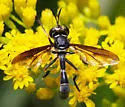
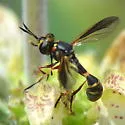
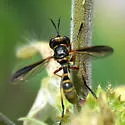
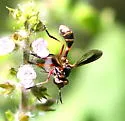
Photo credits: Contributed by Aaron Schusteff
Frequently Asked Questions About Physoconops brachyrhynchus
What is Physoconops brachyrhynchus?
Physoconops brachyrhynchus is a species in the family Conopidae, within the order Diptera.
How do you identify Physoconops brachyrhynchus?
| Feature | Details |
|---|---|
| Head | The frons is medially dark and grades laterally into a paler hue (i.e. whitish or yellowish). The cheeks are uniformly pale (whitish or yellowish). The 3rd antennal segment is longer than the 2nd. The proboscis is relatively short (i.e. it's tip usually reaches only a bit beyond the 1st antennal segment). |
| Thorax | Black, with whitish, pollinose (=dust-like), rectangular markings on the humeri (= anterior corners on dorsum of thorax). There is a whitish-pollinose stripe on the pleuron (= side of the thorax) of uniform width and extending the entire length of the pleuron from between the bases of the fore- and mid-legs to near the upper edge of the thorax. See images below (which also illustrate the pale cheeks): |
| Legs | The femora and tibiae in P. brachyrhynchus can vary from a vivid reddish to virtually black. The basal half of the tibiae are often paler (yellowish or off-whitish). The tarsi are blackish, and the pulvilli are yellowish. |
| Abdomen | The abdominal segments are black in base color, typically with a relatively narrow whitish-to-yellowish posterior pollinose band. The first three segments are usually shiny black...beyond that the segments are often duller and sometimes more-widely finely-pollinose. The female theca is relatively small compared to other members of subgenus Pachyconops : |
Where is Physoconops brachyrhynchus found?
Range: WY to MA, s. to NM and FL