
Tinkham's Shieldback
Pediodectes tinkhami
This record describes Pediodectes tinkhami (species). Recorded family: Tettigoniidae. Recorded order: Orthoptera.
Identification and Appearance
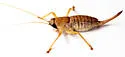
Usually light gray or brown with a pattern of slightly darker shading; abdominal segments thinly edged darker (often black). With lateral lobes of pronotum darker gray or brown bordered with pale with a dark rear edge. With a pale (near white) curved band across front of dark face. P. bruneri is very similar, more widespread (occurs further eastward), in adults with the rear edge of the face (genae) pale, and with a large broad white to near white triangle on otherwise mostly dark face. Knees of legs generally black and often with a black line along top of hind femur. Nymphs are less contrastingly marked, and the blackish dark patterning is often not developed on young nymphs. P. stevensenii is somewhat similar, but the face is not so contrastingly marked, with the lower third not black (there may be some black patterning though), and the area where the white band would be is more of a pale grayish or brownish like the rest of the body. Also, the mark below the eye is a usually a black curved vertical line with gray or brown shading behind it. It is a somewhat smaller species as well. Type locality: Chinati Mts., Presidio County, Texas
Classification
- Kingdom
- Animalia
- Phylum
- Arthropoda
- Class
- Insecta
- Order
- Orthoptera (Grasshoppers, Crickets, Katydids)
- Suborder
- Ensifera
- Family
- Tettigoniidae (Katydids)
- Subfamily
- Tettigoniinae
- Genus
- Pediodectes
Imported taxonomy record. Source availability varies; see the source references and editorial policy below.
Habitat and Range
Habitat
Mostly in open brushy areas, in mountains of Chihuahuan Desert. It is often abundant in low-lying areas of more "lush" vegetation where extra water may occur (often areas of heavy grass cover surrounded by dry scrub).
Geographic Range
Southeastern New Mexico, Trans-Pecos Texas, south into ne. Mexico. Mostly within Chihuahuan Desert region.
Seasonal Activity
Overwinters as eggs with nymphs mostly in summer, and adults most common in late summer and autumn.
Diet and Behavior
Diet: As with most species, seems to be omnivorous. May be found at night walking on roadways looking for roadkill to eat, and often the roadkill is of unfortunate individuals of the same species. Sometimes will come to lights.
About Grasshoppers, Crickets, Katydids: the wider group
Order-level background for Orthoptera, the group containing Pediodectes tinkhami. Species-specific details appear above.
Group overview
Orthoptera includes ~28,000 described species of grasshoppers, crickets, and katydids. Desert locusts can form swarms covering 460 square miles containing up to 80 million individuals per square kilometer.
Ecological role of the group
Grasshoppers and crickets are a primary food source for birds, reptiles, and small mammals. Cricket farming is a growing industry - crickets require 12× less feed than cattle to produce the same amount of protein, using 2,000× less water.
Economic and practical significance of the group
A single large locust swarm can consume the same amount of food in one day as 35,000 people. The 2019-2021 East Africa locust crisis affected food security for 42 million people across multiple countries. Global crop losses from locusts can reach billions annually.
Recorded sources for this group: FAO, UN World Food Programme, research publications. Imported estimates may describe particular regions or reporting periods.
Photos of Tinkham's Shieldback (4)
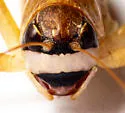

Photo credits: Contributed by David J. Ferguson; Additional contributions by Mike Quinn
Frequently Asked Questions About Tinkham's Shieldback
What is Tinkham's Shieldback?
Tinkham's Shieldback (Pediodectes tinkhami) is a species in the family Tettigoniidae, within the order Orthoptera.
How do you identify Tinkham's Shieldback?
Usually light gray or brown with a pattern of slightly darker shading; abdominal segments thinly edged darker (often black). With lateral lobes of pronotum darker gray or brown bordered with pale with a dark rear edge. With a pale (near white) curved band across front of dark face. P. bruneri is very similar, more widespread (occurs further eastward), in adults with the rear edge of the face (genae) pale, and with a large broad white to near white triangle on otherwise mostly dark face. Knees of legs generally black and often with a black line along top of hind femur. Nymphs are less contrastingly marked, and the blackish dark patterning is often not developed on young nymphs. P. stevensenii is somewhat similar, but the face is not so contrastingly marked, with the lower third not black (there may be some black patterning though), and the area where the white band would be is more of a pale grayish or brownish like the rest of the body. Also, the mark below the eye is a usually a black curved vertical line with gray or brown shading behind it. It is a somewhat smaller species as well.
Where is Tinkham's Shieldback found?
| Feature | Details |
|---|---|
| Habitat | Mostly in open brushy areas, in mountains of Chihuahuan Desert. It is often abundant in low-lying areas of more lush vegetation where extra water may occur (often areas of heavy grass cover surrounded by dry scrub). |
| Range | Southeastern New Mexico, Trans-Pecos Texas, south into ne. Mexico. Mostly within Chihuahuan Desert region. |
What does Tinkham's Shieldback eat?
The diet of the Tinkham's Shieldback includes As with most species, seems to be omnivorous. May be found at night walking on roadways looking for roadkill to eat, and often the roadkill is of unfortunate individuals of the same species. Sometimes will come to lights..
When is Tinkham's Shieldback active?
Tinkham's Shieldback: seasonal activity - Overwinters as eggs with nymphs mostly in summer, and adults most common in late summer and autumn..