
Alpine Shieldback
Acrodectes philopagus
This record describes Acrodectes philopagus (species). Recorded family: Tettigoniidae. Recorded order: Orthoptera.
Identification and Appearance
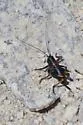
The unusual black and tan coloration readily serves to distinguish this species The genus Acrodectes is monotypic (i.e. contains a single species). The original description of both the genus and species, written be Hebard & Morgan in 1920, begins here (with supporting figures on Plate XI here ). More info (as well as a somewhat entertaining field trip account) appears on pg. of 274 (= pg. 18 of the PDF) the 1944 paper by Tinkham here . The genus even has a 4000+ meter peak that was named for it! :-)
Classification
- Kingdom
- Animalia
- Phylum
- Arthropoda
- Class
- Insecta
- Order
- Orthoptera (Grasshoppers, Crickets, Katydids)
- Suborder
- Ensifera
- Family
- Tettigoniidae (Katydids)
- Subfamily
- Tettigoniinae
- Genus
- Acrodectes
Imported taxonomy record. Source availability varies; see the source references and editorial policy below.
Habitat and Range
Habitat
Live in alpine fell fields among boulders, slabs and talus. Males call from upper edges of boulders.
Geographic Range
Restricted to crags and rock piles above the timber line in the high Sierra Nevada, CA
About Grasshoppers, Crickets, Katydids: the wider group
Order-level background for Orthoptera, the group containing Acrodectes philopagus. Species-specific details appear above.
Group overview
Orthoptera includes ~28,000 described species of grasshoppers, crickets, and katydids. Desert locusts can form swarms covering 460 square miles containing up to 80 million individuals per square kilometer.
Ecological role of the group
Grasshoppers and crickets are a primary food source for birds, reptiles, and small mammals. Cricket farming is a growing industry - crickets require 12× less feed than cattle to produce the same amount of protein, using 2,000× less water.
Economic and practical significance of the group
A single large locust swarm can consume the same amount of food in one day as 35,000 people. The 2019-2021 East Africa locust crisis affected food security for 42 million people across multiple countries. Global crop losses from locusts can reach billions annually.
Recorded sources for this group: FAO, UN World Food Programme, research publications. Imported estimates may describe particular regions or reporting periods.
Photos of Alpine Shieldback (4)
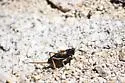
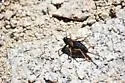
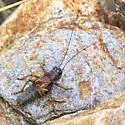
Photo credits: Contributed by metrioptera; Additional contributions by Aaron Schusteff
Frequently Asked Questions About Alpine Shieldback
What is Alpine Shieldback?
Alpine Shieldback (Acrodectes philopagus) is a species in the family Tettigoniidae, within the order Orthoptera.
How do you identify Alpine Shieldback?
The unusual black and tan coloration readily serves to distinguish this species
Where is Alpine Shieldback found?
| Feature | Details |
|---|---|
| Habitat | Live in alpine fell fields among boulders, slabs and talus. Males call from upper edges of boulders. |
| Range | Restricted to crags and rock piles above the timber line in the high Sierra Nevada, CA |