
Red Katydid
Paracyrtophyllus robustus
This record describes Paracyrtophyllus robustus (species). Recorded family: Tettigoniidae. Recorded order: Orthoptera.
Identification and Appearance
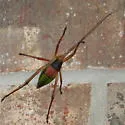
True katydids have leaf-like wings that form cups enclosing the abdomen. Wings only allow for feeble flight. (The cupped wings probably serve to amplify their songs.) Antennae longer and stiffer than in other katydids Green form (nymphs and adults): Red form ( outbreak conditions ) : Known county records for past outbreaks: 2022: Guadalupe County, TX 2016: along the Bexar-Guadalupe county line, TX 2013: Seminole County, OK 2012: Bandera, Bastrop, Bexar, Blanco, Burnet, Collin, Comal, Fayette, Hays, Kendall, Kerr, Medina, Parker, Real, Tarrant, Travis, Uvalde and Williamson counties, TX 2010: Bexar, Comal, Medina, and Real counties, TX 2007: Bandera, Bexar, Comal, Hays, Kendall, and Medina counties, TX 2001: Lee County, TX 2024: abundant across the eastern third of the Edwards Plateau and up into the n. TX metroplex ( 4 )
Classification
- Kingdom
- Animalia
- Phylum
- Arthropoda
- Class
- Insecta
- Order
- Orthoptera (Grasshoppers, Crickets, Katydids)
- Suborder
- Ensifera
- Family
- Tettigoniidae (Katydids)
- Subfamily
- Pseudophyllinae
- Genus
- Paracyrtophyllus (Western True Katydids)
Imported taxonomy record. Source availability varies; see the source references and editorial policy below.
Habitat and Range
Habitat
An arboreal (tree-dwelling) species found mostly in oak-woodlands. They mostly inhabit the tree's crown except during outbreak conditions. ( 3 ) During normal population levels, this species' green color and propensity to sing from the tree tops means they are much more likely to be heard than seen. During outbreaks, they can be found everywhere.
Geographic Range
Edwards Plateau to Dallas (plus questionable OK records) - Map (SINA), Map (GBIF)
Seasonal Activity
Late instar nymphs out in April per BG data. Adults primarily sing from late May to mid-July , but can be heard until September.
Diet and Behavior
Diet: Feed on Oaks. During outbreaks, they have defoliated post oaks ( Quercus stellata ), plateau live oaks ( Quercus fusiformis ) and Texas red oaks ( Quercus buckleyi ). Distrubution of Texas red oak ( Quercus buckleyi ) most closely fits the consentrated distribution of this katydid.
Life History
Only one generation per year (thankfully!) Katydids normally sing only at night, starting at dusk, but during outbreaks they sing day and night (and how!!!)
Additional species information
Species notes from the sources
Etymology: Paracyrtophyllus robustus Caudell 1906 "Central Texas Leaf-Katydid" - coined by Taber & Fleenor a little better than "Truncated True Katydid" (SINA) "Red Katydid" - vernacular name in Texas. Isolated individuals are green, whereas outbreak individuals are mostly pink to red.
About Grasshoppers, Crickets, Katydids: the wider group
Order-level background for Orthoptera, the group containing Paracyrtophyllus robustus. Species-specific details appear above.
Group overview
Orthoptera includes ~28,000 described species of grasshoppers, crickets, and katydids. Desert locusts can form swarms covering 460 square miles containing up to 80 million individuals per square kilometer.
Ecological role of the group
Grasshoppers and crickets are a primary food source for birds, reptiles, and small mammals. Cricket farming is a growing industry - crickets require 12× less feed than cattle to produce the same amount of protein, using 2,000× less water.
Economic and practical significance of the group
A single large locust swarm can consume the same amount of food in one day as 35,000 people. The 2019-2021 East Africa locust crisis affected food security for 42 million people across multiple countries. Global crop losses from locusts can reach billions annually.
Recorded sources for this group: FAO, UN World Food Programme, research publications. Imported estimates may describe particular regions or reporting periods.
Photos of Red Katydid (5)
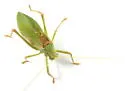
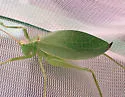
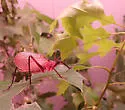
Photo credits: Contributed by Lynette Elliott; Additional contributions by Mike Quinn , Ethan Kistler , metrioptera , dvoribird
Frequently Asked Questions About Red Katydid
What is Red Katydid?
Red Katydid (Paracyrtophyllus robustus) is a species in the family Tettigoniidae, within the order Orthoptera.
How big is Red Katydid?
33-42 mm (SINA)
How do you identify Red Katydid?
True katydids have leaf-like wings that form cups enclosing the abdomen. Wings only allow for feeble flight. (The cupped wings probably serve to amplify their songs.) Antennae longer and stiffer than in other katydids Green form (nymphs and adults): Red form ( outbreak conditions ) :
Where is Red Katydid found?
| Feature | Details |
|---|---|
| Habitat | An arboreal (tree-dwelling) species found mostly in oak-woodlands. They mostly inhabit the tree's crown except during outbreak conditions. ( 3 ) During normal population levels, this species' green color and propensity to sing from the tree tops means they are much more likely to be heard than seen. During outbreaks, they can be found everywhere. |
| Range | Edwards Plateau to Dallas (plus questionable OK records) - Map (SINA), Map (GBIF) |
What does Red Katydid eat?
The diet of the Red Katydid includes Feed on Oaks. During outbreaks, they have defoliated post oaks ( Quercus stellata ), plateau live oaks ( Quercus fusiformis ) and Texas red oaks ( Quercus buckleyi ). Distrubution of Texas red oak ( Quercus buckleyi ) most closely fits the consentrated distribution of this katydid..
When is Red Katydid active?
Red Katydid: seasonal activity - Late instar nymphs out in April per BG data. Adults primarily sing from late May to mid-July , but can be heard until September..
What is the life cycle of a Red Katydid?
Only one generation per year (thankfully!) Katydids normally sing only at night, starting at dusk, but during outbreaks they sing day and night (and how!!!)