
Black Zigzag - Hodges#9177
Panthea acronyctoides
This record describes Panthea acronyctoides (species). Recorded family: Noctuidae. Recorded order: Lepidoptera.
Identification and Appearance
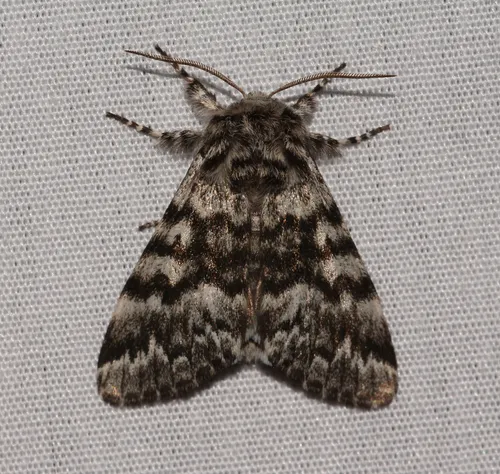
Adult : forewing white with bold black zigzag lines; pattern usually visible on either white, black (melanic), or gray-shaded specimens; fringe checkered black-and-white; orbicular spot a large white disk bordered by black and with a black dot in the center [when the moth is at rest, the two orbicular spots resemble spectacled eyes with tiny black pupils] hindwing uniformly gray except for white patch at anal angle Larva : body black and white with pale tubercles that bear compact tufts of long hairs or less dense tufts of shorter hairs; head blackish with some white marks; prominent, paired, white dorsal hair tufts on T1, A1, and A8; smaller, more-sparsely-haired tufts on low tubercles that encircle most segments; white middorsal stripe variably expanded over anterior half of most segments; white spot near subdorsal tubercles; faint, broken, white supraspiracular stripe; angular, white inverted V marks extend upward from subspiracular tubercle to dorsolateral area
Classification
- Kingdom
- Animalia
- Phylum
- Arthropoda
- Class
- Insecta
- Order
- Lepidoptera (Butterflies and Moths)
- Superfamily
- Noctuoidea
- Family
- Noctuidae (Owlet Moths)
- Subfamily
- Pantheinae
- Genus
- Panthea
Imported taxonomy record. Source availability varies; see the source references and editorial policy below.
Habitat and Range
Habitat
coniferous forests
Geographic Range
Newfoundland to British Columbia and adjacent northern states, south in the west to Colorado, south in the east to New England and Kentucky. Moth Photographers Group - large map with some collection locations and dates.
Seasonal Activity
adults fly from May to August larvae from July to September
Diet and Behavior
Diet: larvae feed on Balsam Fir, Eastern Hemlock, Eastern Larch, White Spruce, and species of pine
Life History
one generation per year; overwinters as a pupa in soil or debris
Additional species information
Species notes from the sources
Etymology: ACRONYCTOIDES: from the Greek "akros" (summit; high; tip; pointed) + "nyktos" (night); might refer to the "black as night" larva, and the pointed zigzag lines on the adult and pointed markings on the larva
About Butterflies and Moths: the wider group
Order-level background for Lepidoptera, the group containing Panthea acronyctoides. Species-specific details appear above.
Group overview
Lepidoptera includes approximately 180,000 described species of butterflies and moths. Moths outnumber butterflies roughly 10:1. The monarch butterfly's eastern population has declined by more than 80% since the mid-1990s, and the western population by over 95% since the 1980s. The IUCN lists the migratory monarch as Vulnerable.
Ecological role of the group
Butterflies and moths are essential indicators of ecosystem health. As caterpillars, they are a primary food source for birds - a single nest of blue tit chicks requires ~10,000 caterpillars. Adult moths pollinate many night-blooming plants.
Economic and practical significance of the group
Lepidoptera are critical pollinators. In Europe, grassland butterfly species have declined by almost 50% since the early 1990s. In the UK, three-quarters of butterflies are in decline. In the U.S., five butterfly species have gone extinct since 1950, with 29 listed as endangered.
Recorded sources for this group: IUCN Red List, Xerces Society, USFWS, PNAS, WWF. Imported estimates may describe particular regions or reporting periods.
Photos of Black Zigzag - Hodges#9177 (2)
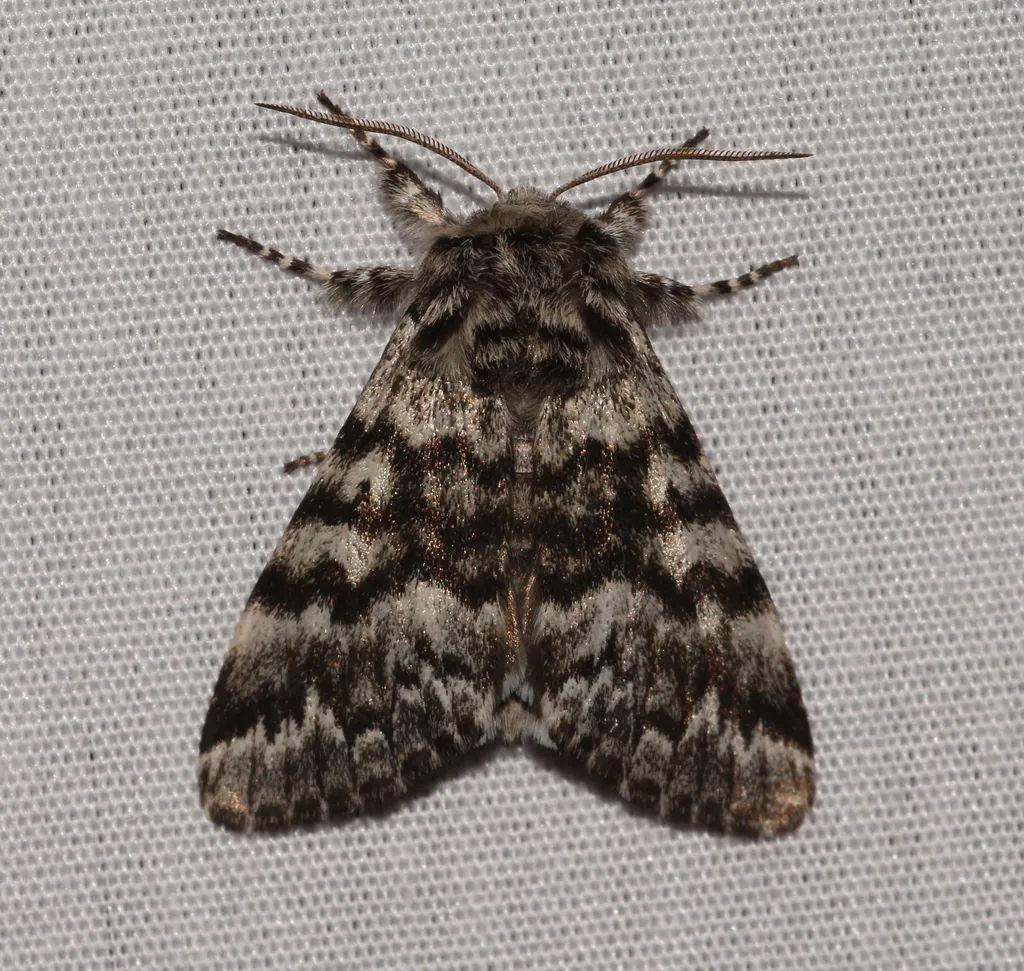
Photo credits: Contributed by Robin McLeod; Additional contributions by Mike Boone , john and jane balaban , Tony-2 , Jason D. Roberts , Maury Heiman , Steve Morris
Frequently Asked Questions About Black Zigzag - Hodges#9177
What is Black Zigzag - Hodges#9177?
Black Zigzag - Hodges#9177 (Panthea acronyctoides) is a species in the family Noctuidae, within the order Lepidoptera.
How big is Black Zigzag - Hodges#9177?
wingspan 30-35 mm larvae to 35 mm
How do you identify Black Zigzag - Hodges#9177?
Adult : forewing white with bold black zigzag lines; pattern usually visible on either white, black (melanic), or gray-shaded specimens; fringe checkered black-and-white; orbicular spot a large white disk bordered by black and with a black dot in the center [when the moth is at rest, the two orbicular spots resemble spectacled eyes with tiny black pupils] hindwing uniformly gray except for white patch at anal angle Larva : body black and white with pale tubercles that bear compact tufts of long hairs or less dense tufts of shorter hairs; head blackish with some white marks; prominent, paired, white dorsal hair tufts on T1, A1, and A8; smaller, more-sparsely-haired tufts on low tubercles that encircle most segments; white middorsal stripe variably expanded over anterior half of most segments; white spot near subdorsal tubercles; faint, broken, white supraspiracular stripe; angular, white inverted V marks extend upward from subspiracular tubercle to dorsolateral area
Where is Black Zigzag - Hodges#9177 found?
| Feature | Details |
|---|---|
| Habitat | coniferous forests |
| Range | Newfoundland to British Columbia and adjacent northern states, south in the west to Colorado, south in the east to New England and Kentucky. Moth Photographers Group - large map with some collection locations and dates. |
What does Black Zigzag - Hodges#9177 eat?
The diet of the Black Zigzag - Hodges#9177 includes larvae feed on Balsam Fir, Eastern Hemlock, Eastern Larch, White Spruce, and species of pine.
When is Black Zigzag - Hodges#9177 active?
Black Zigzag - Hodges#9177: seasonal activity - adults fly from May to August larvae from July to September.
What is the life cycle of a Black Zigzag - Hodges#9177?
one generation per year; overwinters as a pupa in soil or debris