
San Francisco Lacewing
Nothochrysa californica
This record describes Nothochrysa californica (species). Recorded family: Chrysopidae. Recorded order: Neuroptera.
Identification and Appearance
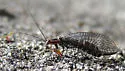
The red-orange and black color pattern on the head is quite distinctive. The antennae are black, slightly shorter than the wings. The pronotum is relatively long, gradually widening towards posterior end, reddish-brown with narrow, pale, medial and lateral stripes. Abdominal segments are dark with pale apical bands, with the abdominal length shorter than the wings. Wing venation is depicted in Fig. 3 of Adams (1967) and Fig. 2 of Bickley & MacLeod (1956) . The very elongate cell im of comparable size to m2 distinguishes this species as well as our Pimachrysa from all of our genera of Chrysopinae. In the Chrysopinae, im is roughly 1/4 the area of m2. Out of all species found in our area, the mating behavior of N. californica is quite unique (though globally shared by members of Nothochrysa , with similar behavior also found in Hypochrysa ). After mating, both the spermatophore and a yellowish to whitish mass of frothy, granular material remain on the female's abdomen. The spermatophore, located at the tip of the abdomen, remains for over an hour while the abdomen pulses, apparently drawing in the spermatozoa over this time. The secondary mass is located on the lateral (dorsolateral?) surface between segments 4 and 7. ( 3 )
Classification
- Kingdom
- Animalia
- Phylum
- Arthropoda
- Class
- Insecta
- Order
- Neuroptera (Antlions, Lacewings, and Allies)
- Family
- Chrysopidae (Green Lacewings)
- Subfamily
- Nothochrysinae
- Genus
- Nothochrysa
Imported taxonomy record. Source availability varies; see the source references and editorial policy below.
Habitat and Range
Habitat
Mostly found in mesic (= medium moisture/humidity) woodlands or chaparral on the coastal side of main mountain ranges along the western edge of North America from British Columbia to south-central California. Larvae have been found on Coast Live Oak ( Quercus agrifolia ) and California Bay Tree ( Umbellularia californica ).
Geographic Range
BC-CA As of 11/23/19, the southernmost BugGuide post is from between Cambria and Atascadero in San Luis Obispo County, and among the CA records from the California Academy of Sciences , the southernmost record is from Gaviota Pass in Santa Barbara County (see here ). There is also a Flickr post from San Marcos Pass in Santa Barbara County, east (and a tiny bit north) of the Gaviota Pass record. The locality info on the type specimen states "Los Angeles Co." and a Ventura Co. sighting was posted on iNaturalist in 2020 , just west of LA County line. It appears that currently the easternmost CA record is from Pacific House in El Dorado County in coniferous habitat on the western slope of the Sierra Nevada. All other current CA records appear to occur west of the crests of the coastal ranges.
Diet and Behavior
Life History
Like many lacewing larvae, those of N. californica carry debris on their dorsum as camouflage. This notably tends to include large particles. Detailed life history info can be found on pp. 426-429 of Toschi .
About Antlions, Lacewings, and Allies: the wider group
Order-level background for Neuroptera, the group containing Nothochrysa californica. Species-specific details appear above.
Group overview
Neuroptera (lacewings, antlions, owlflies) includes ~6,000 described species. Green lacewing larvae are called 'aphid lions' - a single larva can consume up to 200 aphids per week.
Ecological role of the group
Antlion larvae build conical pit traps in sandy soil - an engineering feat studied by physicists for insights into granular mechanics. Adult lacewings are important pollinators of night-blooming flowers.
Economic and practical significance of the group
Lacewings are commercially reared and sold as biological pest control agents. The global biological pest control market, which heavily features lacewings, was valued at $6.6 billion in 2023 and is projected to reach $16.4 billion by 2033.
Recorded sources for this group: USDA IPM, biological control market research. Imported estimates may describe particular regions or reporting periods.
Photos of San Francisco Lacewing (5)
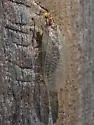
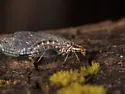
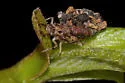
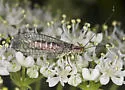
Photo credits: Contributed by Cotinis; Additional contributions by Aaron Schusteff , v belov , PaleoJon
Frequently Asked Questions About San Francisco Lacewing
What is San Francisco Lacewing?
San Francisco Lacewing (Nothochrysa californica) is a species in the family Chrysopidae, within the order Neuroptera.
How do you identify San Francisco Lacewing?
The red-orange and black color pattern on the head is quite distinctive. The antennae are black, slightly shorter than the wings. The pronotum is relatively long, gradually widening towards posterior end, reddish-brown with narrow, pale, medial and lateral stripes. Abdominal segments are dark with pale apical bands, with the abdominal length shorter than the wings. Wing venation is depicted in Fig. 3 of Adams (1967) and Fig. 2 of Bickley & MacLeod (1956) . The very elongate cell im of comparable size to m2 distinguishes this species as well as our Pimachrysa from all of our genera of Chrysopinae. In the Chrysopinae, im is roughly 1/4 the area of m2.
Where is San Francisco Lacewing found?
| Feature | Details |
|---|---|
| Habitat | Mostly found in mesic (= medium moisture/humidity) woodlands or chaparral on the coastal side of main mountain ranges along the western edge of North America from British Columbia to south-central California. Larvae have been found on Coast Live Oak ( Quercus agrifolia ) and California Bay Tree ( Umbellularia californica ). |
| Range | BC-CA As of 11/23/19, the southernmost BugGuide post is from between Cambria and Atascadero in San Luis Obispo County, and among the CA records from the California Academy of Sciences , the southernmost record is from Gaviota Pass in Santa Barbara County (see here ). There is also a Flickr post from San Marcos Pass in Santa Barbara County, east (and a tiny bit north) of the Gaviota Pass record. The locality info on the type specimen states Los Angeles Co. and a Ventura Co. sighting was posted on iNaturalist in 2020 , just west of LA County line. It appears that currently the easternmost CA record is from Pacific House in El Dorado County in coniferous habitat on the western slope of the Sierra Nevada. All other current CA records appear to occur west of the crests of the coastal ranges. |
What is the life cycle of a San Francisco Lacewing?
Like many lacewing larvae, those of N. californica carry debris on their dorsum as camouflage. This notably tends to include large particles. Detailed life history info can be found on pp. 426-429 of Toschi .