
Leda Ministreak - Hodges#4291
Ministrymon leda
This record describes Ministrymon leda (species). Recorded family: Lycaenidae. Recorded order: Lepidoptera.
Identification and Appearance
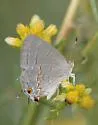
Dull grayish to brownish below, with dark lines usually (not always) edged in orange; with postmedian line continuous but disjointed at veins and W-shaped near tails on hind wing; there is a dark dash at the end of the discal cell on all wings, and on the hind wing there is a broken submedian dark line (that may be reduced to two or three dashes). Hind wing usually with one prominent submarginal orange spot surrounding smaller black spot in cell between base of tails (may be missing), and sometimes also with a little orange sorrounding black at tornus. Upper side dark brown with body, base of front wing, and much of hind wing blue. The hind wing has one long and one short tail (easily broken and may be missing). If the insect is alive, the eyes will be pale grayish in color with a pattern of tiny dark reflective spots that appear to move as you move (typical of butterfly eyes); however, nearly all Hairstreaks (and Blues) have opaque blackish eyes, and Ministrymon leda is one of the few exceptions.
Classification
- Kingdom
- Animalia
- Phylum
- Arthropoda
- Class
- Insecta
- Order
- Lepidoptera (Butterflies and Moths)
- Superfamily
- Papilionoidea
- Family
- Lycaenidae (Blues, Coppers, Hairstreaks, Harvesters)
- Subfamily
- Theclinae
- Tribe
- Eumaeini
- Genus
- Ministrymon (Ministreaks)
Imported taxonomy record. Source availability varies; see the source references and editorial policy below.
Habitat and Range
Habitat
Often near water, or often in canyons and along arroyos, but nearly always associated with Mesquite ( Prosopis species).
Geographic Range
CA-TX, CO / Mex. - Map - MPG At northern limits sometimes absent for several years at a time, and probably re-introduced by strays. Sometimes straying far north of usual range well beyond the distribution of Mesquite (northern Colorado, Nebraska, etc.). Should be watched for in southeastern Colorado, western Oklahoma and central Texas, where there is also Mesquite.
Seasonal Activity
Adults year-round as weather allows, but in the US apparently mostly in two broods (spring and summer) from April or May to October or November. Probably overwinters as pupae (?).
Diet and Behavior
Diet: Larvae feed on Mesquite - Prosopis species. Adults will nectar at a variety of flowers, and will sometimes visit puddles.
Additional species information
Species notes from the sources
Etymology: The form that was named " ines " has the orange coloring below reduced or lacking, and the gray ground color tends to be darker in through the median portion of the wings and palest in the postmedian area. While the form that was originally named " leda " has more even coloring below, and the orange coloring is usually strongly present. These are just color forms, and subject to individual and seasonal variation, with varied degrees of intermediates present as well.
About Butterflies and Moths: the wider group
Order-level background for Lepidoptera, the group containing Ministrymon leda. Species-specific details appear above.
Group overview
Lepidoptera includes approximately 180,000 described species of butterflies and moths. Moths outnumber butterflies roughly 10:1. The monarch butterfly's eastern population has declined by more than 80% since the mid-1990s, and the western population by over 95% since the 1980s. The IUCN lists the migratory monarch as Vulnerable.
Ecological role of the group
Butterflies and moths are essential indicators of ecosystem health. As caterpillars, they are a primary food source for birds - a single nest of blue tit chicks requires ~10,000 caterpillars. Adult moths pollinate many night-blooming plants.
Economic and practical significance of the group
Lepidoptera are critical pollinators. In Europe, grassland butterfly species have declined by almost 50% since the early 1990s. In the UK, three-quarters of butterflies are in decline. In the U.S., five butterfly species have gone extinct since 1950, with 29 listed as endangered.
Recorded sources for this group: IUCN Red List, Xerces Society, USFWS, PNAS, WWF. Imported estimates may describe particular regions or reporting periods.
Photos of Leda Ministreak - Hodges#4291 (5)
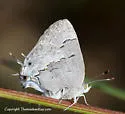
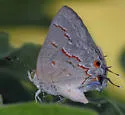
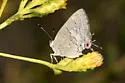
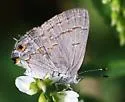
Photo credits: Contributed by Tony; Additional contributions by Mike Quinn , David Ferguson
Frequently Asked Questions About Leda Ministreak - Hodges#4291
What is Leda Ministreak - Hodges#4291?
Leda Ministreak - Hodges#4291 (Ministrymon leda) is a species in the family Lycaenidae, within the order Lepidoptera.
How do you identify Leda Ministreak - Hodges#4291?
Dull grayish to brownish below, with dark lines usually (not always) edged in orange; with postmedian line continuous but disjointed at veins and W-shaped near tails on hind wing; there is a dark dash at the end of the discal cell on all wings, and on the hind wing there is a broken submedian dark line (that may be reduced to two or three dashes). Hind wing usually with one prominent submarginal orange spot surrounding smaller black spot in cell between base of tails (may be missing), and sometimes also with a little orange sorrounding black at tornus. Upper side dark brown with body, base of front wing, and much of hind wing blue. The hind wing has one long and one short tail (easily broken and may be missing). If the insect is alive, the eyes will be pale grayish in color with a pattern of tiny dark reflective spots that appear to move as you move (typical of butterfly eyes); however, nearly all Hairstreaks (and Blues) have opaque blackish eyes, and Ministrymon leda is one of the few exceptions.
Where is Leda Ministreak - Hodges#4291 found?
| Feature | Details |
|---|---|
| Habitat | Often near water, or often in canyons and along arroyos, but nearly always associated with Mesquite ( Prosopis species). |
| Range | CA-TX, CO / Mex. - Map - MPG At northern limits sometimes absent for several years at a time, and probably re-introduced by strays. Sometimes straying far north of usual range well beyond the distribution of Mesquite (northern Colorado, Nebraska, etc.). Should be watched for in southeastern Colorado, western Oklahoma and central Texas, where there is also Mesquite. |
What does Leda Ministreak - Hodges#4291 eat?
The diet of the Leda Ministreak - Hodges#4291 includes Larvae feed on Mesquite - Prosopis species. Adults will nectar at a variety of flowers, and will sometimes visit puddles..
When is Leda Ministreak - Hodges#4291 active?
Leda Ministreak - Hodges#4291: seasonal activity - Adults year-round as weather allows, but in the US apparently mostly in two broods (spring and summer) from April or May to October or November. Probably overwinters as pupae (?)..