
Dungeness Crab
Metacarcinus magister
This record describes Metacarcinus magister (species). Recorded family: Cancridae. Recorded order: Decapoda.
Identification and Appearance
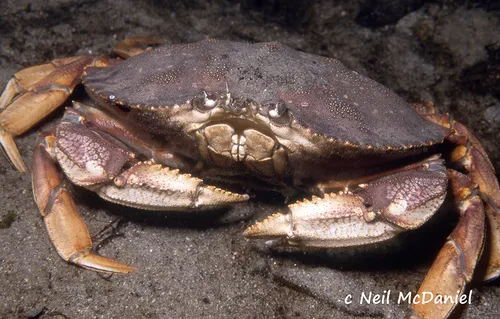
commonly sold in restaurants and markets in w. US. the most commercially important crab in the Pacific Northwest, as well as the western states generally. In 2014, 53 million pounds worth $170 million was harvested. the annual Dungeness Crab and Seafood Festival is held in Port Angeles, Washington each October. the Dungeness crab as the state crustacean of Oregon. (Wikipedia)
Classification
Habitat and Range
Habitat
young in sandy pools near low-tide line; older individuals gradually migrate to deeper waters.
Geographic Range
west coast of North America, from Alaska's Aleutian Islands to near Santa Barbara, California and occasionally further south to Baja California Sur, Mexico. (Wikipedia)
Additional species information
Species notes from the sources
Etymology: magister (L). 'master' named after Dungeness, Washington
About Crabs, Crayfishes, Lobsters, Prawns, and Shrimp: the wider group
Order-level background for Decapoda, the group containing Metacarcinus magister. Species-specific details appear above.
Group overview
Decapoda includes ~15,000 described species of crabs, lobsters, shrimp, and crayfish. Although primarily marine and freshwater, some species like hermit crabs and coconut crabs are fully terrestrial.
Ecological role of the group
Crayfish are keystone species in freshwater ecosystems, influencing water clarity, sediment dynamics, and plant communities. Hermit crabs play vital roles in nutrient cycling on tropical islands.
Economic and practical significance of the group
The global shrimp industry alone is worth over $45 billion annually. Crayfish are important aquaculture species and invasive crayfish cause ecological damage estimated in the hundreds of millions annually in Europe and North America.
Recorded sources for this group: FAO fisheries statistics, freshwater ecology. Imported estimates may describe particular regions or reporting periods.
Photos of Dungeness Crab (2)
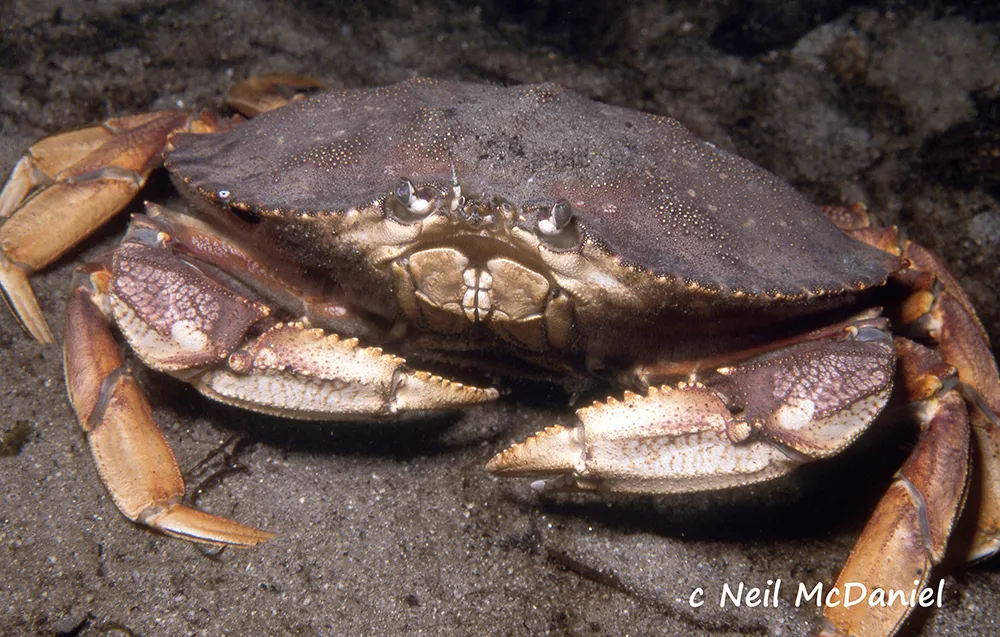
Photo credits: Contributed by Tim Loh; Additional contributions by Mike Quinn
Frequently Asked Questions About Dungeness Crab
What is Dungeness Crab?
Dungeness Crab (Metacarcinus magister) is a species in the family Cancridae, within the order Decapoda.
How big is Dungeness Crab?
to 25 cm carapace width (Wikipedia)
Where is Dungeness Crab found?
| Feature | Details |
|---|---|
| Habitat | young in sandy pools near low-tide line; older individuals gradually migrate to deeper waters. |
| Range | west coast of North America, from Alaska's Aleutian Islands to near Santa Barbara, California and occasionally further south to Baja California Sur, Mexico. (Wikipedia) |