
Melangyna quadrimaculata
This record describes Melangyna quadrimaculata (species). Recorded family: Syrphidae. Recorded order: Diptera.
Identification and Appearance
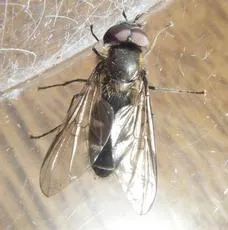
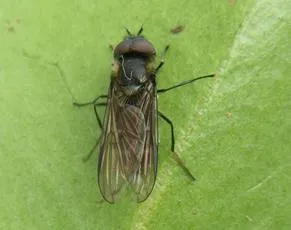
The males are unusual in having only four spots on the abdomen (hence the scientific name), this together with long pale hairs on both the thorasic dorsum and pale yellow scutellum are identifying features. The eyes are also very hairy. Females are distinct in being entirely black with a shape and venation that quickly separates them from spring-flying Cheilosia or Pipiza. Found on Willow and Hazel catkins and on Blackthorn blossom. A spring species seen from February to June and peaking in April. The larvae are predacious on adelgids on firs. Scarce but widely distributed throughout the British Isles. No additional images available for this species.
Classification
Habitat and Range
Habitat
Found on Willow and Hazel catkins and on Blackthorn blossom.
Seasonal Activity
A spring species seen from February to June and peaking in April.
Diet and Behavior
Life History
The larvae are predacious on
Additional species information
Recorded status
Scarce but widely distributed throughout the British Isles.
About Flies: the wider group
Order-level background for Diptera, the group containing Melangyna quadrimaculata. Species-specific details appear above.
Group overview
Diptera includes over 150,000 described species of flies, mosquitoes, and midges. Mosquitoes are the deadliest animal on Earth (CDC). Malaria alone causes ~249 million cases and over 608,000 deaths annually, mostly children under 5 (WHO). Vector-borne diseases account for over 17% of all infectious diseases, causing 700,000+ deaths per year.
Ecological role of the group
Despite their disease impact, flies are critical decomposers and pollinators. Hoverflies alone pollinate hundreds of crop and wildflower species. Flies are also the primary food source for many birds, bats, and fish. Forensic entomology relies heavily on fly species for crime scene analysis.
Economic and practical significance of the group
In the U.S., vector-borne disease cases tripled between 2004-2016, with over 640,000 cases reported in that period (CDC). Tickborne diseases doubled from 22,000 to 48,000 annual reports. Globally, mosquito-borne diseases cost billions in healthcare and lost productivity.
Recorded sources for this group: WHO, CDC, PNAS. Imported estimates may describe particular regions or reporting periods.
Photos of Melangyna quadrimaculata (2)
Frequently Asked Questions About Melangyna quadrimaculata
What is Melangyna quadrimaculata?
Melangyna quadrimaculata is a species in the family Syrphidae, within the order Diptera.
Where is Melangyna quadrimaculata found?
Habitat: Found on Willow and Hazel catkins and on Blackthorn blossom.
When is Melangyna quadrimaculata active?
Melangyna quadrimaculata: seasonal activity - A spring species seen from February to June and peaking in April..
What is the life cycle of a Melangyna quadrimaculata?
The larvae are predacious on