
Machimus maneei
This record describes Machimus maneei (species). Recorded family: Asilidae. Recorded order: Diptera.
Identification and Appearance
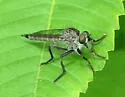
| Feature | Description |
|---|---|
| Additional details | Excerpts from Robber Flies of the Southeast: Machimus maneei occurs in sandy pinewoods throughout the eastern U.S. and Canada though populations appear to be spotty...Compared to other Machimus , this species is relatively easy to identify because it’s the only eastern Machimus with entirely black legs. The tips of the tibias can sometimes have a small amount of red on them, but that’s just par for the course with Machimus identification. Original description from Hine (1909): A small black species with black legs, gray stripes and markings on the thorax and gray posterior borders to the abdominal segments. Length 10-12 millimeters. Facial gibbosity rather prominent, mystax composed of a mixture of gray and black hairs, face and front black but sparsely clothed with gray dust, beard white, occipito-orbital bristles black, proboscis and palpi black, the latter with black hair. |
| Thorax | Thorax black, largely covered with gray dust, the mid-dorsal stripe black but distinctly divided by a white interval; legs black with not more than a suggestion of reddish at the bases of the tibiae, coxae with white hair, femora with some white hair and black bristles, other parts of the legs with short black hairs and prominent black bristles; wings hyaline, faintly gray at the apex and along the posterior border. |
| Abdomen | Abdomen black with rather long gray hairs especially toward the base, and with the posterior border of each segment gray. The male appendages shining black, rather slender, elevated on distal half and about as long as abdominal segments six, seven and eight together. Oviduct shining black, distinctly compressed laterally, end lamella free and style-like. |
Classification
Habitat and Range
Habitat
Sandy woods with pines
Geographic Range
NY-FL to MI-KY ; type specimen from Southern Pines, NC.
Seasonal Activity
Late spring into fall.
Additional species information
Species notes from the sources
Etymology: Named for collector Abram Herbert Manee (1858 - 1927); see original description .
About Flies: the wider group
Order-level background for Diptera, the group containing Machimus maneei. Species-specific details appear above.
Group overview
Diptera includes over 150,000 described species of flies, mosquitoes, and midges. Mosquitoes are the deadliest animal on Earth (CDC). Malaria alone causes ~249 million cases and over 608,000 deaths annually, mostly children under 5 (WHO). Vector-borne diseases account for over 17% of all infectious diseases, causing 700,000+ deaths per year.
Ecological role of the group
Despite their disease impact, flies are critical decomposers and pollinators. Hoverflies alone pollinate hundreds of crop and wildflower species. Flies are also the primary food source for many birds, bats, and fish. Forensic entomology relies heavily on fly species for crime scene analysis.
Economic and practical significance of the group
In the U.S., vector-borne disease cases tripled between 2004-2016, with over 640,000 cases reported in that period (CDC). Tickborne diseases doubled from 22,000 to 48,000 annual reports. Globally, mosquito-borne diseases cost billions in healthcare and lost productivity.
Recorded sources for this group: WHO, CDC, PNAS. Imported estimates may describe particular regions or reporting periods.
Photos of Machimus maneei (5)
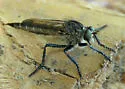
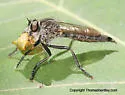
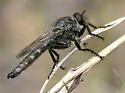
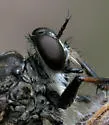
Photo credits: Contributed by Herschel Raney; Additional contributions by cotinis , v belov
Frequently Asked Questions About Machimus maneei
What is Machimus maneei?
Machimus maneei is a species in the family Asilidae, within the order Diptera.
How big is Machimus maneei?
10-12 mm (Hine, 1909)
How do you identify Machimus maneei?
| Feature | Description |
|---|---|
| Additional details | Excerpts from Robber Flies of the Southeast: Machimus maneei occurs in sandy pinewoods throughout the eastern U.S. and Canada though populations appear to be spotty...Compared to other Machimus , this species is relatively easy to identify because it’s the only eastern Machimus with entirely black legs. The tips of the tibias can sometimes have a small amount of red on them, but that’s just par for the course with Machimus identification. Original description from Hine (1909): A small black species with black legs, gray stripes and markings on the thorax and gray posterior borders to the abdominal segments. Length 10-12 millimeters. Facial gibbosity rather prominent, mystax composed of a mixture of gray and black hairs, face and front black but sparsely clothed with gray dust, beard white, occipito-orbital bristles black, proboscis and palpi black, the latter with black hair. |
| Thorax | Thorax black, largely covered with gray dust, the mid-dorsal stripe black but distinctly divided by a white interval; legs black with not more than a suggestion of reddish at the bases of the tibiae, coxae with white hair, femora with some white hair and black bristles, other parts of the legs with short black hairs and prominent black bristles; wings hyaline, faintly gray at the apex and along the posterior border. |
| Abdomen | Abdomen black with rather long gray hairs especially toward the base, and with the posterior border of each segment gray. The male appendages shining black, rather slender, elevated on distal half and about as long as abdominal segments six, seven and eight together. Oviduct shining black, distinctly compressed laterally, end lamella free and style-like. |
Where is Machimus maneei found?
| Feature | Details |
|---|---|
| Habitat | Sandy woods with pines |
| Range | NY-FL to MI-KY ; type specimen from Southern Pines, NC. |
When is Machimus maneei active?
Machimus maneei: seasonal activity - Late spring into fall..