
Brown Heath Robberfly
Machimus cingulatus
This record describes Machimus cingulatus (species). Recorded family: Asilidae. Recorded order: Diptera.
Identification and Appearance
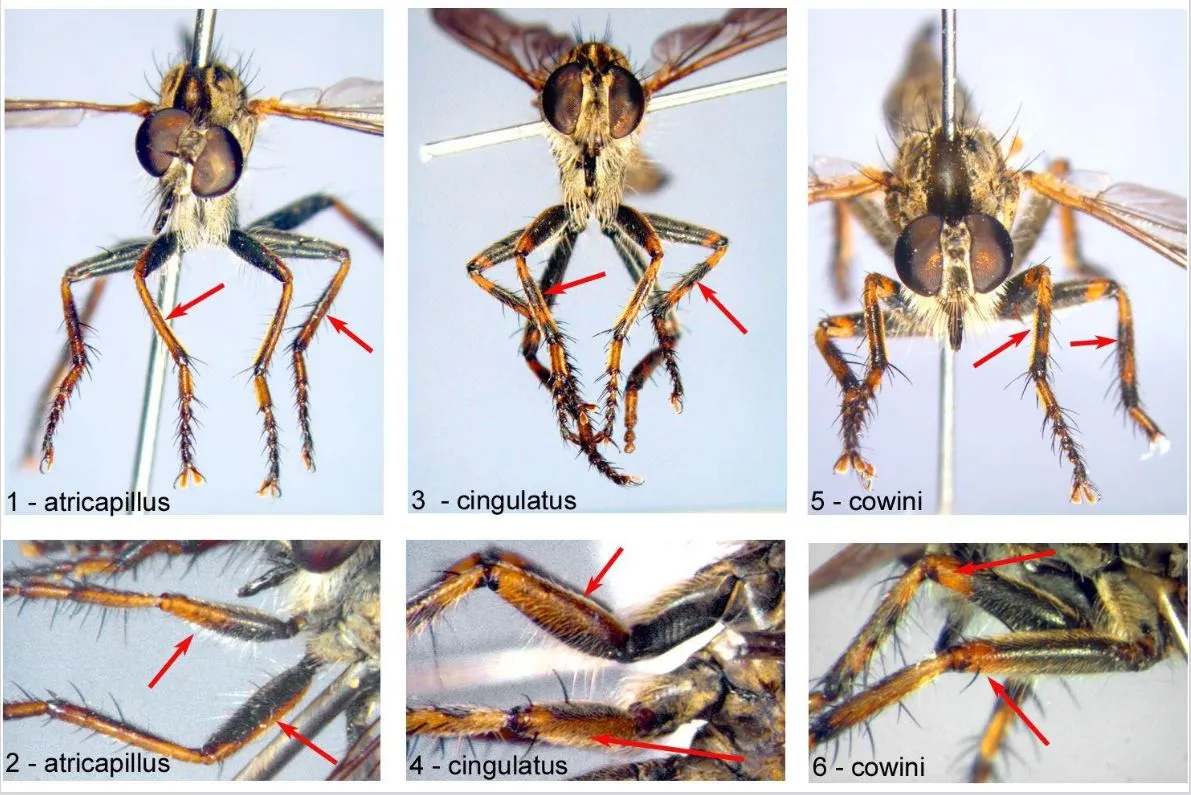
Size 10 to 15mm. A smallish robberfly with black and red legs. The femora are black on the anterior surface and orange of the posterior surface, with an orange ring near the tip. The top of the thorax has a thick black central line. Machimus atricapillus has almost all hairs at sides of frons black whereas M. cingulatus has them mostly white. The 'moustache' of M. atricapillus has denser and more numerous black bristles than that of M. cingulatus . M. cingulatus also tends to have strong dark bands on the anterior surface of the mid and fore tibiae. See ID Aids below. Good quality close-up photographs showing the key ID features, in particular the leg colours and patterns. Warm, open fields such as grasslands and heaths where there is dry, sandy soil. The adult makes short darts to capture prey which mainly consists of smaller Diptera. No additional images available for this species.
Classification
Habitat and Range
Habitat
Warm, open fields such as grasslands and heaths where there is dry, sandy soil.
Seasonal Activity
June to October - peak in August.
Diet and Behavior
Life History
The adult makes short darts to capture prey which mainly consists of smaller Diptera.
Additional species information
Recorded status
Local
About Flies: the wider group
Order-level background for Diptera, the group containing Machimus cingulatus. Species-specific details appear above.
Group overview
Diptera includes over 150,000 described species of flies, mosquitoes, and midges. Mosquitoes are the deadliest animal on Earth (CDC). Malaria alone causes ~249 million cases and over 608,000 deaths annually, mostly children under 5 (WHO). Vector-borne diseases account for over 17% of all infectious diseases, causing 700,000+ deaths per year.
Ecological role of the group
Despite their disease impact, flies are critical decomposers and pollinators. Hoverflies alone pollinate hundreds of crop and wildflower species. Flies are also the primary food source for many birds, bats, and fish. Forensic entomology relies heavily on fly species for crime scene analysis.
Economic and practical significance of the group
In the U.S., vector-borne disease cases tripled between 2004-2016, with over 640,000 cases reported in that period (CDC). Tickborne diseases doubled from 22,000 to 48,000 annual reports. Globally, mosquito-borne diseases cost billions in healthcare and lost productivity.
Recorded sources for this group: WHO, CDC, PNAS. Imported estimates may describe particular regions or reporting periods.
Frequently Asked Questions About Brown Heath Robberfly
What is Brown Heath Robberfly?
Brown Heath Robberfly (Machimus cingulatus) is a species in the family Asilidae, within the order Diptera.
How big is Brown Heath Robberfly?
10 to 15mm. A smallish robberfly with black and red legs. The femora are black on the anterior surface and orange of the posterior surface, with an orange ring near the tip. The top of the thorax has a thick black central line.
Where is Brown Heath Robberfly found?
Habitat: Warm, open fields such as grasslands and heaths where there is dry, sandy soil.
When is Brown Heath Robberfly active?
Brown Heath Robberfly: seasonal activity - June to October - peak in August..
What is the life cycle of a Brown Heath Robberfly?
The adult makes short darts to capture prey which mainly consists of smaller Diptera.