
Macaria sulphurea - Hodges#6283
Macaria sulphurea
This record describes Macaria sulphurea (species). Recorded family: Geometridae. Recorded order: Lepidoptera.
Identification and Appearance
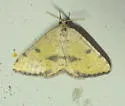
Rich cream-yellow with maroon brown markings, consisting of two to three wedge shaped spots along the forewing costa, prominent discal spots, and variable PM and submarginal lines. The forewing PM band is usually light and spotty, but always widens to a patch at the anal margin. Fringe entirely maroon-brown, unlike the similar M. occiduaria which has the dark forewing fringe restricted to the apex. Sexually dimorphic, females with slightly reduced wings, although not to the same extent as andersoni, simplex and occiduaria. Ferguson (1953) named the subspecies amboflava from western Canada (type locality Calgary) to describe our yellow populations, which are, according to Ferguson, quite distinct from the smaller, greyish eastern sulphurea. (AEC) Regarding sulphurea and amboflava , Ferguson states: Speranza sulphurea is a sexually dimorphic, eastern, bog-dwelling species, of which the male is nearly the color of Speranza argillacearia [more nearly immaculate mouse gray] . (MONA Fascicle 17.2, pg.82) Speranza amboflava is the obvious sister species of sulphurea, replacing the latter species in the West. It lacks the conspicuous sexual dimorphism of the eastern species; both sexes are bright yellow and closely resemble females of sulphurea, although usually larger. (MONA Fascicle 17.2, pg.84) However, more current data than Ferguson (2008) does have sulphurea collected in the pacific northwest and there is a growing number of sequenced male individuals from that population that are quite yellow, and quite well marked. As more individuals of the two species are sequenced, we're finding that the external characteristics are less reliable than previously thought--or so it seems based on the genetic evidence. So distinguishing yellow individuals by photo in overlapping distribution locales may prove difficult or impossible at this time.
Classification
- Kingdom
- Animalia
- Phylum
- Arthropoda
- Class
- Insecta
- Order
- Lepidoptera (Butterflies and Moths)
- Superfamily
- Geometroidea
- Family
- Geometridae (Geometrid Moths)
- Subfamily
- Ennominae
- Tribe
- Macariini
- Genus
- Macaria
Imported taxonomy record. Source availability varies; see the source references and editorial policy below.
Habitat and Range
Habitat
Prairie and parkland woods and shrubby habitats. (AEC)
Geographic Range
Nova Scotia west to BC, south to California and South Dakota (McGuffin 1972; Fauske 2003).
Seasonal Activity
Flies in July and August, peaking in mid to late July. (AEC)
Diet and Behavior
Diet: Unknown in western North America. Larva feed on Vaccinium and Myrica gale in eastern North America (Ferguson 1953; Forbes 1948).
Life History
The life history has not been recorded in detail. Mature larvae are light green with a slightly paler head and a cream dorsal and lateral stripe (Franklin 1907, cited in McGuffin 1972). In eastern North america this is a forest species associated with blueberry (Vaccinium) and sweet gale (Myrica gale). The western race prefers drier habitats, and is not found in association with these plants. The differences in adult size, colouration and habitat preferences between eastern and western populations suggests that they may be separate species. (AEC)
About Butterflies and Moths: the wider group
Order-level background for Lepidoptera, the group containing Macaria sulphurea. Species-specific details appear above.
Group overview
Lepidoptera includes approximately 180,000 described species of butterflies and moths. Moths outnumber butterflies roughly 10:1. The monarch butterfly's eastern population has declined by more than 80% since the mid-1990s, and the western population by over 95% since the 1980s. The IUCN lists the migratory monarch as Vulnerable.
Ecological role of the group
Butterflies and moths are essential indicators of ecosystem health. As caterpillars, they are a primary food source for birds - a single nest of blue tit chicks requires ~10,000 caterpillars. Adult moths pollinate many night-blooming plants.
Economic and practical significance of the group
Lepidoptera are critical pollinators. In Europe, grassland butterfly species have declined by almost 50% since the early 1990s. In the UK, three-quarters of butterflies are in decline. In the U.S., five butterfly species have gone extinct since 1950, with 29 listed as endangered.
Recorded sources for this group: IUCN Red List, Xerces Society, USFWS, PNAS, WWF. Imported estimates may describe particular regions or reporting periods.
Photos of Macaria sulphurea - Hodges#6283 (5)
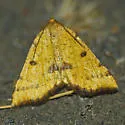
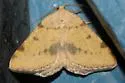
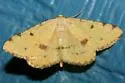
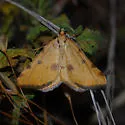
Photo credits: Contributed by Jason D. Roberts; Additional contributions by Maury Heiman , ceiseman , Robert H. Biagi
Frequently Asked Questions About Macaria sulphurea - Hodges#6283
What is Macaria sulphurea - Hodges#6283?
Macaria sulphurea - Hodges#6283 (Macaria sulphurea) is a species in the family Geometridae, within the order Lepidoptera.
How big is Macaria sulphurea - Hodges#6283?
20-25mm
How do you identify Macaria sulphurea - Hodges#6283?
Rich cream-yellow with maroon brown markings, consisting of two to three wedge shaped spots along the forewing costa, prominent discal spots, and variable PM and submarginal lines. The forewing PM band is usually light and spotty, but always widens to a patch at the anal margin. Fringe entirely maroon-brown, unlike the similar M. occiduaria which has the dark forewing fringe restricted to the apex. Sexually dimorphic, females with slightly reduced wings, although not to the same extent as andersoni, simplex and occiduaria. Ferguson (1953) named the subspecies amboflava from western Canada (type locality Calgary) to describe our yellow populations, which are, according to Ferguson, quite distinct from the smaller, greyish eastern sulphurea. (AEC)
Where is Macaria sulphurea - Hodges#6283 found?
| Feature | Details |
|---|---|
| Habitat | Prairie and parkland woods and shrubby habitats. (AEC) |
| Range | Nova Scotia west to BC, south to California and South Dakota (McGuffin 1972; Fauske 2003). |
What does Macaria sulphurea - Hodges#6283 eat?
The diet of the Macaria sulphurea - Hodges#6283 includes Unknown in western North America. Larva feed on Vaccinium and Myrica gale in eastern North America (Ferguson 1953; Forbes 1948)..
When is Macaria sulphurea - Hodges#6283 active?
Macaria sulphurea - Hodges#6283: seasonal activity - Flies in July and August, peaking in mid to late July. (AEC).
What is the life cycle of a Macaria sulphurea - Hodges#6283?
The life history has not been recorded in detail. Mature larvae are light green with a slightly paler head and a cream dorsal and lateral stripe (Franklin 1907, cited in McGuffin 1972). In eastern North america this is a forest species associated with blueberry (Vaccinium) and sweet gale (Myrica gale). The western race prefers drier habitats, and is not found in association with these plants. The differences in adult size, colouration and habitat preferences between eastern and western populations suggests that they may be separate species. (AEC)