
Macaria amboflava - Hodges#6284
Macaria amboflava
This record describes Macaria amboflava (species). Recorded family: Geometridae. Recorded order: Lepidoptera.
Identification and Appearance
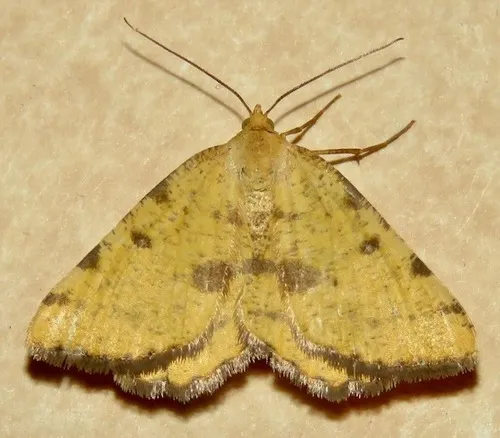
Regarding sulphurea and amboflava , Ferguson states: Speranza sulphurea is a sexually dimorphic, eastern, bog-dwelling species, of which the male is nearly the color of Speranza argillacearia [more nearly immaculate mouse gray] . (MONA Fascicle 17.2, pg.82) Speranza amboflava is the obvious sister species of sulphurea, replacing the latter species in the West. It lacks the conspicuous sexual dimorphism of the eastern species; both sexes are bright yellow and closely resemble females of sulphurea, although usually larger. (MONA Fascicle 17.2, pg.84) However, more current data than Ferguson (2008) does have sulphurea collected in the pacific northwest and there is a growing number of sequenced male individuals from that population that are quite yellow, and quite well marked. As more individuals of the two species are sequenced, we're finding that the external characteristics are less reliable than previously thought--or so it seems based on the genetic evidence. So distinguishing yellow individuals by photo in overlapping distribution locales may prove difficult or impossible at this time.
Classification
- Kingdom
- Animalia
- Phylum
- Arthropoda
- Class
- Insecta
- Order
- Lepidoptera (Butterflies and Moths)
- Superfamily
- Geometroidea
- Family
- Geometridae (Geometrid Moths)
- Subfamily
- Ennominae
- Tribe
- Macariini
- Genus
- Macaria
Imported taxonomy record. Source availability varies; see the source references and editorial policy below.
About Butterflies and Moths: the wider group
Order-level background for Lepidoptera, the group containing Macaria amboflava. Species-specific details appear above.
Group overview
Lepidoptera includes approximately 180,000 described species of butterflies and moths. Moths outnumber butterflies roughly 10:1. The monarch butterfly's eastern population has declined by more than 80% since the mid-1990s, and the western population by over 95% since the 1980s. The IUCN lists the migratory monarch as Vulnerable.
Ecological role of the group
Butterflies and moths are essential indicators of ecosystem health. As caterpillars, they are a primary food source for birds - a single nest of blue tit chicks requires ~10,000 caterpillars. Adult moths pollinate many night-blooming plants.
Economic and practical significance of the group
Lepidoptera are critical pollinators. In Europe, grassland butterfly species have declined by almost 50% since the early 1990s. In the UK, three-quarters of butterflies are in decline. In the U.S., five butterfly species have gone extinct since 1950, with 29 listed as endangered.
Recorded sources for this group: IUCN Red List, Xerces Society, USFWS, PNAS, WWF. Imported estimates may describe particular regions or reporting periods.
Photos of Macaria amboflava - Hodges#6284 (2)
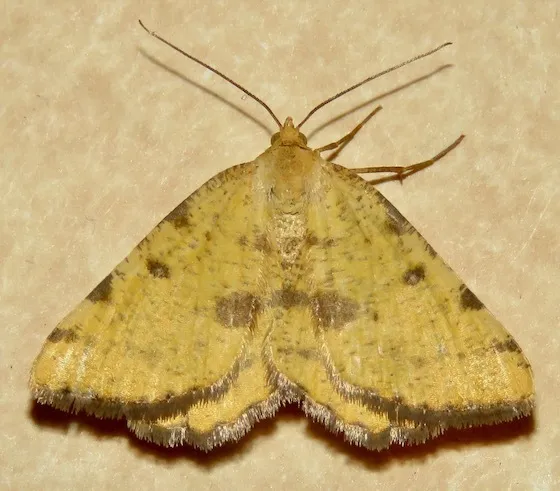
Photo credits: Contributed by John F. Carr; Additional contributions by Jason D. Roberts , Maury Heiman , ceiseman , Robert H. Biagi