
Hemipenthes webberi
This record describes Hemipenthes webberi (species). Recorded family: Bombyliidae. Recorded order: Diptera.
Identification and Appearance
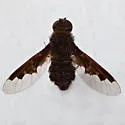
| Feature | Details |
|---|---|
| Head | Round, black with a few yellowish flecks. Females and males identical, except for space between the eyes at top of head. Antenna: Black, very short. |
| Thorax | Black hair with some yellowish flecks; a few white hairs at side edges below the wing bases, barely noticeable. Wings: Brown on outer (costa) edge and inward to a little over half the width of wing. Tips clear. Main ID: Inner wing edge always clear (anal cell). |
| Legs | Black. Tips of front and middle thigh (femora) yellow. Hind shin (tibiae) yellow. Feet black. |
| Abdomen | Black with some white at sides of 1st and last segments. Note: Conflicting descriptions of abdomen from all 3 authors. Types: Holotype as Villa webberi male by Johnson, 1919. Type Locality: Massachusetts. In the Museum of Comparative Zoology, Harvard, Cambridge, Massachusetts. |
Classification
- Kingdom
- Animalia
- Phylum
- Arthropoda
- Class
- Insecta
- Order
- Diptera (Flies)
- Superfamily
- Asiloidea
- Family
- Bombyliidae (Bee Flies)
- Subfamily
- Anthracinae
- Tribe
- Villini
- Genus
- Hemipenthes
Imported taxonomy record. Source availability varies; see the source references and editorial policy below.
Diet and Behavior
Diet: Known larval hosts for Hemipenthes in general include both Lepidoptera and diprionid sawflies and the tachinid flies and ichneumonoid wasps parasitizing them.
Additional species information
Species notes from the sources
Etymology: Hemipenthes webberi (Johnson 1919)
About Flies: the wider group
Order-level background for Diptera, the group containing Hemipenthes webberi. Species-specific details appear above.
Group overview
Diptera includes over 150,000 described species of flies, mosquitoes, and midges. Mosquitoes are the deadliest animal on Earth (CDC). Malaria alone causes ~249 million cases and over 608,000 deaths annually, mostly children under 5 (WHO). Vector-borne diseases account for over 17% of all infectious diseases, causing 700,000+ deaths per year.
Ecological role of the group
Despite their disease impact, flies are critical decomposers and pollinators. Hoverflies alone pollinate hundreds of crop and wildflower species. Flies are also the primary food source for many birds, bats, and fish. Forensic entomology relies heavily on fly species for crime scene analysis.
Economic and practical significance of the group
In the U.S., vector-borne disease cases tripled between 2004-2016, with over 640,000 cases reported in that period (CDC). Tickborne diseases doubled from 22,000 to 48,000 annual reports. Globally, mosquito-borne diseases cost billions in healthcare and lost productivity.
Recorded sources for this group: WHO, CDC, PNAS. Imported estimates may describe particular regions or reporting periods.
Photos of Hemipenthes webberi (5)
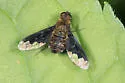
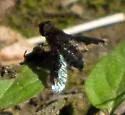
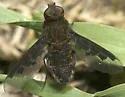
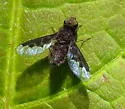
Photo credits: Contributed by Joel Kits; Additional contributions by v belov , lee_penner
Frequently Asked Questions About Hemipenthes webberi
What is Hemipenthes webberi?
Hemipenthes webberi is a species in the family Bombyliidae, within the order Diptera.
How big is Hemipenthes webberi?
6 to 10 mm long.
How do you identify Hemipenthes webberi?
| Feature | Details |
|---|---|
| Head | Round, black with a few yellowish flecks. Females and males identical, except for space between the eyes at top of head. Antenna: Black, very short. |
| Thorax | Black hair with some yellowish flecks; a few white hairs at side edges below the wing bases, barely noticeable. Wings: Brown on outer (costa) edge and inward to a little over half the width of wing. Tips clear. Main ID: Inner wing edge always clear (anal cell). |
| Legs | Black. Tips of front and middle thigh (femora) yellow. Hind shin (tibiae) yellow. Feet black. |
| Abdomen | Black with some white at sides of 1st and last segments. Note: Conflicting descriptions of abdomen from all 3 authors. |
What does Hemipenthes webberi eat?
The diet of the Hemipenthes webberi includes Known larval hosts for Hemipenthes in general include both Lepidoptera and diprionid sawflies and the tachinid flies and ichneumonoid wasps parasitizing them..