
Sinuous Bee Fly
Hemipenthes sinuosa
This record describes Hemipenthes sinuosa (species). Recorded family: Bombyliidae. Recorded order: Diptera.
Identification and Appearance
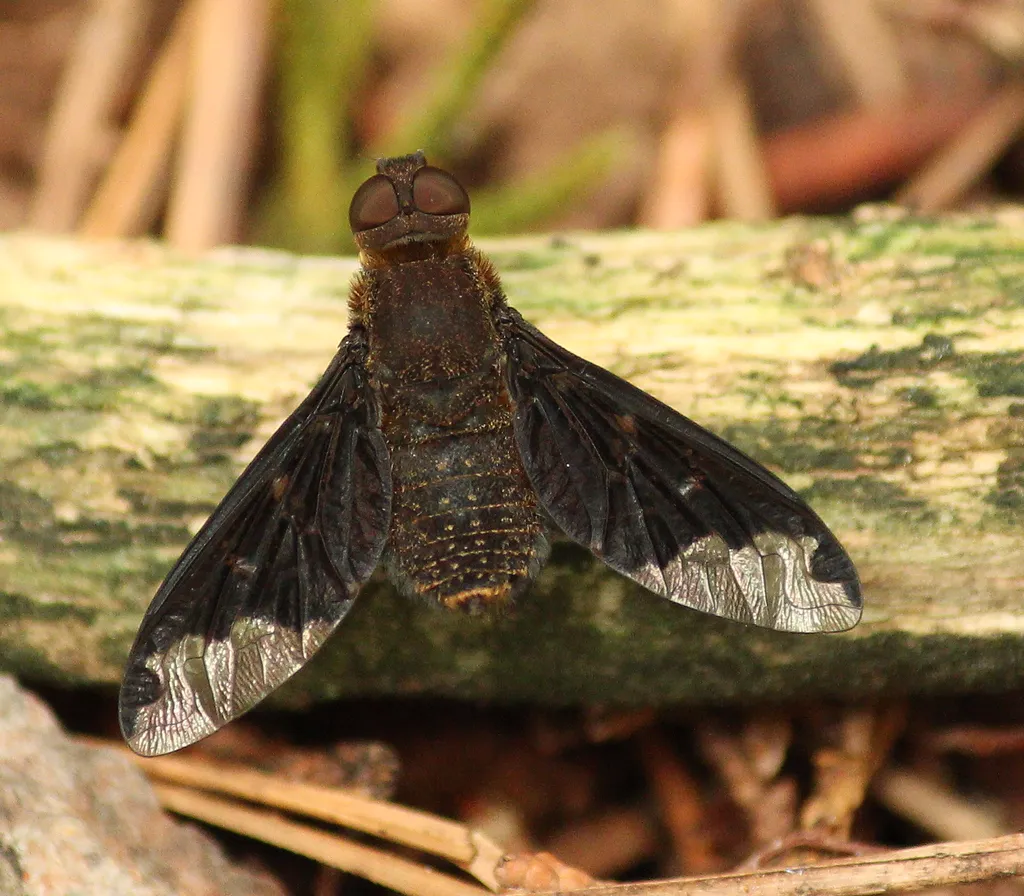
Main ID: Black area of wing has irregular sinuous (wavy) border with a small rounded blob near the apex. There is no cross vein connecting R2+3 and R4. Abdomen, thorax, and head black or very dark with no banding or other obvious markings Types: Holotype as Anthrax sinuosa female by Wiedemann, 1821. Type Locality: Georgia. In the Naturhistorisches Museum Wien (Vienna), Austria. Holotype as Anthrax nycthemera by Macquart, 1840. Type Locality: Georgia. In the Muséum National d'Histoire Naturelle, Paris, France. Holotype as Anthrax concisa by Macquart, 1840. Type Locality: Carolina. In the In the Muséum National d'Histoire Naturelle, Paris, France. Holotype as Anthrax assimilis by Macquart, 1846. Type Locality: Texas. Originally in the early Eugene Pilate Collection, destroyed by fire during Civil War in Louisiana. Pilate’s later collection is in the Dayton Museum, Ohio.
Wikipedia reference for Hemipenthes sinuosa: https://en.wikipedia.org/wiki/Hemipenthes_sinuosa.
Classification
- Kingdom
- Animalia
- Phylum
- Arthropoda
- Class
- Insecta
- Order
- Diptera (Flies)
- Superfamily
- Asiloidea
- Family
- Bombyliidae (Bee Flies)
- Subfamily
- Anthracinae
- Tribe
- Villini
- Genus
- Hemipenthes
Imported taxonomy record. Source availability varies; see the source references and editorial policy below.
Habitat and Range
Habitat
open areas with sandy or well-drained soil and sparse or low vegetation. Boreal forests or forests with pine.
Geographic Range
most of NA
Seasonal Activity
All season; late May to August in the north.
Diet and Behavior
Diet: Larvae feed on Pine Sawflies Neodiprion species.
Life History
Larva: 4.5 mm long. Smooth and flat, no hair; dusky with white head and abdomen tip. Head retracting with jaws on underside. Tubercle on sides of each segment.
Additional species information
Species notes from the sources
Etymology: sinuosa = 'sinuous; winding; undulating' (refers to the border of the black area on the wing)
About Flies: the wider group
Order-level background for Diptera, the group containing Hemipenthes sinuosa. Species-specific details appear above.
Group overview
Diptera includes over 150,000 described species of flies, mosquitoes, and midges. Mosquitoes are the deadliest animal on Earth (CDC). Malaria alone causes ~249 million cases and over 608,000 deaths annually, mostly children under 5 (WHO). Vector-borne diseases account for over 17% of all infectious diseases, causing 700,000+ deaths per year.
Ecological role of the group
Despite their disease impact, flies are critical decomposers and pollinators. Hoverflies alone pollinate hundreds of crop and wildflower species. Flies are also the primary food source for many birds, bats, and fish. Forensic entomology relies heavily on fly species for crime scene analysis.
Economic and practical significance of the group
In the U.S., vector-borne disease cases tripled between 2004-2016, with over 640,000 cases reported in that period (CDC). Tickborne diseases doubled from 22,000 to 48,000 annual reports. Globally, mosquito-borne diseases cost billions in healthcare and lost productivity.
Recorded sources for this group: WHO, CDC, PNAS. Imported estimates may describe particular regions or reporting periods.
Photos of Sinuous Bee Fly (3)
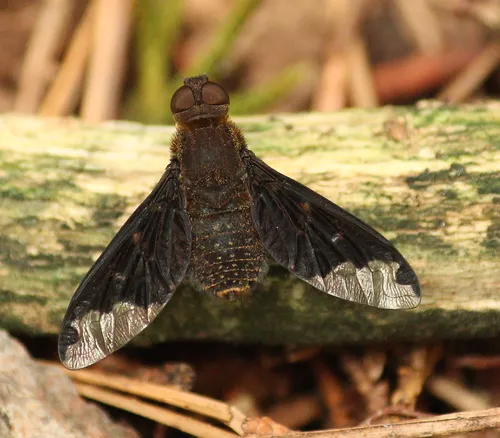
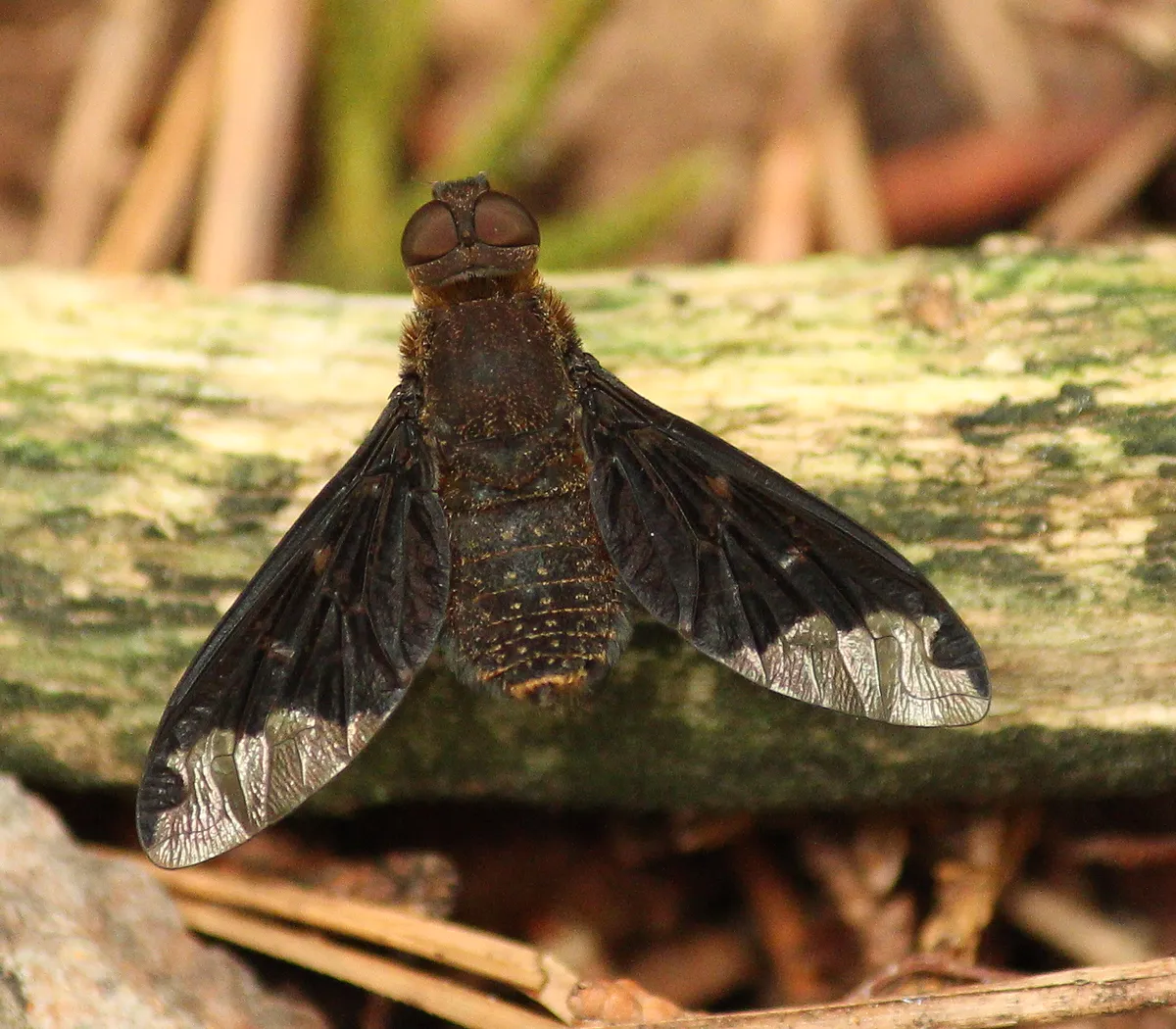
Photo credits: Contributed by Robin McLeod; Additional contributions by Aaron Schusteff , v belov , lee_penner , zdanko
Frequently Asked Questions About Sinuous Bee Fly
What is Sinuous Bee Fly?
Sinuous Bee Fly (Hemipenthes sinuosa) is a species in the family Bombyliidae, within the order Diptera.
How big is Sinuous Bee Fly?
5 to 15 mm long.
How do you identify Sinuous Bee Fly?
Main ID: Black area of wing has irregular sinuous (wavy) border with a small rounded blob near the apex. There is no cross vein connecting R2+3 and R4. Abdomen, thorax, and head black or very dark with no banding or other obvious markings
Where is Sinuous Bee Fly found?
| Feature | Details |
|---|---|
| Habitat | open areas with sandy or well-drained soil and sparse or low vegetation. Boreal forests or forests with pine. |
| Range | most of NA |
What does Sinuous Bee Fly eat?
The diet of the Sinuous Bee Fly includes Larvae feed on Pine Sawflies Neodiprion species..
When is Sinuous Bee Fly active?
Sinuous Bee Fly: seasonal activity - All season; late May to August in the north..
What is the life cycle of a Sinuous Bee Fly?
Larva: 4.5 mm long. Smooth and flat, no hair; dusky with white head and abdomen tip. Head retracting with jaws on underside. Tubercle on sides of each segment.