
Blue-green Sharpshooter
Graphocephala atropunctata
This record describes Graphocephala atropunctata (species). Recorded family: Cicadellidae. Recorded order: Hemiptera.
Identification and Appearance
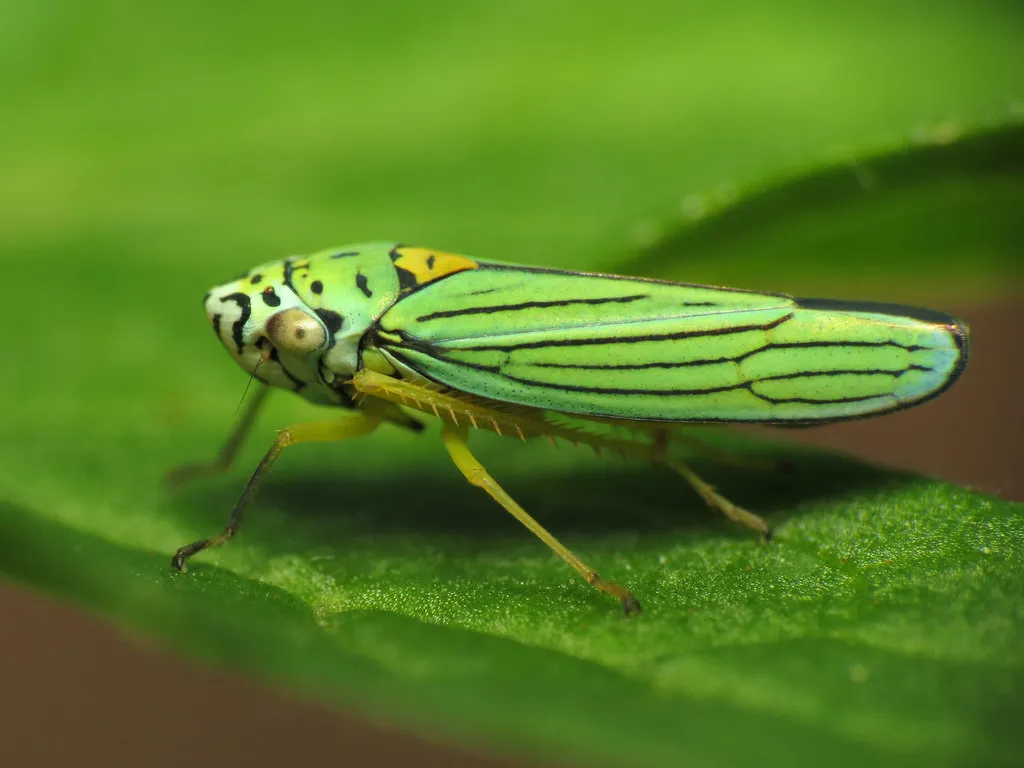
A rather variable species ranging across a number of blue and green forms, usually based on population (due to genetic isolation). Populations in Northern California are often a dark green with fainter markings, while populations in Southern California are bright blue with darker markings. The wings usually have dark/black venation which can sometimes appear very bold and imperfect as if drawn on with bleeding ink. There is a series of spots on the head (which is sometimes paler than the rest of the body) and pronotum, the placement of which can vary slightly based on population. The scutellum is often a pale to bright yellow. Nymphs of this species are white/pale yellow with yellow markings on the abdomen developing with age. They are indiscernible from G. fennahi nymphs from Northern California to British Columbia and identical to nymphs of G. versuta and G. cythura in Southern California. a major vector of Pierce's disease of grape in coastal CA
Wikipedia reference for Graphocephala atropunctata: https://en.wikipedia.org/wiki/Graphocephala_atropunctata.
Classification
- Kingdom
- Animalia
- Phylum
- Arthropoda
- Class
- Insecta
- Order
- Hemiptera (True Bugs, Cicadas, Hoppers, Aphids and Allies)
- Suborder
- Auchenorrhyncha
- Superfamily
- Membracoidea
- Family
- Cicadellidae (Typical Leafhoppers)
- Subfamily
- Cicadellinae
- Tribe
- Cicadellini
- Genus
- Graphocephala
Imported taxonomy record. Source availability varies; see the source references and editorial policy below.
Habitat and Range
Habitat
usually humid riparian areas, but can be found in a wide range of habitats
Geographic Range
widespread throughout the western U.S. (recorded throughout Mexico and Central America, though this may potentially be a separate cryptic species)
Diet and Behavior
Diet: a wide range of associated with vines and woody plants. primarily found on wild grape and blackberry.
Additional species information
Species notes from the sources
Etymology: Graphocephala atropunctata (Signoret 1854)
About True Bugs, Cicadas, Hoppers, Aphids and Allies: the wider group
Order-level background for Hemiptera, the group containing Graphocephala atropunctata. Species-specific details appear above.
Group overview
Hemiptera (true bugs) includes over 80,000 described species across cicadas, aphids, leafhoppers, shield bugs, and bed bugs. Aphids alone cost global agriculture an estimated $2.5 billion annually in crop losses.
Ecological role of the group
Many Hemiptera are essential food sources for birds and predatory insects. Cicadas provide massive nutrient pulses during emergence events - a single Brood X emergence can involve trillions of individuals across 15 states.
Economic and practical significance of the group
The brown marmorated stink bug (Halyomorpha halys) caused $37 million in apple crop losses in a single year in the U.S. Mid-Atlantic region. Bed bug infestations in the U.S. increased by 500% between 2001-2010, costing the hotel industry hundreds of millions annually.
Recorded sources for this group: USDA, EPA, University research. Imported estimates may describe particular regions or reporting periods.
Photos of Blue-green Sharpshooter (2)
Photo credits: Contributed by Robin McLeod; Additional contributions by v belov , antarctica
Frequently Asked Questions About Blue-green Sharpshooter
What is Blue-green Sharpshooter?
Blue-green Sharpshooter (Graphocephala atropunctata) is a species in the family Cicadellidae, within the order Hemiptera.
How do you identify Blue-green Sharpshooter?
A rather variable species ranging across a number of blue and green forms, usually based on population (due to genetic isolation). Populations in Northern California are often a dark green with fainter markings, while populations in Southern California are bright blue with darker markings. The wings usually have dark/black venation which can sometimes appear very bold and imperfect as if drawn on with bleeding ink. There is a series of spots on the head (which is sometimes paler than the rest of the body) and pronotum, the placement of which can vary slightly based on population. The scutellum is often a pale to bright yellow. Nymphs of this species are white/pale yellow with yellow markings on the abdomen developing with age. They are indiscernible from G. fennahi nymphs from Northern California to British Columbia and identical to nymphs of G. versuta and G. cythura in Southern California.
Where is Blue-green Sharpshooter found?
| Feature | Details |
|---|---|
| Habitat | usually humid riparian areas, but can be found in a wide range of habitats |
| Range | widespread throughout the western U.S. (recorded throughout Mexico and Central America, though this may potentially be a separate cryptic species) |
What does Blue-green Sharpshooter eat?
The diet of the Blue-green Sharpshooter includes a wide range of associated with vines and woody plants. primarily found on wild grape and blackberry..