
Anicia Checkerspot - Hodges#4519
Euphydryas anicia
This record describes Euphydryas anicia (species). Recorded family: Nymphalidae. Recorded order: Lepidoptera.
Identification and Appearance
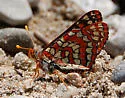
Distinction from E. chalcedona is based mainly on differences in genitalia; however, in most regions they may be told apart by the darker, more prevalently black coloring of E. chalcedona . Distinction from E. editha is sometimes difficult, and is also best done by looking at genitalia. However, in many areas E. editha can be separated by the fact that on the under side of the hind wing the orange postmedian (just outside the middle) orange band is usually divided by a black line, while in E. anicia and E. chalcedona this same black line is ill-defined or absent and located near the inner edge, with the inner side of it white or yellowish instead of orange. On the upper side the markings of E. editha appear to be more squared (especially in the median orange band), more regular, and more continuous and lined up from front to hind wings. Also the wings of E. editha are often more rounded in shape and more elongate and pointed in E. anicia and E. chalcedona . Often two or three of these species fly together. In most inland cold winter regionas E. editha and E. chalcedona begin to fly well before E. anicia . Many subspecies names have been given, but some are of debatable distinction. It is often difficult to know where to draw a line between them. Thus (for example) in Colorado at least five subspecies are usually recognized that blend with one another depending on location and elevation, but a sixth subspecies occurs there that usually behaves as if a different species. The norm for the E. anicia is that it looks a bit different (and sometimes quite different) every time you move to a new location. Also, where there are two broods, the spring flight sometimes looks a bit different from the later flight. An attempt is made here to put the right subspecies name on the photos; however, since subspecies do blend into one another broadly, and since more than one subspecies occur together in some regions, the assignments given here may be a bit uncertain or arbitrary at times, and should be taken with a grain of salt. This is especially true in areas of varied habitats and where subspecies displace one another over relatively short distances.
Classification
- Kingdom
- Animalia
- Phylum
- Arthropoda
- Class
- Insecta
- Order
- Lepidoptera (Butterflies and Moths)
- Superfamily
- Papilionoidea
- Family
- Nymphalidae (Brush-footed Butterflies)
- Subfamily
- Nymphalinae
- Tribe
- Melitaeini
- Genus
- Euphydryas (Checkerspots)
Imported taxonomy record. Source availability varies; see the source references and editorial policy below.
Habitat and Range
Geographic Range
Primarily in mountains. Arizona and New Mexico north through the Colorado Plateuas, Rockies, and mountains of the Great Basin north to South Dakota, Alberta, and Alaska. Similar looking orangey populations with the male genitalia of E. chalcedona that occur in mountains nearer the Pacific Coast are grouped separately.
About Butterflies and Moths: the wider group
Order-level background for Lepidoptera, the group containing Euphydryas anicia. Species-specific details appear above.
Group overview
Lepidoptera includes approximately 180,000 described species of butterflies and moths. Moths outnumber butterflies roughly 10:1. The monarch butterfly's eastern population has declined by more than 80% since the mid-1990s, and the western population by over 95% since the 1980s. The IUCN lists the migratory monarch as Vulnerable.
Ecological role of the group
Butterflies and moths are essential indicators of ecosystem health. As caterpillars, they are a primary food source for birds - a single nest of blue tit chicks requires ~10,000 caterpillars. Adult moths pollinate many night-blooming plants.
Economic and practical significance of the group
Lepidoptera are critical pollinators. In Europe, grassland butterfly species have declined by almost 50% since the early 1990s. In the UK, three-quarters of butterflies are in decline. In the U.S., five butterfly species have gone extinct since 1950, with 29 listed as endangered.
Recorded sources for this group: IUCN Red List, Xerces Society, USFWS, PNAS, WWF. Imported estimates may describe particular regions or reporting periods.
Photos of Anicia Checkerspot - Hodges#4519 (5)
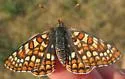
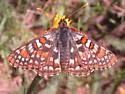
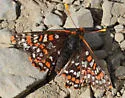
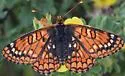
Photo credits: Contributed by Chuck Entz; Additional contributions by Steve Nanz , David Ferguson
Frequently Asked Questions About Anicia Checkerspot - Hodges#4519
What is Anicia Checkerspot - Hodges#4519?
Anicia Checkerspot - Hodges#4519 (Euphydryas anicia) is a species in the family Nymphalidae, within the order Lepidoptera.
How do you identify Anicia Checkerspot - Hodges#4519?
Distinction from E. chalcedona is based mainly on differences in genitalia; however, in most regions they may be told apart by the darker, more prevalently black coloring of E. chalcedona . Distinction from E. editha is sometimes difficult, and is also best done by looking at genitalia. However, in many areas E. editha can be separated by the fact that on the under side of the hind wing the orange postmedian (just outside the middle) orange band is usually divided by a black line, while in E. anicia and E. chalcedona this same black line is ill-defined or absent and located near the inner edge, with the inner side of it white or yellowish instead of orange. On the upper side the markings of E. editha appear to be more squared (especially in the median orange band), more regular, and more continuous and lined up from front to hind wings. Also the wings of E. editha are often more rounded in shape and more elongate and pointed in E. anicia and E. chalcedona . Often two or three of these species fly together. In most inland cold winter regionas E. editha and E. chalcedona begin to fly well before E. anicia .
Where is Anicia Checkerspot - Hodges#4519 found?
Range: Primarily in mountains. Arizona and New Mexico north through the Colorado Plateuas, Rockies, and mountains of the Great Basin north to South Dakota, Alberta, and Alaska. Similar looking orangey populations with the male genitalia of E. chalcedona that occur in mountains nearer the Pacific Coast are grouped separately.