
chalcedona-like
Euphydryas anicia--c
This record describes Euphydryas anicia--c (species). Recorded family: Nymphalidae. Recorded order: Lepidoptera.
Identification and Appearance
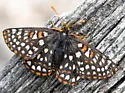
This grouping is for populations which look different from the bulk of E. anicia , and which sometimes seem to intergrade with populations of E. chalcedona to the west and south. They have male genitalia that are of the E. anicia type. These populations tend to occur in drier and often lower elevation habitats than more typical populations of E. anicia , but in many areas the two basic types occur side by side in the same locations and behave as different entities. Most often these less orange populations start flying somewhat earlier than the more orange and more typical E. anicia populations. It is tempting to call them all subspecies of E. chalcedona , but they are listed as belonging to E. anicia by most authors, and the situation may not be quite so simple. There may be a distinct species involved. Indeed, some of these have been considered to belong to a distinct species, using the name E. bernadetta . This is a tempting solution, but bernadetta is perhaps not the oldest name available for the group, so it seems best to wait until more studies are completed before jumping on this name for the whole group. The situation remains a bit confusing, but these secondary groupings under the species names will help to sort similar butterflies together in what hopefully are more useful categories that are easier to understand, and reflect better (at least somewhat) the real big picture.
Classification
- Kingdom
- Animalia
- Phylum
- Arthropoda
- Class
- Insecta
- Order
- Lepidoptera (Butterflies and Moths)
- Superfamily
- Papilionoidea
- Family
- Nymphalidae (Brush-footed Butterflies)
- Subfamily
- Nymphalinae
- Tribe
- Melitaeini
- Genus
- Euphydryas (Checkerspots)
Imported taxonomy record. Source availability varies; see the source references and editorial policy below.
Habitat and Range
Habitat
mostly arid to semi-arid areas, often associated with sagebrush or in dry canyons.
Geographic Range
As a group, found from western Nebraska and South Dakota to southeast Washington, and southward into Colorado, Utah, and Nevada (perhaps northern Arizona). Found only west from the Rockies in Colorado.
Additional species information
Species notes from the sources
Etymology: The proper species name does not include the "c" at the end, this is just a qualifier added to make it posible to separate them from the bulk of the species.
About Butterflies and Moths: the wider group
Order-level background for Lepidoptera, the group containing Euphydryas anicia--c. Species-specific details appear above.
Group overview
Lepidoptera includes approximately 180,000 described species of butterflies and moths. Moths outnumber butterflies roughly 10:1. The monarch butterfly's eastern population has declined by more than 80% since the mid-1990s, and the western population by over 95% since the 1980s. The IUCN lists the migratory monarch as Vulnerable.
Ecological role of the group
Butterflies and moths are essential indicators of ecosystem health. As caterpillars, they are a primary food source for birds - a single nest of blue tit chicks requires ~10,000 caterpillars. Adult moths pollinate many night-blooming plants.
Economic and practical significance of the group
Lepidoptera are critical pollinators. In Europe, grassland butterfly species have declined by almost 50% since the early 1990s. In the UK, three-quarters of butterflies are in decline. In the U.S., five butterfly species have gone extinct since 1950, with 29 listed as endangered.
Recorded sources for this group: IUCN Red List, Xerces Society, USFWS, PNAS, WWF. Imported estimates may describe particular regions or reporting periods.
Photos of chalcedona-like (5)
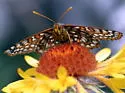
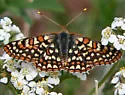
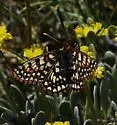
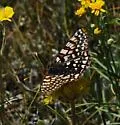
Photo credits: Contributed by David J. Ferguson