
Vidler's Alpine - Hodges#4591
Erebia vidleri
This record describes Erebia vidleri (species). Recorded family: Nymphalidae. Recorded order: Lepidoptera.
Identification and Appearance
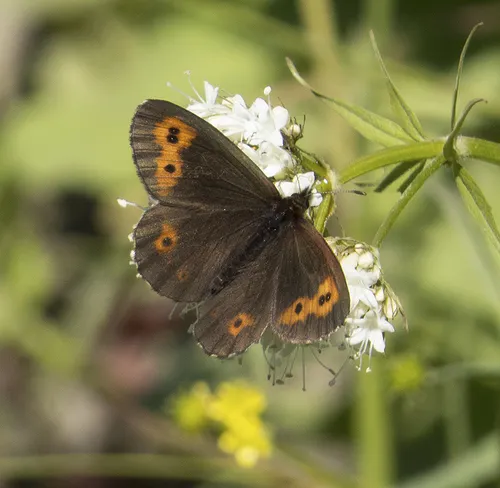
Adult: chocolate-brown base; DFW with broad, light orange band with ragged outlines, band tapering down toward trailing edge; two eye-spots near the tip, plus one farther down. VFW same as above but with yellow band. DHW with narrower orange band, and two or three eye spots; VHW with gray band, eye spots absent or inconspicuous. Wing margin checkered, giving a scalloped appearance. [Info. based in part on Pyle , and CBIF information - see Internet reference below]
Classification
- Kingdom
- Animalia
- Phylum
- Arthropoda
- Class
- Insecta
- Order
- Lepidoptera (Butterflies and Moths)
- Superfamily
- Papilionoidea
- Family
- Nymphalidae (Brush-footed Butterflies)
- Subfamily
- Satyrinae
- Tribe
- Satyrini
- Genus
- Erebia (Alpines)
Imported taxonomy record. Source availability varies; see the source references and editorial policy below.
Habitat and Range
Habitat
Subalpine and alpine meadows, seeps, upper montane forest openings (3,500-8,300 feet)
Geographic Range
A Pacific Northwest endemic: occurs only in mountainous regions of Washington (Olympic and north Cascade Mountains) and southwestern British Columbia as far north as Mount Hoadley.
Seasonal Activity
adults fly from late June to late August (early Aug. in its northern range)
Diet and Behavior
Diet: Though larval food unknown, sedges and grasses may be host plants. Guppy and Shepard refer to Pinegrass ( Calamagrostis rubescens ) as a possible larval food plant.
Life History
Larvae have been reared from eggs deposited by captive females; pupa unknown (descriptions and photos in the ground-breaking book by James & Nunnallee, 2011 ( 3 ) ).
Additional species information
Species notes from the sources
Etymology: Genus name derived from Greek Έρεβος (Erebos), darkness, or God of darkness; probably chosen in reference to the dark color. Species name refers to Captain Vidler, who collected the type specimen in the mountains above Seton Lake, near Lillooet, B.C. .
About Butterflies and Moths: the wider group
Order-level background for Lepidoptera, the group containing Erebia vidleri. Species-specific details appear above.
Group overview
Lepidoptera includes approximately 180,000 described species of butterflies and moths. Moths outnumber butterflies roughly 10:1. The monarch butterfly's eastern population has declined by more than 80% since the mid-1990s, and the western population by over 95% since the 1980s. The IUCN lists the migratory monarch as Vulnerable.
Ecological role of the group
Butterflies and moths are essential indicators of ecosystem health. As caterpillars, they are a primary food source for birds - a single nest of blue tit chicks requires ~10,000 caterpillars. Adult moths pollinate many night-blooming plants.
Economic and practical significance of the group
Lepidoptera are critical pollinators. In Europe, grassland butterfly species have declined by almost 50% since the early 1990s. In the UK, three-quarters of butterflies are in decline. In the U.S., five butterfly species have gone extinct since 1950, with 29 listed as endangered.
Recorded sources for this group: IUCN Red List, Xerces Society, USFWS, PNAS, WWF. Imported estimates may describe particular regions or reporting periods.
Photos of Vidler's Alpine - Hodges#4591 (2)
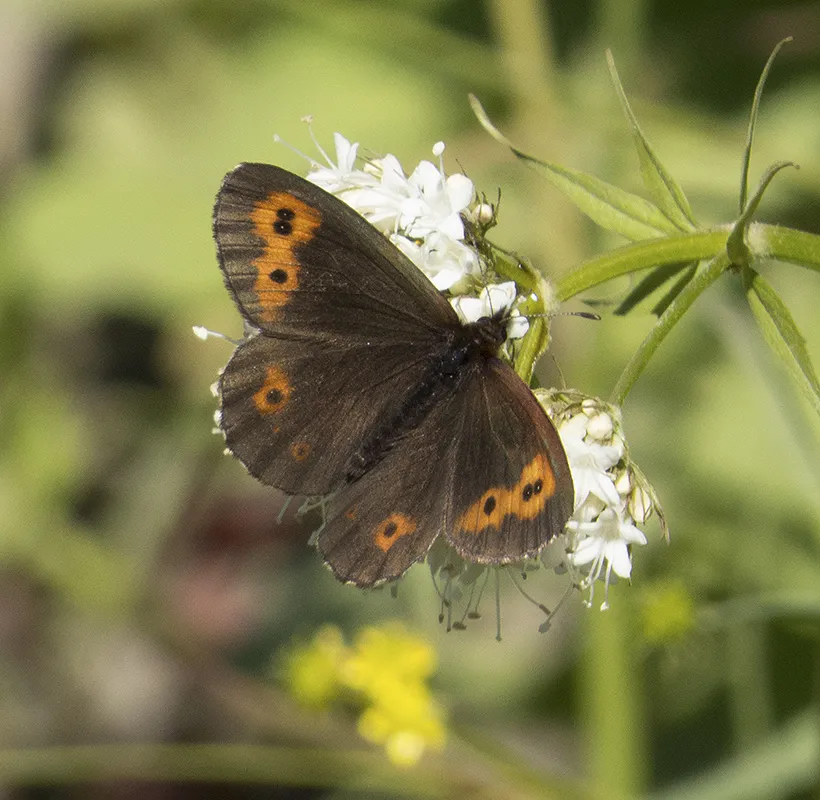
Photo credits: Contributed by Hartmut Wisch; Additional contributions by Robin McLeod , Kyhl Austin
Frequently Asked Questions About Vidler's Alpine - Hodges#4591
What is Vidler's Alpine - Hodges#4591?
Vidler's Alpine - Hodges#4591 (Erebia vidleri) is a species in the family Nymphalidae, within the order Lepidoptera.
How big is Vidler's Alpine - Hodges#4591?
wingspan reported as 41-48 mm at nearctica.com, and 35-45 mm at CBIF
How do you identify Vidler's Alpine - Hodges#4591?
Adult: chocolate-brown base; DFW with broad, light orange band with ragged outlines, band tapering down toward trailing edge; two eye-spots near the tip, plus one farther down. VFW same as above but with yellow band. DHW with narrower orange band, and two or three eye spots; VHW with gray band, eye spots absent or inconspicuous. Wing margin checkered, giving a scalloped appearance. [Info. based in part on Pyle , and CBIF information - see Internet reference below]
Where is Vidler's Alpine - Hodges#4591 found?
| Feature | Details |
|---|---|
| Habitat | Subalpine and alpine meadows, seeps, upper montane forest openings (3,500-8,300 feet) |
| Range | A Pacific Northwest endemic: occurs only in mountainous regions of Washington (Olympic and north Cascade Mountains) and southwestern British Columbia as far north as Mount Hoadley. |
What does Vidler's Alpine - Hodges#4591 eat?
The diet of the Vidler's Alpine - Hodges#4591 includes Though larval food unknown, sedges and grasses may be host plants. Guppy and Shepard refer to Pinegrass ( Calamagrostis rubescens ) as a possible larval food plant..
When is Vidler's Alpine - Hodges#4591 active?
Vidler's Alpine - Hodges#4591: seasonal activity - adults fly from late June to late August (early Aug. in its northern range).
What is the life cycle of a Vidler's Alpine - Hodges#4591?
Larvae have been reared from eggs deposited by captive females; pupa unknown (descriptions and photos in the ground-breaking book by James & Nunnallee, 2011 ( 3 ) ).